Your Cart is Empty


Recyclable materials win on infrastructure and accountability. Biodegradable materials break down naturally over time, but the term carries no guaranteed timeline, no federal standard, and no required certification, as explained in the benefits for Citrus County with biodegradable cleaners. If you’ve been standing at the recycling bin wondering whether that “eco-friendly” package belongs inside, you’re not alone. Here’s the short answer: recyclable materials re-enter production cycles through existing municipal systems, while biodegradable materials decompose through microbial activity at rates that vary wildly depending on conditions. The two categories are not interchangeable, and mixing them up creates real problems at waste facilities.
Quick reference:
Recyclable materials are those that can be collected, sorted, and reprocessed into new products using existing infrastructure. The key word is “existing.” Unlike biodegradable or compostable claims, recyclability is tied to real, operational systems you can access today through your curbside bin or a local drop-off center.
The most commonly recycled materials include:
What makes recyclable materials genuinely sustainable is their role in a circular economy. Instead of extracting raw materials for every new product, manufacturers use recovered material. Recycled plastic production uses up to 70% less energy compared to virgin plastic, which cuts greenhouse gas emissions and conserves natural resources at the same time.
How to dispose of recyclable materials correctly:
One common mistake is assuming that any plastic with a resin code is recyclable. Codes 3 through 7 are often not accepted by curbside programs, so checking your local guidelines before tossing them in the bin saves a facility from having to sort out contaminated loads.
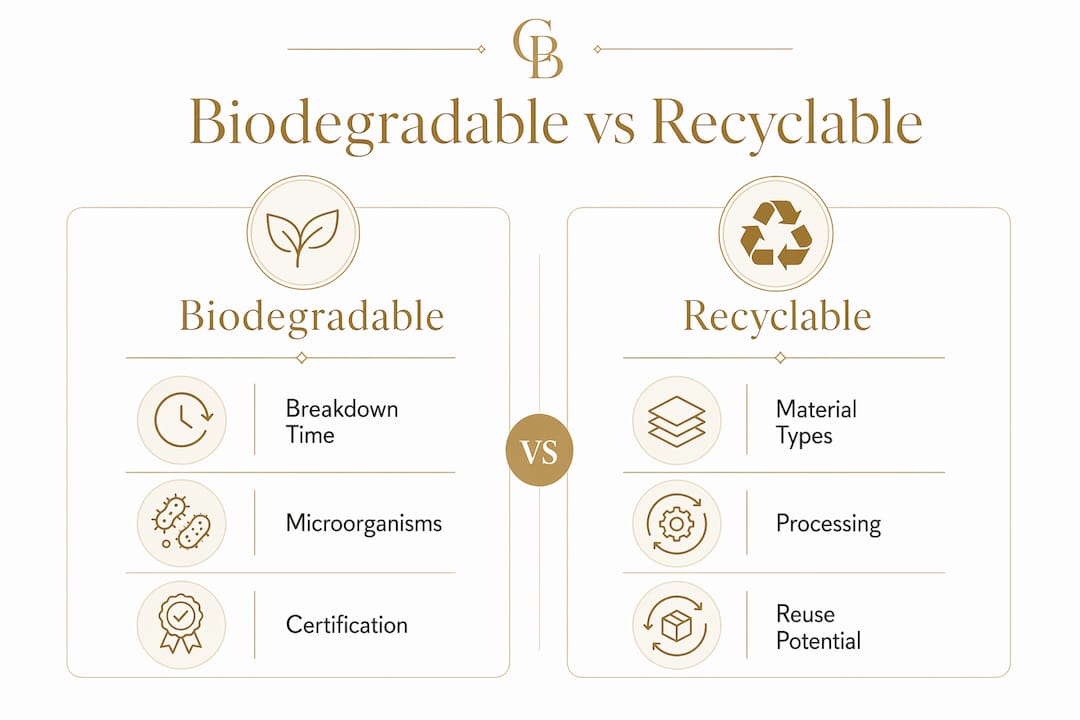
Biodegradable means a material can be broken down by bacteria, fungi, or other microorganisms into natural compounds like water, carbon dioxide, and organic matter. Sounds clean and simple. The problem is that the term is largely unregulated, which makes it one of the most misused words in sustainable marketing.
The Federal Trade Commission’s Green Guides state that unqualified biodegradable claims are deceptive when items enter landfills, incinerators, or recycling facilities, because those environments do not support complete decomposition within one year. A product labeled “biodegradable” could take decades to break down in a landfill where oxygen and microbial activity are limited. That’s not a minor caveat. It’s the core reason why the claim is so often a form of greenwashing.
Common genuinely biodegradable materials:
What to watch out for:
For a deeper look at what the term really means for your purchasing decisions, Cozee-bay’s guide on biodegradable sustainable living breaks down the nuances clearly.
Pro Tip: When you see “biodegradable” on a product, look for a specific certification or disposal instruction alongside it. A bare claim with no certification, no timeframe, and no disposal guidance is a red flag. Certified compostable or recyclable labels give you something concrete to act on.
Compostable is the strictest of the three categories, and it’s the one most consumers conflate with biodegradable. Every compostable material is biodegradable, but the reverse is not true. Compostable materials must meet specific standards for decomposition rate, toxicity, and end-product quality.
To carry a legitimate compostable label, a plastic product must meet ASTM D6400 or ASTM D6868 standards in the United States. These certifications require that the material breaks down within six months in an industrial composting facility, leaves no toxic residue, and produces compost that can support plant growth. The European equivalent is EN 13432. For a full breakdown of what these certifications require, Cozee-bay’s resource on compostable packaging standards covers each criterion in detail.
Industrial composting works very differently from your backyard bin. Facilities maintain temperatures above 140°F with controlled moisture and microbial activity, allowing certified compostable materials to break down into nutrient-rich compost within approximately 90 days. Your home compost pile rarely reaches those temperatures, which is why most compostable plastics are not suitable for home composting unless the label explicitly says so.
Common compostable materials:
Disposal steps for compostable items:
The infrastructure gap is real. Industrial composting facilities are far less widespread than recycling programs, so compostable packaging only delivers on its promise when the right facility is accessible. Without that, a certified compostable cup in a landfill behaves much like any other plastic.
Recyclable materials are the stronger default choice for most consumers. They connect to existing infrastructure, carry verifiable labels like How2Recycle, and support a circular economy where materials stay in use rather than returning to the earth. Compostable materials earn their place for food-contact and single-use items, but only where industrial composting is available. Biodegradable, as a standalone claim, is the weakest of the three because it lacks enforceable standards.
Best practices to put into action today:
Recycled plastic production uses up to 70% less energy than virgin plastic production, significantly reducing greenhouse gas emissions and conserving raw materials.
For professionals managing packaging decisions in restaurants, offices, or retail, the sustainable packaging benefits guide from Cozee-bay offers practical guidance on selecting the right material for each application.

The EPA recommends recyclable materials as the default for long-life products and reserves biodegradable or compostable options for short-term, single-use items prone to environmental loss. That framing is useful because it shifts the question from “which label sounds greener?” to “what actually happens to this material after I’m done with it?”

Contamination is the hidden cost that most consumers don’t see. When biodegradable or compostable materials enter recycling streams, they reduce the quality of recovered material and raise processing costs for facilities. Sorting errors at the consumer level ripple through the entire system. Clear labeling with certifications like How2Recycle and ASTM D6400 is the most practical tool for reducing those errors, because it removes guesswork at the point of disposal.
A hybrid approach works well for businesses and households that want to cover multiple waste streams. Use recyclable packaging for durable outer components, and choose certified compostable materials for food-contact inner components where composting infrastructure exists. This combination, supported by the EPA and sustainability professionals, delivers real environmental benefits without relying on vague claims.
At Cozee-bay, the commitment to eco-conscious materials is evident in products like the bamboo paper towel dispenser, where the material itself is naturally renewable, durable, and a genuine alternative to single-use plastic dispensers. Bamboo grows without pesticides, regenerates quickly, and doesn’t require the same recycling infrastructure that plastics do. It’s a practical example of choosing a material whose environmental story holds up from production through end of life.
Pro Tip: Before you buy any product marketed as eco-friendly, check for three things: a named certification (ASTM D6400, How2Recycle, BPI), a specific disposal instruction, and whether your local waste system can actually handle it. If any of those three are missing, the claim is incomplete.
For consumers navigating the overlap between biodegradable and compostable, Cozee-bay’s comparison of biodegradable versus compostable products is a practical next read.
Recyclable materials are the most reliable sustainability choice for most consumers because they connect to verified infrastructure, while compostable materials require industrial facilities and biodegradable claims require scrutiny.
| Point | Details |
|---|---|
| Recyclable is the strongest default | Aluminum, glass, PET, and HDPE connect to existing curbside programs with verifiable labels like How2Recycle. |
| Biodegradable claims are often unregulated | The FTC treats vague biodegradable claims as deceptive when items enter landfills, incinerators, or recycling facilities. |
| Compostable requires certification | ASTM D6400 and ASTM D6868 are the U.S. standards; industrial facilities must reach above 140°F for proper breakdown. |
| Mixing categories harms recycling | Biodegradable and compostable items in recycling bins contaminate batches and raise facility processing costs. |
| Energy savings favor recycling | Recycled plastic production uses up to 70% less energy than virgin plastic, significantly reducing greenhouse gas emissions and conserving raw materials. |
Comments will be approved before showing up.