Your Cart is Empty


TL;DR:
- Biodegradable materials can break down into natural substances when environmental conditions are ideal, but they do not guarantee quick or complete decomposition in practice. Proper disposal and certification standards, such as BPI, are crucial for ensuring environmental benefits, as many biodegradable items deteriorate slowly or fragment into microplastics in landfills or waterways. Making sustainable choices relies on understanding these distinctions, matching products to waste streams, and prioritizing durability and reuse over solely relying on labels.
You grab a product labeled “biodegradable” and feel good about it. That feeling makes sense. But here’s what most labels won’t tell you: biodegradable what does it mean in practice is far more complicated than the word suggests. A product being biodegradable does not mean it breaks down quickly, safely, or even completely. It depends on where it ends up, what conditions surround it, and how long you’re willing to wait. This article cuts through the confusion so you can make smarter choices for your home and family.
| Point | Details |
|---|---|
| Biodegradation requires microbes | Bacteria and fungi must be present along with moisture, oxygen, and warmth for breakdown to happen. |
| “Biodegradable” has no time limit | A product can carry this label and still take decades to break down under the wrong conditions. |
| Compostable is more specific | All compostable materials are biodegradable, but most biodegradable items are not compostable. |
| Disposal method matters most | Throwing a biodegradable product in a landfill can prevent it from ever fully breaking down. |
| Look for certification labels | Certifications like BPI give you far more reliable disposal guidance than “biodegradable” alone. |
So, what is biodegradable? At its core, the term describes any material that microorganisms can physically or chemically break down into water, carbon dioxide, and other naturally occurring substances. According to the US EPA definition, biodegradable substances include food scraps, cotton, wool, and paper. Standard plastics are generally not on that list.
The key players are bacteria and fungi. These microorganisms consume organic material and convert it into simpler compounds. Think of what happens to a banana peel left on a forest floor. Moisture softens it, bacteria colonize it, and within weeks it becomes part of the soil. That is biodegradation in action.
What does biodegradable mean in terms of speed or reliability? That is where things get nuanced. Biodegradability reflects capability, not a guaranteed timeframe or outcome. A material can technically biodegrade and still take 50 years to do so. The label tells you what is possible under ideal conditions. It says nothing about what will actually happen after you toss the product in the bin.
Here are the core environmental conditions that drive biodegradation:
Pro Tip: If you want to test a product’s real biodegradability at home, scientists use standardized tests measuring oxygen uptake or CO2 release. You can find information on OECD biodegradability testing to understand how lab results compare to real-world claims.
Understanding how biodegradable work starts with accepting that the process is biological, not magical. Conditions have to be right. And in most homes, landfills, and even oceans, those conditions are rarely ideal.

This is where most families get turned around. The terms sound similar, but they carry very different implications for how you should dispose of products and what the environmental outcome will actually be.
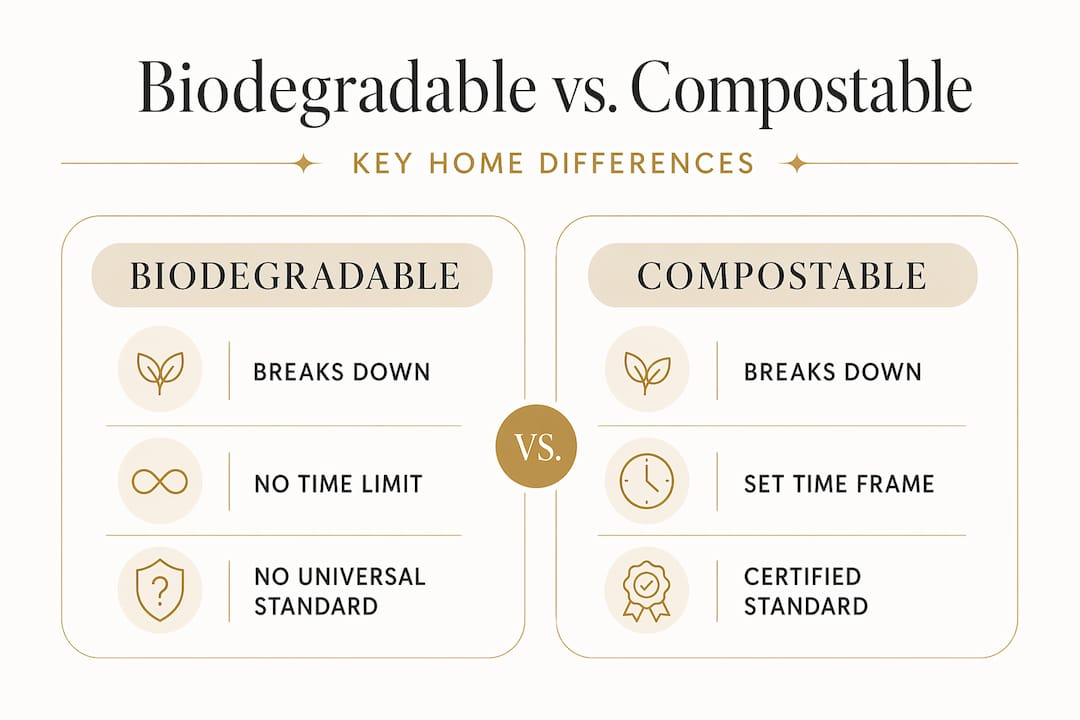
Here is a breakdown that puts it all in plain terms:
| Term | What it means | Time requirement | Standards or certification | Where it belongs |
|---|---|---|---|---|
| Biodegradable | Breaks down via microorganisms | No defined timeframe | No universal standard | Varies widely by product |
| Compostable | Breaks down fully into compost | Within specific timeframes | BPI, ASTM D6400 | Industrial or home compost bin |
| Degradable | Breaks apart physically or chemically | No defined timeframe | No standard | Often landfill or recycling stream |
All compostable materials are biodegradable, but not all biodegradable materials are compostable. Compostable products must meet specific standards for how quickly and completely they break down under composting conditions. That is a meaningful distinction.
“Degradable” is the term you should be most cautious about. Products labeled degradable often break apart into smaller fragments under UV light or mechanical stress. They do not necessarily disappear. Instead, they can fragment into microplastics, which persist in soil and water for centuries.
The vagueness of the biodegradable label is a real problem. Unlike compostable claims, there is no universal standard requiring a biodegradable product to break down within a set period or under defined conditions. That means a manufacturer can call almost anything biodegradable and technically not be lying.
Pro Tip: When shopping for genuinely sustainable products, look for BPI certification marks on compostable items. These certifications set clear standards for breakdown time and environmental safety, giving you something concrete to rely on.
If you want to go deeper on this distinction, Cozee-bay’s article on compostable vs biodegradable walks through how these terms play out in real retail products you might already be buying.
Even a genuinely biodegradable product can sit in a landfill for decades without breaking down in any meaningful way. Landfills are compacted and oxygen-deprived environments. Without airflow and active microbial communities, biodegradation essentially stalls. Newspaper from the 1970s has been found readable in excavated landfills. That is not a hypothetical. It is a well-documented reality.
Let’s walk through the most common real-world disposal scenarios your family might encounter:
The concern with partial degradation deserves attention. Oxo-degradable plastics fragment but persist in the environment, generating microplastic particles that enter food chains and water systems. Buying a product labeled biodegradable and dropping it in the wrong bin can cause more harm than simply using a durable, reusable item.
Biodegradability claims also vary significantly based on whether tests were conducted in aerobic or anaerobic conditions, in soil or marine water, and at what temperature. A product tested under optimal lab conditions may behave completely differently in your backyard or local waste stream.
Common household items and their biodegradation realities:
Now that the meaning of biodegradable is clearer, the real question is what to actually do with that knowledge. Here is a practical approach, ranked by what makes the biggest difference:
Reduce first, then choose biodegradable. Buying less is always more effective than buying a “greener” version of something you did not need. Reusable items like bamboo kitchenware eliminate disposal decisions entirely.
Look beyond the word biodegradable on labels. The biodegradable label alone offers no guarantee about breakdown timeline or environmental safety. A product with a BPI compostability certification gives you something measurable.
Match the product to your disposal stream. Before you buy something marketed as compostable, check whether your city has industrial composting pickup. If not, that certification is largely useless for your household.
Watch for greenwashing. Phrases like “eco-friendly,” “earth-conscious,” or “plant-based” do not mean biodegradable or compostable. They are marketing language with no regulatory teeth behind them.
Sort waste correctly every time. Misplacing a biodegradable item in the recycling bin or landfill prevents effective breakdown. The right bin for the right material is one of the simplest ways to make your choices count.
Pro Tip: When reading product packaging, train yourself to ask three questions: Does this have a recognized certification? Where is my nearest composting facility? And what happens to this product if I put it in the regular trash? The answers will tell you whether the eco-friendly claim has any real teeth.
For a fuller picture of how to choose biodegradable homeware materials that align with your daily routines, Cozee-bay’s blog has a thoughtful breakdown worth bookmarking.
I have seen a lot of products come through with “biodegradable” stamped across the front like a badge of honor. And I understand why families feel reassured by it. The desire to do the right thing is real, and manufacturers know it. But in my experience, that label has been used so loosely that it has lost much of its practical meaning.
What I have learned is this: the word biodegradable tells you about a material’s potential, not its behavior in the real world. A paper bag tossed in a landfill without oxygen will outlast some plastics in the same conditions. Meanwhile, a bamboo product used daily for five years and then composted at end of life will have a far smaller footprint than a “biodegradable” single-use version used once.
The uncomfortable truth is that buying biodegradable products without understanding your local waste infrastructure can make you feel good without actually doing good. The system matters as much as the product. And until municipal composting is universal, the most reliable eco-friendly choice is still durability, reusability, and reduction.
That said, I am genuinely encouraged by how much awareness has grown. Families asking these questions, reading labels critically, and pushing for better infrastructure are exactly how systemic change begins. You do not need to be perfect. You just need to be informed.
— Cozee
If understanding the meaning of biodegradable has you rethinking the products in your home, you are already ahead of most people. At Cozee-bay, sustainability is not a buzzword. It is built into every product, from handcrafted bamboo paper towel dispensers to wrap and foil organizers designed to replace disposable clutter with something durable and beautiful.

Bamboo is one of the fastest-growing natural materials on Earth, and every Cozee-bay product is crafted with longevity in mind so you buy less, waste less, and live cleaner. Whether you are outfitting your kitchen or organizing a commercial space, you can explore our full collection and find products that hold up to real daily use without the disposable guilt. For more guidance on building a greener home, check out our in-depth guide on why choose biodegradable products and start making choices that actually match your values.
Biodegradable means a material can be broken down by bacteria or fungi into natural substances like water and carbon dioxide. The process requires the right environmental conditions, including moisture, oxygen, and warmth, to occur.
No. All compostable items are biodegradable, but not all biodegradable items are compostable. Compostable materials must meet specific standards for how quickly they break down under composting conditions, while biodegradable items have no such requirement.
Most biodegradable products break down very slowly in landfills because landfills are low in oxygen and microbial activity. Disposal method has a bigger impact on actual biodegradation than the label on the product.
Yes. Some biodegradable plastics fragment into microplastics if they do not fully break down, particularly in aquatic environments. Plastics designed for soil biodegradation may not degrade properly in marine or ocean conditions.
Look for recognized certifications like BPI for compostable products rather than relying on the word biodegradable alone. Check whether your local waste system can handle the product correctly, since even certified materials require the right disposal infrastructure to deliver their environmental benefit.
Comments will be approved before showing up.