Your Cart is Empty


TL;DR:
- Certified compostable products meet strict standards and disintegrate safely in industrial facilities, unlike biodegradable claims with no proof. Environmental conditions determine actual degradation, with industrial composting providing the best environment for breaking down certified materials. Verifying certification details and understanding disposal options are essential for making truly sustainable choices.
Biodegradable versus compostable defines two sustainability terms that sound interchangeable but differ fundamentally in science, regulation, and real-world impact. Biodegradable means a material can break down through biological processes, but no regulation sets a timeline or safety standard for that breakdown. Compostable is the stricter category: certified under standards like ASTM D6400 (USA), EN 13432 (EU), or CPCB IS 17088 (India), compostable products must fully disintegrate within a defined period and leave no toxic residue. All compostable products are biodegradable, but the reverse is not true. Knowing this distinction protects you from greenwashing and helps you make choices that actually reduce environmental harm.
Certification is the clearest line between compostable and biodegradable claims. Compostable standards like ASTM D6400 require a product to pass three independent tests before it earns a label: disintegration, biodegradation rate, and ecotoxicity. Biodegradable claims carry none of those requirements.
Here is what each major certification demands:
Biodegradable labeling, by contrast, has no equivalent framework in the United States. A product labeled “biodegradable” could take five years or five hundred years to break down. Biodegradable claims are frequently used for greenwashing because companies face no legal obligation to prove a timeline or safe outcome. The EU recognized this problem and now restricts unsubstantiated biodegradable marketing claims, but no comparable federal rule exists in the U.S. as of 2026.
Certified compostable products must pass disintegration, biodegradation, and ecotoxicity tests to confirm they break down safely and produce nutrient-rich compost. That multi-step verification is what makes compostability a meaningful claim rather than a marketing phrase.
Pro Tip: Look for the BPI (Biodegradable Products Institute) logo on packaging in the U.S. BPI certification confirms a product meets ASTM D6400, so you do not have to decode the fine print yourself.
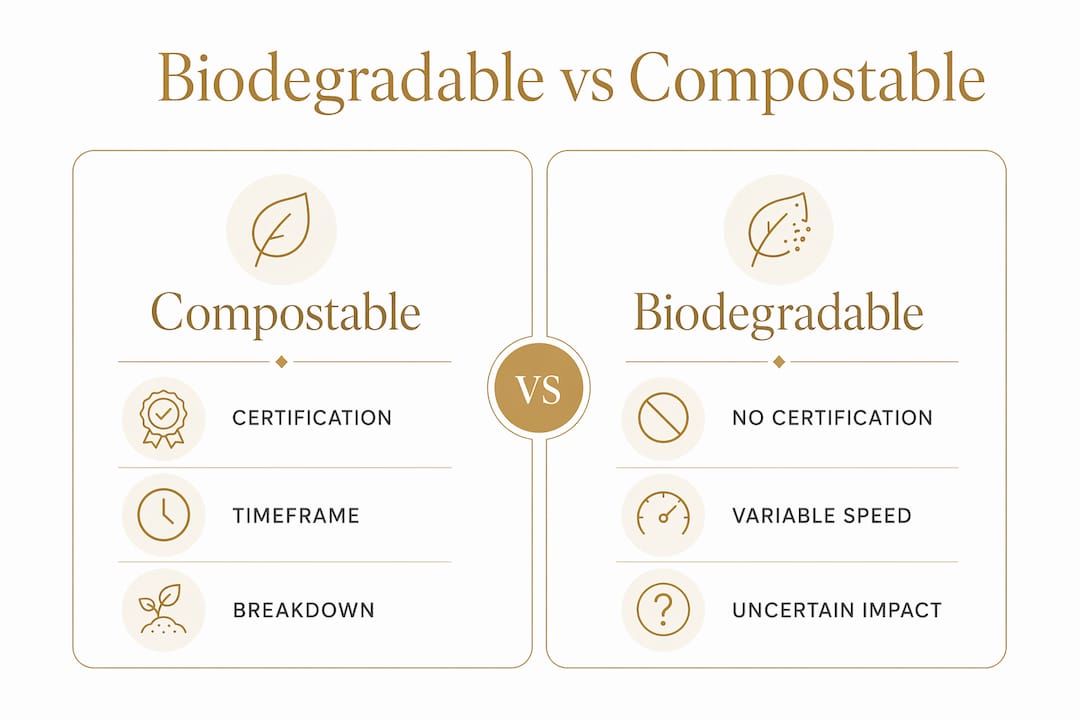
When you are evaluating eco-labels and certifications for any product, ask the supplier to name the specific standard and the certifying body. A vague “certified biodegradable” claim with no named standard is a red flag.
The environment where a product ends up determines whether it actually degrades at all. This is the part most labels leave out, and it is where a lot of well-intentioned purchasing goes wrong.
Industrial composting facilities maintain temperatures of 58°C (±2°C) with controlled oxygen and moisture levels and active microbial populations. These conditions allow certified compostable materials to fully disintegrate within roughly 12 weeks. Without that controlled heat and biology, the same material may not break down at all.
Home compost bins rarely reach sustained temperatures above 50°C. Most backyard setups lack the microbial diversity and heat needed to process certified compostable plastics. Commercial composting operates at 130–160°F; home compost simply does not replicate that. A certified compostable bag tossed into a backyard bin may sit largely intact for years.
Landfills are the worst-case scenario for both material types. Landfills are anaerobic environments, meaning oxygen is absent. Without oxygen, organic breakdown produces methane rather than carbon dioxide. Non-certified biodegradable plastics in landfills can persist for decades and emit methane, a greenhouse gas far more potent than CO₂ over a 20-year period.
Soil and water environments produce highly variable results. A biodegradable product buried in moist, warm, microbe-rich soil may break down in months. The same product in cold, dry, or compacted soil could persist for years with no meaningful degradation.
The practical takeaway is direct: a compostable certification only delivers its environmental benefit when the product reaches an industrial composting facility. If your city does not offer compostable waste collection, a certified compostable bag and a conventional plastic bag may end up with nearly identical environmental outcomes in a landfill.
Pro Tip: Check your local waste management website before buying compostable packaging in bulk. Many U.S. cities still do not accept compostable plastics in curbside organics bins, which means the product needs to go to a private composting drop-off to fulfill its promise.
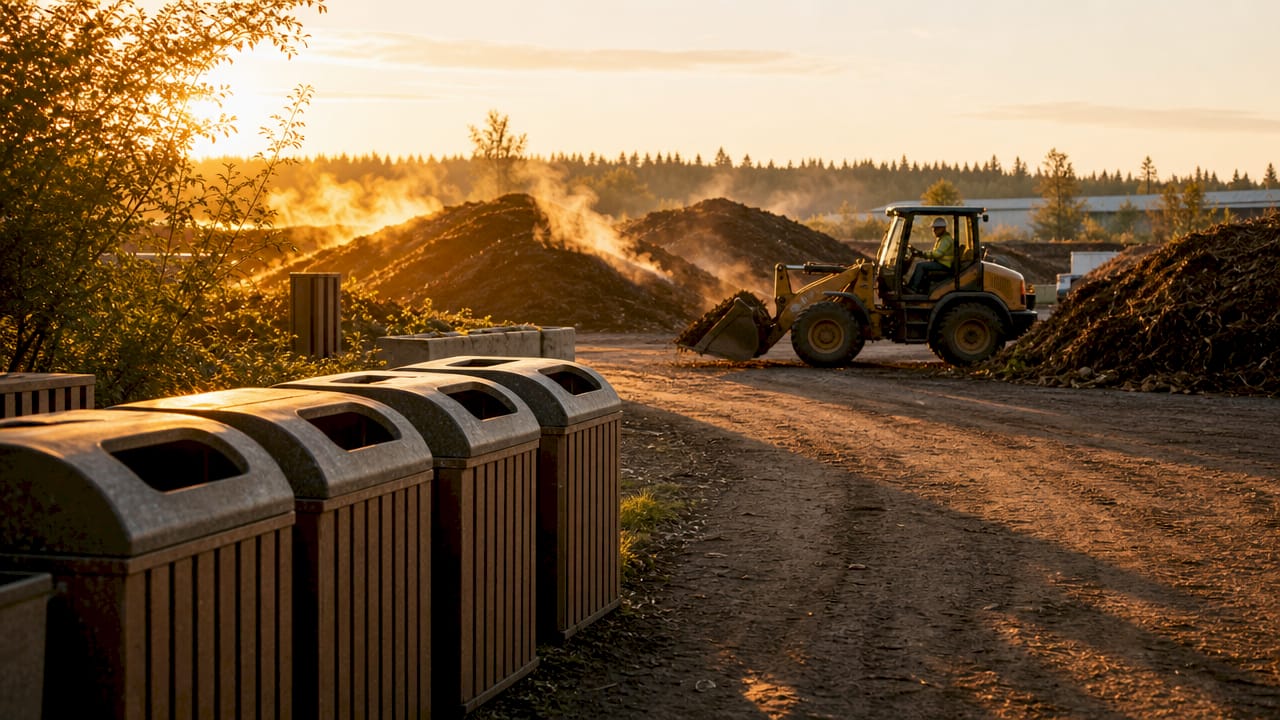
The gap between what these labels promise and what they deliver in practice is wide. Understanding where the confusion comes from helps you read packaging more critically.
“Biodegradable” is one of the most misused terms in sustainable marketing. Without a named certification standard, a defined timeframe, and verified ecotoxicity data, the word tells you almost nothing about a product’s actual environmental fate.
Verifying supplier claims is straightforward. Ask for the certification number, the certifying body, and the specific standard. Cross-check on the certifying body’s public database. If a supplier cannot provide that information, treat the claim as unverified. You can also read more about what biodegradable really means before making purchasing decisions.
The right choice depends on your disposal infrastructure, your supply chain, and the specific product category. Here is a practical framework.
| Factor | Compostable | Biodegradable (uncertified) |
|---|---|---|
| Certification required | Yes (ASTM D6400, EN 13432, CPCB IS 17088) | No standard required |
| Breakdown timeline | 12 weeks in industrial composting | 5 to 500+ years, no guarantee |
| Safe residue | Confirmed by ecotoxicity testing | Not guaranteed; may release microplastics |
| Best disposal method | Industrial composting facility | Depends on material; landfill is worst case |
| Best use case | Food service, packaging with composting access | Limited; verify claims before purchasing |
| Cost | Generally higher due to certification costs | Often lower, but environmental cost may be higher |
When composting infrastructure exists: Prioritize certified compostable products, particularly for food-contact items like bags, trays, and serviceware. Compostable packaging for food waste makes the most sense because the food scraps and packaging can go into the same composting stream.
When composting infrastructure is absent: Assess biodegradable claims critically. Prefer materials with a named certification or a published third-party test result. For bags specifically, the difference between biodegradable versus compostable plastic bags matters most at the disposal stage. Without composting access, a certified compostable bag offers little advantage over a conventional one in a landfill.
Questions to ask any supplier:
Pro Tip: For businesses buying packaging at scale, request a Certificate of Compostability from your supplier before placing a large order. This document names the standard, the certifying body, and the test results. It also protects you from regulatory scrutiny if your region enforces green claims laws.
Understanding compostable packaging standards and impact gives you a stronger foundation when evaluating supplier claims and building a sustainable procurement policy.
Compostable products are the more reliable sustainability choice because they meet verified standards, break down safely within a defined timeframe, and leave no toxic residue, while biodegradable claims without certification offer no such guarantees.
| Point | Details |
|---|---|
| Certification is the key difference | Compostable products meet ASTM D6400, EN 13432, or CPCB IS 17088; biodegradable claims require no standard. |
| Disposal environment determines outcome | Certified compostable products only break down as promised in industrial composting facilities, not landfills or home bins. |
| Biodegradable can mean almost anything | Without a named standard and timeline, a biodegradable label is a marketing claim, not an environmental guarantee. |
| Microplastic risk is real | Non-certified biodegradable materials may release microplastics or toxic fragments as they degrade. |
| Ask suppliers for documentation | Request the certificate number and certifying body before purchasing any product marketed as compostable or biodegradable. |
The regulatory environment around these terms has shifted noticeably in recent years, and not fast enough. The EU’s move to restrict unsubstantiated biodegradable claims is the right direction, but the U.S. still has no equivalent federal rule. That gap leaves consumers and businesses exposed to claims that sound credible but carry no legal weight.
The most common mistake I see businesses make is buying “biodegradable” bags or packaging because the price is lower, without checking whether any certification backs the claim. They assume the label means something. It often does not. The product ends up in a landfill, behaves like conventional plastic, and the business has paid a premium for a sustainability story that never happened.
My honest advice: treat “biodegradable” as a starting point for a question, not an answer. The question is always, “Certified by whom, to what standard, under what conditions?” If you cannot get a clear answer, the product is not worth the premium. Compostability, when backed by ASTM D6400 or EN 13432 and paired with actual composting infrastructure, is the only claim that holds up to scrutiny. Push your suppliers for documentation. Push your local government for composting collection. Both matter equally.
— Cozee
Choosing products made from materials with a clear environmental story is the most direct way to put these principles into practice.

Cozee-bay specializes in eco-friendly bamboo products for home and commercial use, from paper towel dispensers to food bag organizers and drawer organizers. Bamboo is one of the fastest-growing natural materials on earth, and Cozee-bay’s products are crafted with responsible sourcing and sustainability at the core. Whether you run a restaurant, a school, or a senior living center, or you are simply upgrading your home kitchen, Cozee-bay offers durable, stylish options that align with a lower-impact lifestyle. Free shipping within the contiguous U.S. and a money-back guarantee make it easy to shop with confidence.
No. All compostable products are biodegradable, but not all biodegradable products are compostable. Compostable products must meet certified standards like ASTM D6400 and break down safely within a defined timeframe, while biodegradable products have no such requirement.
Compostable bags meet a certified standard and break down in industrial composting facilities within roughly 12 weeks, leaving no toxic residue. Biodegradable bags carry no guaranteed timeline and may persist in landfills for decades, potentially releasing microplastics.
Certified compostable is the stronger environmental choice when industrial composting is available. Without composting infrastructure, neither option offers a clear advantage over the other in a landfill setting, making disposal access the deciding factor.
Most products certified for industrial composting will not fully break down in a home compost bin. Industrial facilities maintain temperatures of 58°C or higher, which home bins rarely reach. Look specifically for a home compostable certification if you plan to use backyard composting.
Ask the supplier for the specific certification standard, the certifying body’s name, and the certificate number. Cross-check the certificate on the certifying body’s public database. A claim without a named standard and verifiable certificate should be treated as unconfirmed.
Comments will be approved before showing up.