Your Cart is Empty


TL;DR:
- Bamboo trays offer natural aesthetics and quick renewable sourcing but require proper care for longevity.
- They are not dishwasher safe; handwashing and regular oiling extend their lifespan.
- Proper maintenance and quality manufacturing are essential for bamboo trays to truly be sustainable over time.
Bamboo trays have become a go-to choice for eco-conscious homeowners and property managers who want their spaces to look good while doing right by the planet. But here’s something most people don’t expect: bamboo fiber composites can lose most of their integrity after just a few months of daily dishwasher use, while glass holds up far better in that same environment. That one fact turns a lot of assumptions upside down. This guide cuts through the noise and gives you a clear, honest look at what makes bamboo trays truly sustainable, how to pick the right one, and how to care for it so it earns its place in your home or business.
| Point | Details |
|---|---|
| Bamboo’s appeal | Bamboo trays combine warm style with eco-friendly materials, making them a smart choice for homes and businesses. |
| True sustainability | Durability and proper care matter more than material alone for real environmental impact. |
| Care tips | Handwash and reseal your tray to extend its lifespan and maintain its beauty. |
| Better than plastic? | Bamboo only beats plastic if maintained properly and used for at least two years. |
Walk into any well-styled kitchen, coffee shop, or boutique hotel lobby today, and there’s a solid chance you’ll spot a bamboo tray on display. There’s a reason for that. Bamboo carries a warmth and natural texture that plastic simply cannot replicate, and it fits just as comfortably in a minimalist modern home as it does in a cozy farmhouse-style café. The visual appeal is immediate and versatile.
Beyond looks, bamboo’s environmental reputation is well-earned on several fronts. The plant grows extraordinarily fast, which means it can be harvested and replenished at a rate that most other wood sources can’t match. Understanding the key eco-friendly benefits of bamboo helps you see why so many designers and sustainability advocates have embraced it. And when you factor in bamboo growth advantages, it’s clear why this material keeps showing up in eco-conscious product lines.
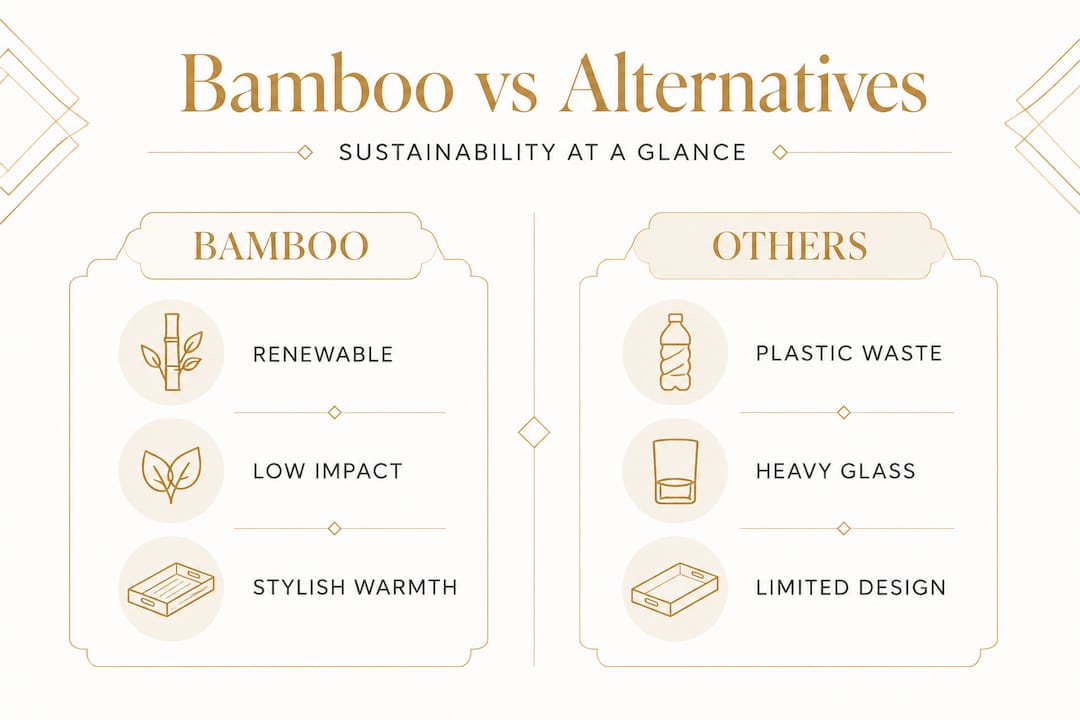
That said, bamboo trays are not a magic solution. As noted in research comparing food tray options, bamboo’s appeal and upkeep can differ significantly from plastic in both cost and care requirements. In other words, you’re making a considered investment, not just swapping one tray for another.
Here are some reasons bamboo trays genuinely stand out:
“Choosing bamboo isn’t just about looking eco-friendly. It’s about committing to a material that rewards care with longevity.”
Pro Tip: If you’re outfitting a commercial space like a café or senior living center, look for bamboo trays with a satin or food-grade lacquer finish. These hold up better under regular use and require less frequent resealing than raw or lightly oiled options.
Understanding what sets bamboo trays apart, it’s crucial to weigh their durability and upkeep against other materials. This is where the conversation gets more nuanced and a lot more useful for making smart purchasing decisions.

One of the most important things to know is that bamboo trays are not dishwasher safe as a general rule. Research shows that 37% quality retention is all bamboo fiber composites manage after 12 weeks of daily dishwasher cycles, compared to 94% for glass. That’s a dramatic difference, and it matters enormously if you’re placing an order for a restaurant or school setting where trays get washed dozens of times a week.
Here’s a side-by-side look at how bamboo trays stack up against common alternatives:
| Feature | Bamboo | Glass | Plastic |
|---|---|---|---|
| Aesthetic warmth | High | Medium | Low |
| Dishwasher safe | No | Yes | Usually yes |
| Eco-friendly sourcing | Yes | Partially | No |
| Weight | Light | Heavy | Very light |
| Durability (with care) | High | High | Medium |
| Durability (without care) | Low | High | Medium |
| Maintenance required | Regular | Minimal | Minimal |
| Biodegradability | Yes | No | No |
| Cost | Medium-high | Medium-high | Low |
The table makes one thing clear: bamboo trays are competitive, but only when you hold up your end of the bargain with proper care. It also shows why glass is sometimes the smarter pick for high-volume dishwasher environments, while bamboo shines in settings where handwashing is standard practice.
Proper bamboo product longevity really does come down to how the tray was made and how it’s used day to day. Kiln-drying is a critical step in manufacturing. Bamboo that isn’t dried to the right moisture content, typically between 8 and 12%, is far more prone to warping and cracking over time. If a tray warps after a few months, it ends up in the landfill, which eliminates any sustainability benefit it had going in.
And that’s the sustainability tipping point most people overlook. Bamboo’s sustainability edge is genuinely lost if a tray has a lifespan under two years due to frequent replacement. A plastic tray that lasts five years and gets recycled properly may actually have a lower environmental footprint than a bamboo tray that warps and gets tossed after eighteen months.
Here’s how to assess durability before you buy:
Now that we know how durability and maintenance affect bamboo’s appeal, let’s discuss how to pick the best tray for your needs. The “right” bamboo tray varies significantly depending on whether you’re styling a home bathroom, organizing a coffee bar, or setting up service trays in a busy restaurant.
For homeowners, the priority is usually a blend of style and practicality. You want something that looks polished on your kitchen counter or bathroom vanity without demanding too much of your time. A well-sealed bamboo tray with a natural oil finish hits that sweet spot. It looks beautiful, works well for organizing toiletries or kitchen essentials, and requires only occasional resealing to stay in great shape.
For commercial property managers, the calculus shifts. High foot traffic, frequent cleaning, and the need for food-safe surfaces mean you need to prioritize durability and certification over aesthetics alone. That said, a well-chosen commercial bamboo tray can absolutely deliver both. Many restaurants and senior living centers use bamboo trays not just for function but to create a warm, welcoming atmosphere that synthetic materials can’t achieve. Understanding stylish eco-friendly organization principles helps you balance those goals confidently.
Research confirms that finish and maintenance outweigh the core material when it comes to tray longevity. A well-finished lower-grade bamboo tray will outlast a poorly sealed premium one every single time. So don’t just shop by price or brand. Look closely at how the product is finished and sealed.
Key features to look for when selecting a bamboo tray:
Pro Tip: If you manage a commercial space like a church, school, or senior center, buy two or three extra trays at the time of your initial order. Bamboo shades can vary slightly between production batches, so matching replacements later may be difficult.
Once you’ve chosen your ideal bamboo tray, maintaining it correctly ensures it remains both beautiful and sustainable for years. The good news is that bamboo care is not complicated. It just needs to be consistent.
Proper hand maintenance is critical for bamboo trays to outperform plastics across their lifespan. The moment you start cutting corners on cleaning and drying, you’re shortening the tray’s life and, ironically, increasing your environmental footprint. Also, one of the most important rules: avoid submerging bamboo trays in water without proper sealant, and never let moisture sit on the surface for long.
Follow these steps to keep your bamboo tray in top condition:
Here’s a simple maintenance schedule to help you stay on track:
| Task | Frequency | Notes |
|---|---|---|
| Wipe down surface | After every use | Dry cloth or barely damp sponge |
| Handwash with mild soap | Weekly or as needed | No soaking, no dishwasher |
| Dry immediately | Every wash | Critical step to prevent warping |
| Apply conditioning oil | Every 2 to 3 months | Food-grade mineral oil preferred |
| Full resealing | Once a year | For heavily used commercial trays |
| Inspect for cracks or warping | Monthly | Replace or repair early to extend life |
For more detailed guidance, the step-by-step bamboo cleaning process walks you through each stage clearly. And if you prefer to keep things chemical-free, the guide on natural bamboo maintenance covers plant-based and food-safe conditioning options.
Pro Tip: Set a recurring calendar reminder every 10 weeks to oil your bamboo trays. It sounds small, but skipping this step twice in a row is often what starts the cracking and splitting process.
Having covered both practical and technical care, let’s challenge some widely held beliefs about bamboo tray sustainability.
Most sustainability conversations around bamboo focus almost entirely on sourcing: the fast growth, the low pesticide requirements, the carbon absorption. All of that is real and worth celebrating. But it’s only half the story, and it’s the easier half to tell. The harder truth is that hand maintenance is critical to outperforming plastics in the long run, and bamboo’s edge fades fast if the tray is poorly cared for and replaced too often.
We’ve seen this pattern play out in commercial settings. A property manager reads about bamboo’s eco credentials, orders a set of beautiful trays for their café, skips the maintenance routine because things get busy, and six months later the trays are warped and heading for the dumpster. Meanwhile, the plastic trays in the kitchen are still going strong. That outcome is not bamboo’s fault. It’s a mismatch between expectation and practice.
The sustainable impact of bamboo is real, but it’s conditional. It depends on the tray being made well, used appropriately, and maintained consistently. When those three things line up, bamboo genuinely outperforms most alternatives across its bamboo lifecycle from growth to end use. When they don’t, you’re just paying more for something that ends up in a landfill faster than a cheap plastic tray would have.
Our honest recommendation is this: before you buy bamboo trays, especially in volume for a commercial space, ask yourself whether you have the systems in place to care for them properly. If the answer is yes, bamboo is an outstanding choice. If not, it’s worth building those systems first, or starting with a smaller quantity to test your team’s habits before scaling up.
Bamboo trays are not just a trend or a feel-good purchase. They are a commitment to a different way of interacting with the objects in your space, one that rewards attention and consistency with genuine environmental value.
For those ready to put knowledge into practice, here’s where to start your search.
At Cozee Bay, we’ve built our entire product line around the principle that eco-friendly and stylish should never be a compromise. Our handcrafted bamboo trays are designed for both residential and commercial use, from bathroom vanities and kitchen counters to restaurant service areas and retail displays.

Each tray in our collection comes with detailed care guidance so you can get the most out of your investment. Whether you’re looking for eco-friendly bamboo trays to organize your home or outfit a high-traffic commercial space, our curated selection makes it easy to find the right fit. We offer free shipping within the contiguous U.S. and stand behind every product with a satisfaction guarantee. Browse our catalog and find the tray that works as hard as you do.
Most bamboo trays are not dishwasher safe, and daily dishwasher use causes bamboo fiber composites to degrade significantly within 12 weeks. Always handwash and dry immediately to preserve the tray’s finish and structure.
Handwashing with mild soap, drying the tray right away, and applying conditioning oil every 2 to 3 months are the three most impactful habits. Proper hand maintenance is what gives bamboo trays a real sustainability edge over plastic alternatives over time.
Bamboo trays are more eco-friendly when they last at least two years with consistent care, because frequent replacement erases bamboo’s sustainability advantage over plastic. Your maintenance habits matter just as much as the material itself.
Look for kiln-dried construction, a smooth food-safe finish, and clear information about the sealant used. Trays that are not kiln-dried properly to the right moisture content are far more prone to warping, splitting, and early failure.
Comments will be approved before showing up.