Your Cart is Empty


More than 80 percent of American restaurant owners now consider sustainability a top priority for daily operations. Finding materials that match style with genuine eco benefits is crucial for businesses looking to stand out and reduce their footprint. Bamboo’s rapid growth, strong durability, and proven environmental advantages offer restaurants an opportunity to create modern spaces with minimal impact. Discover how adopting bamboo products can help American restaurants lead in both design and sustainability.
| Point | Details |
|---|---|
| Bamboo as a Sustainable Material | Bamboo grows rapidly, maturing in 3-5 years, making it a superior eco-friendly alternative for environmentally conscious businesses. |
| Environmental Benefits of Bamboo | Bamboo’s extensive root system prevents soil erosion and sequesters significant amounts of carbon dioxide, aiding in climate change mitigation. |
| Harvesting Practices Matter | Sustainable harvesting techniques ensure bamboo ecosystems remain intact while providing a continuous supply for commercial use. |
| Bamboo vs. Alternatives | Bamboo offers significant environmental advantages over plastic and wood, including faster regeneration and full biodegradability. |
Bamboo represents a revolutionary eco-friendly material with extraordinary environmental credentials that make it particularly appealing for restaurants seeking sustainable solutions. Recognized as a keystone species supporting ecological restoration, bamboo offers remarkable benefits beyond traditional materials.
At its core, bamboo is a fast-growing grass with unprecedented regenerative capabilities. Unlike traditional timber, which can take decades to mature, bamboo reaches full growth potential in just 3-5 years. Comprehensive research demonstrates bamboo’s efficient carbon absorption and minimal resource demands, positioning it as a superior sustainable material for environmentally conscious businesses.
The ecological advantages of bamboo extend far beyond rapid growth. Its extensive root system prevents soil erosion, supports biodiversity, and actively contributes to ecosystem health. Bamboo absorbs significantly more carbon dioxide compared to equivalent tree stands, making it a powerful tool in mitigating climate change. For restaurants committed to reducing their environmental footprint, bamboo presents an authentic, scientifically validated sustainable material choice.
Pro tip: When evaluating eco-friendly materials, consider bamboo’s comprehensive sustainability profile, which goes well beyond surface-level environmental claims.
Bamboo stands out as an extraordinary plant with unparalleled growth dynamics that position it as a superior sustainable material for environmentally conscious restaurants. As a highly productive woody grass adaptable across diverse environments, bamboo offers remarkable regenerative capabilities that distinguish it from traditional timber sources.
The growth rate of bamboo is nothing short of remarkable. While most hardwood trees require 20-50 years to reach maturity, bamboo can complete its growth cycle in just 3-5 years. This rapid growth means restaurants can source a renewable material that replenishes itself quickly, reducing pressure on forest ecosystems. The plant’s unique rhizome system allows it to regrow from its root network after harvesting, ensuring continuous production without requiring replanting.

Sustainability extends beyond rapid growth for bamboo. Its extensive root system provides significant environmental benefits, including soil stabilization, erosion prevention, and carbon sequestration. Bamboo can absorb up to 12 tons of carbon dioxide per hectare annually, making it a powerful tool in mitigating climate change. For restaurants committed to reducing their environmental impact, bamboo represents a scientifically validated, eco-friendly material choice that supports both operational needs and ecological preservation.
Pro tip: When selecting sustainable materials, evaluate bamboo not just for its immediate benefits but for its comprehensive ecological contribution and regenerative potential.
Bamboo harvesting represents a critical intersection of ecological sustainability and resource management, with profound implications for restaurants seeking environmentally responsible material sources. Sustainable harvesting techniques play a pivotal role in maintaining bamboo ecosystem health and long-term productivity.
Traditional harvesting methods often damage bamboo groves, but modern approaches like the Tunnel Method have revolutionized sustainable extraction. By carefully selecting mature culms while preserving younger shoots, restaurants can ensure a continuous and renewable bamboo supply. This method involves strategic spacing and selective cutting that allows the bamboo ecosystem to regenerate naturally, minimizing environmental disruption and maintaining the plant’s robust reproductive capabilities.
The environmental impact of bamboo harvesting extends far beyond immediate resource extraction. Unlike timber logging, which often requires complete forest clearance, bamboo harvesting supports ecosystem diversity. The plant’s extensive root network remains intact during harvesting, preventing soil erosion and maintaining ground stability. Moreover, bamboo’s rapid regrowth means that a single harvested area can be productive again within 3-5 years, creating a truly regenerative resource cycle that supports both economic needs and ecological preservation.
Pro tip: When sourcing bamboo products, prioritize suppliers who demonstrate transparent, scientifically validated sustainable harvesting practices.
Bamboo’s potential as a commercial material extends far beyond its environmental credentials, offering restaurants and businesses a robust alternative to traditional materials. Technological advancements have dramatically improved bamboo’s durability and industrial applications, transforming it from a simple grass to a sophisticated engineering material.
Preservation techniques have been specifically developed to address bamboo’s natural structural vulnerabilities. While bamboo initially has thin walls and lacks natural decay resistance, modern chemical treatments and specialized drying methods now enable it to withstand diverse commercial environments. These innovations allow bamboo products to maintain structural integrity in high-traffic restaurant settings, resisting moisture, temperature variations, and mechanical stress.
The versatility of bamboo in commercial applications is remarkable. Beyond traditional uses, bamboo now appears in sophisticated product lines including textiles, composite materials, packaging, and precision-engineered restaurant accessories. Its combination of lightweight properties, inherent strength, and eco-friendly production makes it an increasingly attractive option for businesses seeking sustainable yet high-performance materials. Restaurants can now confidently integrate bamboo products knowing they deliver both environmental responsibility and professional-grade durability.
Key uses and benefits of bamboo in restaurants summarized for easy reference:
| Application Area | Bamboo Product Example | Main Benefit |
|---|---|---|
| Tableware | Utensils, plates | Compostable, sustainable |
| Food Packaging | Containers, wraps | Reduces single-use plastics |
| Interior Elements | Flooring, wall panels | Durable, modern appearance |
| Staff Uniforms | Bamboo textiles | Breathable, eco-friendly |
Pro tip: When selecting bamboo products for commercial use, always request detailed specifications about preservation treatments and performance testing.
Comparative research demonstrates bamboo’s substantial environmental advantages over traditional plastic and wood materials, positioning it as a superior choice for restaurants committed to sustainability. Where plastic contributes to long-term environmental degradation and traditional wood harvesting depletes forest resources, bamboo offers a revolutionary alternative that balances performance with ecological responsibility.
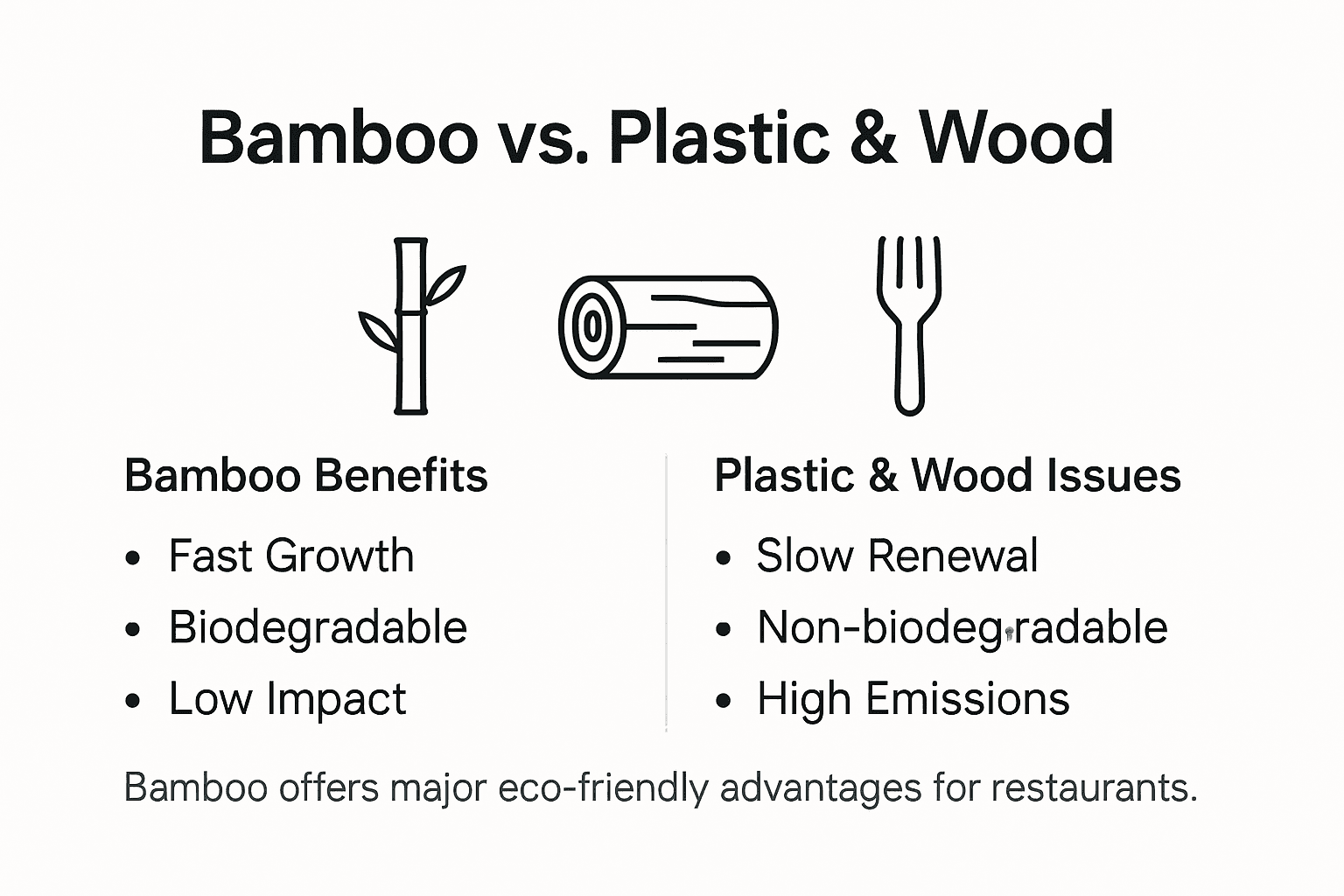
Unlike petroleum-based plastics that persist in landfills for centuries, bamboo products provide a biodegradable solution with remarkable mechanical properties. Bamboo-fiber-reinforced polymer composites now offer strength and durability comparable to conventional materials while maintaining significantly lower environmental impact. These advanced composites can withstand restaurant-grade usage, resisting corrosion and mechanical stress while remaining fully compostable at the end of their lifecycle.
The comparative advantages of bamboo extend beyond environmental metrics. While traditional wood requires decades of growth and causes significant forest destruction, bamboo regenerates within 3-5 years and actively supports ecosystem health. Restaurants can replace single-use plastic utensils, disposable packaging, and wood-based products with bamboo alternatives that reduce carbon footprint, minimize waste, and demonstrate genuine commitment to sustainable practices. The material’s versatility allows for everything from cutlery and food containers to decorative elements, providing a comprehensive green solution.
Here’s how bamboo’s sustainability profile compares with traditional wood and plastic:
| Attribute | Bamboo | Wood | Plastic |
|---|---|---|---|
| Growth Cycle | 3-5 years | 20-50 years | Not renewable |
| Carbon Absorption | Up to 12 tons/hectare/yr | Moderate | None |
| Biodegradability | Fully biodegradable | Partially biodegradable | Not biodegradable |
| Regeneration Method | Grows from roots | Replanting required | Cannot regenerate |
| Lifecycle Impact | Reduces emissions | Deforestation impact | Pollution and landfill |
Pro tip: When transitioning to bamboo products, start by replacing high-volume, single-use items to maximize your sustainability impact and minimize initial investment.
Restaurants striving to reduce their environmental impact face challenges sourcing materials that combine rapid regeneration, durability, and eco friendliness. Bamboo offers a scientifically proven solution with fast growth and carbon absorption far surpassing traditional wood. To truly harness bamboo’s potential, your restaurant needs products crafted from premium sustainable bamboo that hold up under daily use and add a touch of natural elegance.
Discover how bamboo paper towel dispensers from Cozee Bay can transform your commercial space with durable, eco-conscious design.

Don’t wait to make a lasting impact. Choose from our handcrafted bamboo essentials designed to support your green initiatives and streamline operations. Visit Cozee Bay now to explore bamboo products that blend sustainability with style. Start turning your restaurant into a model of environmental responsibility today.
Bamboo is a fast-growing grass that reaches maturity in just 3-5 years, making it a highly renewable resource. It also absorbs significant amounts of carbon dioxide and has a robust root system that prevents soil erosion and supports biodiversity.
Bamboo regenerates much more quickly than traditional hardwood, which can take 20-50 years to mature. While wood harvesting often leads to deforestation, bamboo’s harvesting methods allow for sustainability and ecosystem preservation, making it a better choice for eco-conscious restaurants.
Bamboo products are fully biodegradable, while plastic contributes to long-term environmental damage and can take centuries to decompose. Bamboo also offers excellent mechanical strength and durability, making it a reliable replacement for single-use plastic items in restaurants.
Yes, bamboo products such as tableware (utensils, plates), food packaging, flooring, and textiles for staff uniforms are ideal. They are not only sustainable but also offer durability and aesthetic appeal suitable for high-traffic restaurant environments.
Comments will be approved before showing up.