Your Cart is Empty


Bio-based plastic is any plastic material whose carbon comes from renewable biological sources, such as corn starch, sugarcane, or cellulose, rather than from fossil fuels. The IUPAC Gold Book recommends the term “biobased polymer” over the popular shorthand “bioplastic,” because origin alone says nothing about whether a product will break down in your backyard or outlast a landfill for centuries. That single distinction is the most important thing you can carry away from this article: bio-based does not automatically mean biodegradable. Before you toss a “plant-based” cup into your compost bin, check whether it carries an ASTM D6400 compostability certification and whether your local facility actually accepts it. The USDA BioPreferred Program provides the most reliable U.S. labeling standard for biobased content, measured by the radiocarbon method defined in ASTM D6866.
Bio-based plastic is defined by where its carbon comes from, not by what happens to it at end of life — and that distinction shapes every purchasing and disposal decision you make.
| Point | Details |
|---|---|
| Bio-based means origin, not end-of-life | A biobased polymer is made from renewable biomass; it may or may not biodegrade depending on its chemistry. |
| Check for ASTM D6866 and USDA BioPreferred | These are the U.S. standards that verify biobased content; they do not certify compostability. |
| Compostability requires its own certification | Look for ASTM D6400 or BPI certification, and confirm your local facility accepts compostable plastics. |
| Drop-in bio-PE and bio-PET recycle normally | These are chemically identical to fossil PE and PET and belong in standard recycling streams. |
| Reduction and reuse outperform switching materials | Durable natural materials like bamboo or glass eliminate the disposal question that bio-based single-use items still leave open. |
The terminology around bio-based plastics is genuinely confusing, and that confusion is not accidental. Marketing teams love the word “bioplastic” precisely because it sounds both natural and responsible. IUPAC advises against that term, recommending “biobased polymer” or “biobased content” instead, because biobased origin does not guarantee environmental benefit without a favorable life-cycle assessment.
Here are the four terms you need to keep straight:
The practical split to remember: biobased content tells you where the material came from; biodegradability and compostability tell you where it can go. Drop-in biobased equivalents like bio-PE and bio-PET are chemically identical to their fossil counterparts and behave the same way in recycling streams. Newer biopolymers like PLA and PHA are chemically distinct and require separate end-of-life handling.
Bioplastics account for roughly 1–2% of global plastics production, yet they span a surprisingly wide range of chemistries and behaviors. The clearest way to organize them is by two questions: Is the material chemically new, or is it a biobased copy of an existing fossil plastic? And does it biodegrade?
| Polymer | Biobased content | Biodegradable / compostable | Common uses | Feedstock | End-of-life options | Key trade-offs |
|---|---|---|---|---|---|---|
| PLA | Up to 100% | Industrial compost only (ASTM D6400) | Cups, cutlery, food containers | Corn starch, sugarcane | Industrial composting; not compatible with standard plastic recycling | Requires high-temp facility; can contaminate PET streams |
| PHA / PHB | Up to 100% | Biodegradable in soil, marine, and industrial compost | Films, medical devices, specialty packaging | Microbial fermentation of sugars or oils | Industrial compost, some soil/marine degradation | High production cost; limited commercial scale |
| Bio-PE | Typically 95%+ | Not biodegradable | Bottles, flexible packaging, bags | Sugarcane ethanol | Recyclable in standard PE streams | Land use for sugarcane; same recycling as fossil PE |
| Bio-PET | Partial biobased in commercial versions | Not biodegradable | Beverage bottles, textiles | Sugarcane or corn (for MEG component) | Recyclable in standard PET streams | Only partially biobased; fossil PTA still required |
| Starch / cellulose blends | Variable biobased content | Biodegradable under composting conditions | Bags, loose-fill packaging, trays | Corn, potato, wheat starch; wood pulp | Industrial or home compost depending on formulation | Performance limitations in heat and humidity |
PLA is the bio-based polymer you are most likely to encounter at a coffee shop or food festival. Made from fermented plant sugars, typically corn starch in the U.S., it looks and feels like conventional clear plastic. The catch: PLA only breaks down reliably at the sustained high temperatures found in industrial composting facilities, not in your backyard pile or a landfill. If it ends up in a standard plastic recycling bin, it can contaminate PET streams.
PHAs, including the subtype PHB, are produced by bacteria that accumulate the polymer as an energy reserve when fed sugars or oils. They are genuinely biodegradable across a wider range of environments, including soil and marine settings, which makes them attractive for applications where collection is difficult. Production costs remain high, so PHAs are still mostly found in specialty films and medical applications rather than everyday packaging.
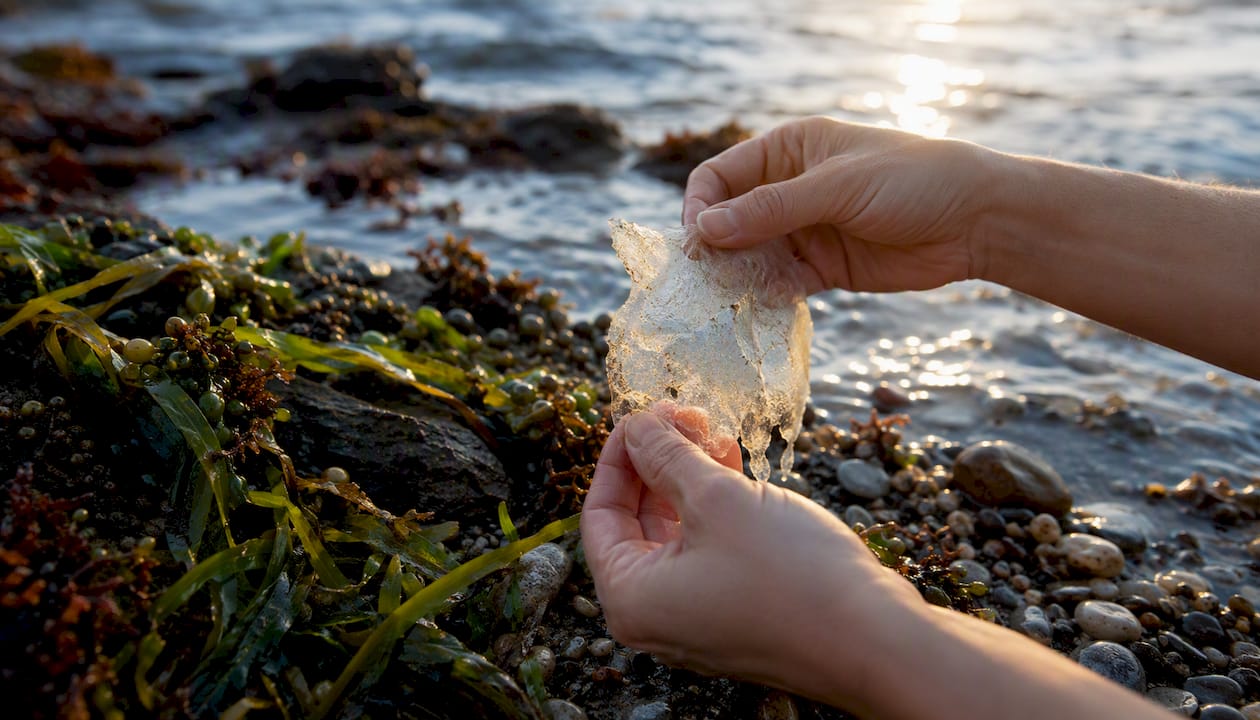
Bio-PE starts with sugarcane ethanol, which is converted to ethylene and then polymerized. The resulting material is chemically identical to fossil-derived PE, so it slots directly into existing PE recycling infrastructure. That “drop-in” compatibility is its biggest practical advantage. It does not biodegrade, but it does recycle.
Commercial bio-PET is only partially biobased. Like bio-PE, it is recyclable in standard PET streams and is not biodegradable.
Starch-based materials use native or modified starch from corn, potato, or wheat, often blended with other polymers to improve durability. Cellulose-based variants draw on wood pulp or agricultural fiber. Both categories tend to be compostable under the right conditions, though performance in heat and moisture can be a limitation. You will find them most often in compostable bags and loose-fill packaging.
The feedstock a manufacturer chooses shapes both the environmental profile and the cost of the final material. Most bio-based plastics today rely on first-generation feedstocks, meaning food crops like corn, sugarcane, and potato starch. These are well-understood and relatively cheap to process, but they compete directly with food supply and require agricultural land, water, and fertilizer.
Second-generation feedstocks sidestep the food competition problem by using agricultural residues (corn stover, bagasse from sugarcane processing), forestry waste, or used cooking oil. Converting these materials into usable monomers is more technically complex, but the sustainability profile improves considerably when supply chains are managed responsibly.
Third-generation feedstocks are still largely at the research stage. They include algae, CO₂ captured from industrial emissions, and methane from biogas. The appeal is obvious: no land competition, potentially carbon-negative inputs. Commercial scale remains limited.
The production route depends on the target polymer:
Pro Tip: When evaluating a bio-based product’s sustainability, ask the manufacturer which generation of feedstock they use. A product made from second-generation agricultural residues typically carries a lower land-use footprint than one made from virgin food crops, even if the biobased content percentage is the same.
This is where most label confusion originates, and it is worth being precise. Two separate properties are in play, and they are measured by entirely different test methods.
Biobased content is a measurement of origin. ASTM D6866 uses radiocarbon (carbon-14) analysis to determine what fraction of the carbon in a material came from recently living biomass versus ancient fossil sources. That score says nothing about whether it will decompose.
Biodegradability and compostability are measurements of end-of-life behavior. The relevant standards are:
Conversely, some fossil-derived materials can be engineered to biodegrade under specific conditions. Origin and end-of-life are simply different questions.
The label “compostable” only means something if your local facility accepts it. Most PLA and starch-based compostable plastics require industrial composting at sustained temperatures above 130°F. Home compost piles rarely reach those temperatures consistently. Before relying on a compostable claim, check with your municipal solid-waste authority or waste hauler to confirm they accept certified compostable plastics. Many U.S. facilities do not, which means a “compostable” cup may end up in landfill regardless of its certification.
You can verify compostability claims and find certified products through the Biodegradable Products Institute (BPI), which maintains a searchable database of ASTM D6400-certified items. For a deeper look at how biodegradable and compostable labels differ in practice, the distinction matters more than most packaging claims let on.
Bio-based plastics can reduce dependence on fossil carbon and, in some cases, lower greenhouse gas emissions across their life cycle. But the European Commission is direct on this point: biobased origin does not guarantee a positive environmental outcome. Full life-cycle assessment (LCA) is required to evaluate actual impacts, and the results depend heavily on feedstock sourcing, production energy, and end-of-life management.
A European Commission communication reported that biobased, biodegradable, and compostable plastics represented about 1% of total plastic production capacity, at over 2 million tonnes per year, and cautioned that scaling this sector must be managed to avoid negative impacts on biodiversity and land use.
Where bio-based plastics can help:
Where trade-offs arise:
The honest answer is that bio-based plastics are not a universal upgrade. They are a better choice in specific applications, particularly where compostable end-of-life is genuinely available and where the feedstock is a waste or residue rather than a food crop. For understanding how biodegradable packaging affects waste reduction more broadly, the picture is similarly nuanced.
Disposal depends almost entirely on which type of bio-based plastic you have. Getting this wrong can contaminate recycling streams or defeat the composting benefit entirely.
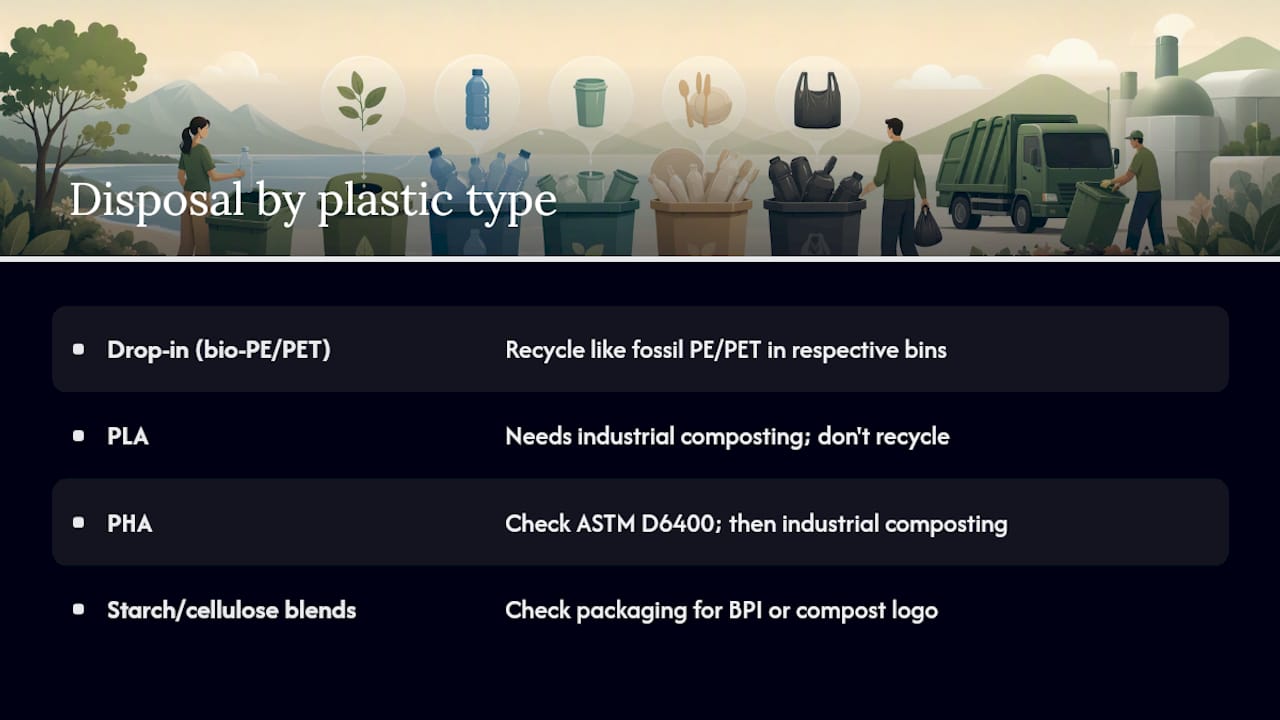
Drop-in biobased polymers (bio-PE, bio-PET): Treat these exactly like their fossil equivalents. Bio-PE goes in the plastic film recycling bin (or store drop-off for PE bags). Bio-PET goes in the standard PET recycling bin. These materials are chemically identical to fossil PE and PET, so they cause no contamination issues in standard recycling streams.
PLA: Do not put PLA in your standard plastic recycling bin. It is not compatible with PET or PP recycling streams and can degrade the quality of recycled material if mixed in. PLA belongs in an industrial composting facility. If your municipality does not accept compostable plastics, PLA goes in the trash. Putting it in home compost is unlikely to produce meaningful breakdown unless your pile runs very hot for an extended period.
PHA: PHAs are more flexible in end-of-life options than PLA. Some formulations biodegrade in soil and marine environments, making them suitable for applications where collection is impractical. For household disposal, check the product’s certification. If it carries ASTM D6400 certification, it can go to an industrial composting facility.
Starch and cellulose blends: These vary by formulation. Many are certified for industrial composting; some thinner films are certified for home composting. Read the packaging and look for BPI certification or a recognized compostability logo.
To find out whether your local facility accepts compostable plastics, call your waste hauler directly or check your municipal solid-waste authority’s website. You can also search the Sustainable Packaging Coalition’s How2Recycle database by product type. For sustainable packaging choices in foodservice settings, disposal infrastructure is often the deciding factor.
Packaging claims around bio-based plastics are among the most inconsistently used in the consumer goods market. Here is a practical checklist for shopping smarter:
Look for these on packaging:
Treat these as red flags:
How to follow up:
For a broader guide on choosing eco-friendly packaging across product categories, the same verification principles apply.
Bio-based plastics show up in more places than most people realize, though the polymer type varies widely by application.
When durability matters more than compostability, bio-based single-use items are often the wrong tool. A reusable bamboo or glass item eliminates the disposal question entirely and typically carries a lower per-use environmental footprint after a relatively small number of uses. Emerging applications include bio-based coatings for paper packaging, bio-based nylon for textiles, and bio-based epoxy resins for composites, though most of these are still scaling toward mainstream availability.
For niche food packaging applications, sustainable packaging options for specialty food products illustrate how bio-based materials are being evaluated alongside other eco-friendly alternatives in real product contexts.
At Cozee-bay, we spend a lot of time thinking about what “sustainable” actually means in practice, not just on a label. Our honest view: bio-based single-use plastics are a genuine improvement over fossil-based single-use plastics in specific, well-managed situations. But they are not a reason to keep buying single-use items you could replace with something durable.
The cases where bio-based packaging makes real sense are narrow but real. If you run a food-service operation with a verified industrial composting pickup, certified compostable PLA or starch-blend serviceware is a legitimate choice. If you are sourcing flexible packaging for a product that genuinely cannot use rigid materials, bio-PE gives you recycling compatibility without the fossil feedstock. For sustainable coffee packaging decisions, the same logic applies: the right bio-based choice depends on what end-of-life infrastructure your customers actually have access to.
Where we push back is on the idea that switching from fossil plastic to bio-based plastic is automatically a win. If the compostable cup ends up in landfill, the benefit disappears. If the bio-based packaging requires more water and fertilizer to produce than the fossil version saves in carbon, the LCA does not favor it. Reduction and reuse come first. A bamboo paper towel dispenser that lasts years, or a glass container that gets washed and refilled, sidesteps the entire disposal question. Bio-based materials fill the gap where single-use is genuinely unavoidable, not where it is just convenient.
Comments will be approved before showing up.