Your Cart is Empty


The single highest-impact move in any green home is a tight, well-insulated building envelope paired with a right-sized heat pump system. Get those two things right, and everything else, from solar panels to smart thermostats, performs better and costs less to install. Here is where to start:
A tight, well-insulated building envelope paired with a right-sized heat pump system delivers the largest long-term energy savings of any single design decision in a green home.
| Point | Details |
|---|---|
| Envelope and HVAC first | Air sealing, insulation, and a right-sized heat pump cut operating energy more than any product upgrade. |
| LED and appliances | Replacing incandescent bulbs with LEDs cuts lighting energy use by up to 90%; ENERGY STAR appliances compound those savings. |
| PV and water readiness | Run conduit and size your panel for solar now; install a heat-pump water heater that uses up to 70% less energy than standard electric models. |
| Materials and IAQ | Specify zero-VOC finishes and FSC or reclaimed materials; flush out the home after installation to protect indoor air quality. |
| Cozee-bay bamboo accessories | Cozee-bay’s handcrafted bamboo products replace plastic kitchen and home accessories with a durable, renewable alternative. |
A prioritized list beats a long laundry list every time. These 12 ideas are ranked roughly by impact, and each one comes with a clear next step so you know exactly what to do.
Pro Tip: Items 1, 3, and 7 above pay off the most over a home’s lifetime. Prioritize them even if budget forces you to phase everything else.
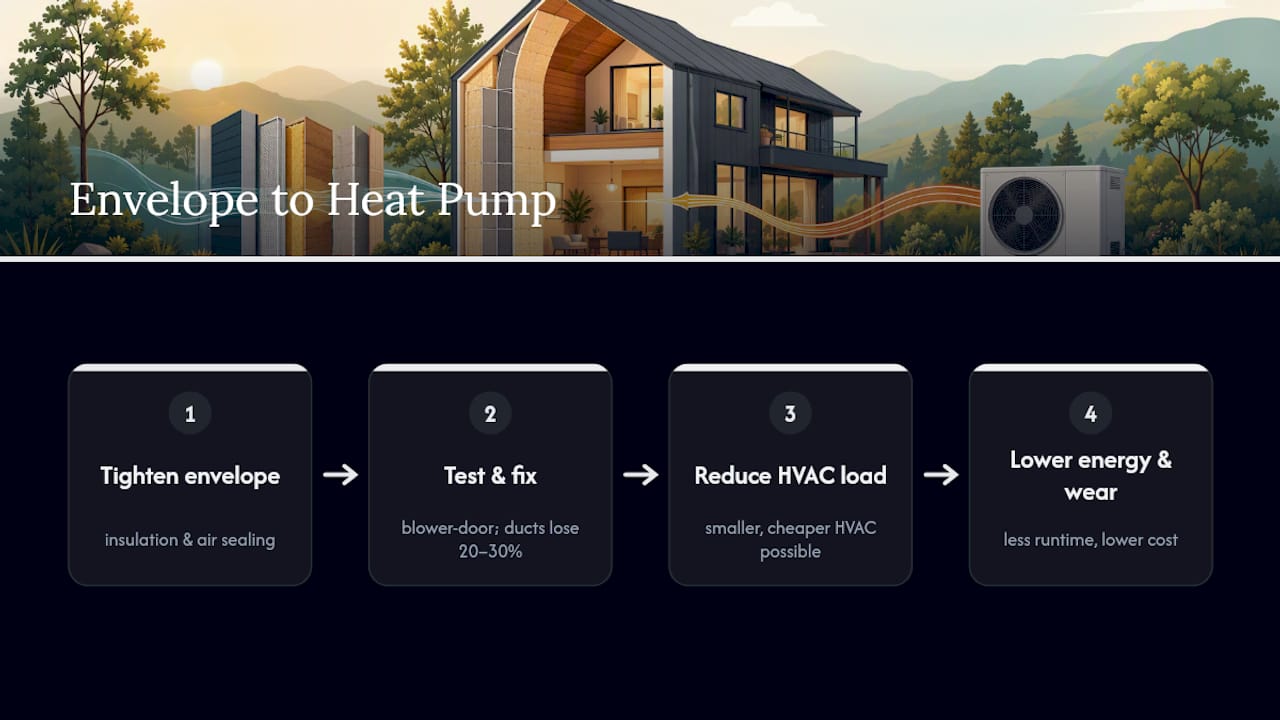
The building envelope is the shell that separates conditioned air from the outdoors: walls, roof, floor, windows, and doors. When that shell leaks or conducts heat poorly, your HVAC system runs longer, costs more, and wears out faster. Tighten the envelope first, and you can install a smaller, cheaper HVAC unit that still keeps the home comfortable.
Recommended thermal performance targets by climate zone (IECC 2021):
For windows, solar heat gain coefficient (SHGC) matters as much as U-factor. In hot climates, choose SHGC below 0.25 on south and west elevations. In cold climates, a higher SHGC (0.40 or above) on south-facing glass lets winter sun contribute free heat.
Heat pumps work best in a tight home because they deliver heat at lower temperatures than a gas furnace. Oversizing a heat pump in a leaky house is a common and expensive mistake. Always ask your contractor for a Manual J load calculation, and verify the result with a blower-door test after construction. Duct leakage testing is equally worth scheduling: ducts outside the thermal envelope can waste 20–30% of conditioned air before it reaches a room.
Pro Tip: Schedule a blower-door test and duct leakage test during the build or retrofit, not after move-in. Fixing gaps costs a fraction of the price when walls are still open.
For a deeper look at certified product options, the energy-efficient home products guide at Cozee-bay covers ENERGY STAR appliances and related recommendations.
Solar photovoltaic (PV) panels perform best on a south-facing roof with a pitch between 15 and 40 degrees and no shading between 9 AM and 3 PM. You do not have to install panels on day one, but you should plan for them from the start. The DOE Efficient New Homes checklist includes specific PV-ready, EV-ready, and heat-pump-ready line items that cost very little to add during construction and a great deal to retrofit later.
PV-readiness checklist for new builds:
Water heating and conservation:
Heat-pump water heaters are the most cost-effective upgrade for most U.S. homes. They use up to 70% less energy than conventional electric resistance models, and DOE guidance on water heating confirms they outperform both tankless gas and standard electric options in most climates. Solar thermal water heating can be cost-effective in high-solar regions, but heat-pump water heaters are simpler to install and maintain in most cases.
Savings callout: WaterSense-labeled showerheads use no more than 2.0 gallons per minute, compared to the standard 2.5 gpm, and WaterSense-certified fixtures can cut indoor water use meaningfully across a household.
Rainwater capture systems range from simple rain barrels connected to a downspout to larger cisterns that feed irrigation. Check local regulations before installing: some states restrict rainwater collection, while others offer rebates for it. Greywater reuse (from sinks and showers to irrigation) is permitted with conditions in many states but requires a permit in most jurisdictions.
ASID guidance frames the right approach clearly: keep and repair what you have first, then refurbish or repurpose, and only buy new as a last resort. That sequence reduces embodied carbon and waste more reliably than any single “eco” product label.
When you do buy new, these material categories tend to perform well across durability, health, and environmental impact:
The EPA identifies indoor air quality as a serious health concern, and VOC off-gassing from paints, adhesives, and cabinetry is a primary contributor. Specify zero-VOC paint, formaldehyde-free plywood and MDF, and low-VOC adhesives for every finish layer.
Certification checklist to keep handy:
Ask suppliers for EPDs before specifying a product. An EPD is a standardized, third-party-verified document that quantifies a material’s environmental impact across its lifecycle. Most reputable manufacturers provide them on request.
Pro Tip: After any new installation, run the HVAC system on maximum ventilation for 48–72 hours with windows open if weather allows. This “flush-out” protocol significantly reduces initial VOC concentrations indoors.
For practical ideas on sustainable home decor that applies circular-design thinking, Cozee-bay’s blog covers upcycled and reclaimed furnishing options in detail.
Passive solar design uses the sun’s position and the home’s geometry to heat, cool, and light spaces without mechanical systems. Passive solar design, when integrated early, can reduce household heating and cooling needs by up to around 40%, according to the American Solar Energy Society (ASES). That is a significant reduction that no appliance upgrade can match.
The core rules for U.S. homes are straightforward:
Compact footprints matter here too. Fewer corners and a simpler roofline reduce thermal bridging, cut construction waste, and shrink the surface area that needs insulating. Building Science research consistently shows that architectural simplicity outperforms many individual “green” product upgrades because it reduces heat loss pathways from the start.
Daylighting strategies like light shelves (horizontal reflectors above eye level), clerestory windows, and tubular skylights can bring natural light deep into a floor plan without adding solar gain. In hot climates, prioritize north-facing skylights or tubular daylighting devices that admit light without heat.

Pro Tip: Balance total glazing area with exterior shading devices before adding more windows for views. A well-shaded south window outperforms an unshaded west window every summer.
Smart controls and efficient appliances are the easiest wins in a retrofit because most of them require no structural work. Start with the upgrades that pay back fastest.
Savings callout: Homes built to ENERGY STAR NextGen standards are about 20% more energy-efficient than homes built to standard code, with heat pumps and efficient water heating delivering a large share of that gain.
Simple automation amplifies these savings. Schedule your EV charger to run between midnight and 6 AM when grid electricity is cheapest and often cleaner. Set your dishwasher and washing machine to run during peak solar production hours if you have PV. Zoned HVAC controls let you condition only occupied rooms, which is especially useful in larger homes.
A phased upgrade plan for a typical retrofit: start with LEDs and a smart thermostat (under $500 combined), then move to ENERGY STAR appliances as existing ones reach end of life, and schedule the heat pump and water heater as the final major investment.
The sequence matters as much as the choice. For a new build, the order is: design for passive solar and compact form, then specify the envelope, then size mechanical systems, then choose finishes. For a retrofit, the order is: energy audit, then air sealing and insulation, then systems, then finishes.
Phase 1: Low-cost wins (under $1,000, DIY or simple contractor)
Phase 2: Medium-cost retrofits ($1,000–$10,000)
| Upgrade | Typical Cost Range | Simple Payback (years) |
|---|---|---|
| Air sealing + attic insulation | $1,500 | 3–7 |
| Heat-pump water heater | $1,200 | 3–6 |
| Smart thermostat + zoning | $500 | 2–5 |
| EV-ready 240V circuit | $500 | Immediate (future-proofing) |
Phase 3: Major investments ($10,000+)
Federal incentives under the Inflation Reduction Act include tax credits for heat pumps, heat-pump water heaters, insulation, windows, and solar. State and utility rebates stack on top of federal credits in many cases. Check the DSIRE database and your utility’s website for current incentives in your state, since amounts and eligibility rules change regularly.
For a structured checklist that covers ENERGY STAR guidelines and phased steps, the eco home design checklist at Cozee-bay is a practical companion to this section.
Not every contractor who calls themselves “green” has the training to deliver a high-performance home. These credentials signal real technical knowledge:
Interview questions worth asking:
Red flags to watch for:
The claims in this article are grounded in U.S. programs and research. Here is a compact snapshot of the key figures and where they come from:
Primary U.S. sources to bookmark:
Use the ENERGY STAR product registry to verify appliance certification before purchase. Use the DOE checklist when designing a new roof or electrical panel. Use the WaterSense product search for every plumbing fixture decision.
Sustainability is a sequence of practical decisions, not a checklist you complete once. The homes that perform best over 30 years are rarely the ones that chased the lowest upfront carbon number or the flashiest product label. They are the ones where the owner made durable choices, tested the envelope, and resisted the urge to add complexity.
Here are three trade-offs worth accepting consciously. First, a slightly more expensive heat pump or triple-pane window often has a lower lifetime cost than the cheaper alternative, even when the upfront carbon is marginally higher. Durability beats embodied-carbon optimization in most residential scenarios. Second, a product labeled “natural” or “eco” is not automatically the right choice for every application. ASID’s guidance is clear: sustainability depends on fit-for-purpose, expected durability, and end-of-life pathways, not the marketing copy on the package. Third, a smaller, simpler home almost always outperforms a larger, feature-rich one on every sustainability metric, from embodied carbon to operating energy to maintenance cost.
If your budget is limited, put it into the envelope and indoor air quality first. A tight, well-ventilated home with low-VOC finishes protects your family’s health every single day, regardless of what the energy bill says.
Cozee-bay’s handcrafted bamboo products are a natural fit for a home you are already making more sustainable.

Bamboo is one of the fastest-growing plants on earth, and Cozee-bay’s paper towel dispensers, drawer organizers, and kitchen accessories are built from it with quality craftsmanship and a clean, minimal aesthetic that suits eco-conscious living spaces. Every product ships free within the contiguous U.S. and comes with a money-back guarantee.
Browse the full collection and find the right fit for your kitchen or home office at Cozee-bay.
These are the authoritative sources to consult as you plan, build, or retrofit:
Comments will be approved before showing up.