Your Cart is Empty


TL;DR:
- Biodegradable paper may not benefit the environment if it ends up in landfills, coated in plastic, or containing inks that hinder decomposition.
- Unlike compostable paper, which breaks down within specific timeframes and conditions, biodegradable labels lack standardized standards and may take centuries to decompose.
Picking up a roll of paper towels labeled “biodegradable” feels like doing the right thing. But here’s the uncomfortable reality: that label may mean almost nothing for the environment if the product ends up in a landfill, is coated in plastic, or carries inks that slow decomposition for decades. As the NRDC and other advocates remind us, biodegradable vs compostable are two very different claims, and the gap between them can quietly undo your best eco-friendly intentions. This guide cuts through the noise so you can shop with real confidence.
| Point | Details |
|---|---|
| Label confusion | Biodegradable and compostable mean different things—always check for specifics and standards. |
| Disposal matters | How you dispose of paper is as important as what it’s made of for climate impact. |
| Certification is key | Third-party certifications like ASTM boost trust and true environmental benefit. |
| Better alternatives | Recycled-content and responsibly-sourced paper often outperforms generic biodegradable options. |
| Smart shopping | Combine eco-labels with disposal practices and real use cases for maximum sustainability. |
Now that the confusion is on the table, let’s break down the actual meaning of biodegradable paper versus similar eco-labels.
When a paper product says “biodegradable,” it simply means living organisms, mainly bacteria and fungi, can break it down. That sounds great. The catch? There is no regulated timeframe attached to that claim. A product could theoretically take 500 years in a sealed landfill and still qualify as biodegradable under many labeling conventions.
Compostable paper is a stricter, more reliable standard. As researchers and industry groups consistently note, compostable vs biodegradable are not interchangeable terms. Compostable means the product must break down within a specific timeframe under defined composting conditions, leaving no toxic residue. “Biodegradable” lacks any defined breakdown timeframe and conditions, while “compostable” implies breakdown within specified composting conditions and timeframes, according to the Biodegradable vs Compostable Materials guide by Imperial Paper.
Here is a quick side-by-side comparison to keep things clear:
| Feature | Biodegradable paper | Compostable paper |
|---|---|---|
| Defined breakdown timeframe | No | Yes |
| Requires specific conditions | Not specified | Yes (industrial or home composting) |
| Leaves no toxic residue | Not guaranteed | Required by standard |
| Third-party certification common | Rare | More common |
| Works in landfill | Extremely slow | No, needs composting environment |
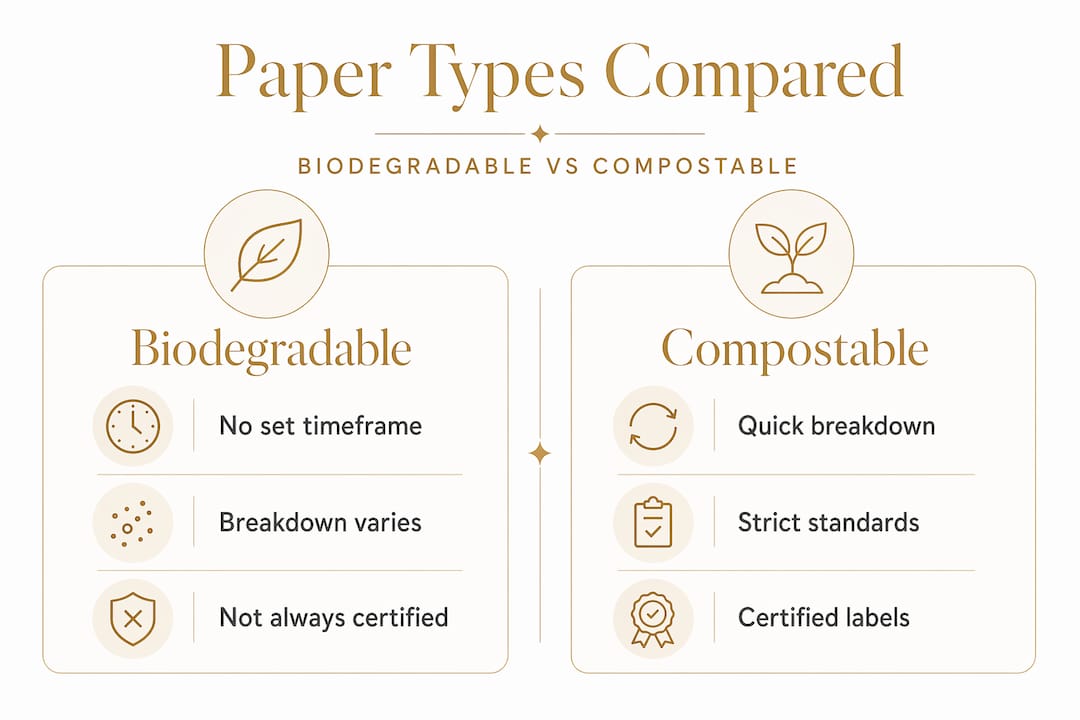
Many paper products sit in a murky middle ground. Manufacturers may add plastic coatings for moisture resistance, use synthetic dyes, or blend in non-organic materials. These additions can make a technically plant-based paper neither recyclable nor compostable in practice. Understanding compostable materials explained helps you spot the difference before you buy.
A few common paper product categories labeled as biodegradable include:
“Compostable paper is not the same as biodegradable. Biodegradable lacks a defined breakdown timeframe and conditions, while compostable implies breakdown within specified composting conditions and timeframes.” — Imperial Paper
The bottom line here is that the word “biodegradable” on packaging is marketing language unless it is backed by something more specific. Your job as an eco-conscious buyer is to dig just a little deeper.
Once you know what biodegradable means, it’s crucial to see how it plays out in real-world circumstances, and why not all biodegradable paper disappears equally.
Paper is primarily made of cellulose, a plant-based fiber that microbes genuinely love. Under ideal conditions, such as a warm, moist compost pile with good airflow, plain paper can break down in as little as two to six weeks. But ideal conditions are rarely where your paper products end up.
The biggest culprit slowing decomposition is the landfill. Landfills are designed to be stable containment systems, not decomposition chambers. Oxygen is scarce, moisture is inconsistent, and the layered compaction creates an anaerobic (low-oxygen) environment where even food scraps can take years to break down. Paper inside a landfill may survive for decades, slowly releasing methane, a greenhouse gas far more potent than carbon dioxide, as it eventually degrades. You can see the broader picture of this in a look at biodegradable packaging impact on waste systems.
Coatings and treatments are the second major barrier. A shiny wrapping paper or a grease-resistant sandwich bag may look harmless, but those finishes are often polyethylene or other plastic-based coatings that physically block microbial access to the cellulose beneath. As confirmed by industry research, coatings in treated papers can hinder breakdown entirely, and end-of-life outcomes vary significantly by formulation.
Here is how different disposal environments stack up for average paper products:
| Disposal environment | Approximate breakdown time | Key factors |
|---|---|---|
| Home compost (plain paper) | 2 to 8 weeks | Heat, moisture, microbial activity |
| Industrial composting | 12 days to 6 weeks | Controlled heat, shredding, turning |
| Landfill (no coatings) | 2 to 6 years | Low oxygen, compaction |
| Landfill (coated/treated) | Decades or longer | Plastic barrier, anaerobic conditions |
| Marine/ocean environment | Highly variable | Salinity, temperature, paper type |
| Open air/soil | Weeks to months | Moisture, sun exposure, microbial load |
Common factors that slow or stop paper biodegradation:
Pro Tip: If you are composting paper at home, shred it first. Smaller pieces expose more surface area to microbes and can cut breakdown time in half compared to whole sheets.
The marine environment deserves a special mention. Certain cellulose-based paperboard products have been shown to biodegrade in ocean conditions, but this is not a general property of all biodegradable paper. Most products marketed as biodegradable will not break down meaningfully if they enter waterways, and some coatings may even leach harmful compounds into aquatic ecosystems.
With breakdown routes in mind, the real power lies in choosing paper that meets transparent, third-party standards. Let’s break down which labels matter.
Certifications exist precisely because “biodegradable” alone is too vague to mean much. Third-party standards create a consistent benchmark that manufacturers must meet before making environmental claims. For buyers, these certifications are your best shortcut to trustworthy products.
Here are the key steps to decoding a product’s eco-credentials:
Look for ASTM certification. The American Society for Testing and Materials (ASTM) has developed standards that measure real-world compostability, not just lab results. ASTM standards for composting include test methods designed to evaluate disintegration and compostability under actual composting facility conditions, which gives you a much more realistic picture than theoretical breakdown rates.
Check whether it is approved for home or industrial composting. These are very different things. Industrial composting facilities reach higher temperatures and maintain tighter controls. A product certified for industrial composting only will not break down properly in your backyard pile, and may not be accepted at all local composting facilities.
Ask about inks and coatings. Even a certified compostable paper base can be compromised by non-compostable printing inks or coatings applied after production. Look for products that disclose their full material composition.
Verify the end-of-life pathway. Does the manufacturer tell you what to do with the product after use? A transparent, responsible brand will point you toward composting, recycling, or another specific disposal route rather than leaving it to chance.
Look for FSC certification alongside compostability claims. The Forest Stewardship Council (FSC) label tells you the paper fiber was sourced from responsibly managed forests. While FSC does not speak to biodegradability, it covers the supply chain sustainability that biodegradable labels ignore entirely.
Checking compostable packaging standards can further clarify what different certifications actually require, so you are not left guessing when you see a label at the store.
Pro Tip: When shopping online, search for the product’s data sheet or compliance certificate rather than relying solely on the label. Many certified products publish this documentation directly on their product page or upon request.
Understanding the standards gives you tools. Now, see how these insights turn into smart shopping and usage strategies.
One of the most counterintuitive lessons in the eco-friendly paper world is that biodegradable does not automatically mean better. Choosing paper with high recycled content, even if it is not labeled biodegradable, often delivers a lower overall environmental footprint than virgin-fiber paper with a biodegradable claim. The NRDC’s tissue brand guidance confirms that eco-conscious consumers often get better environmental outcomes by choosing high-quality paper systems built on recycled content and responsible sourcing, rather than assuming “biodegradable” is automatically the greener path.
Here is a comparison of common paper choices to put this in perspective:
| Paper type | Recycled content | Biodegradable? | Best end-of-life |
|---|---|---|---|
| Standard virgin paper | None | Yes (slow) | Landfill or recycle |
| Recycled-content paper | High (30 to 100%) | Yes | Recycle or compost |
| Compostable certified paper | Varies | Yes (defined) | Industrial or home compost |
| Coated/glossy paper | Low | No (in practice) | Landfill only |
| FSC-certified paper | Varies | Yes | Recycle or compost |
Practical choices that genuinely reduce impact:
When you apply these principles to your everyday purchases, whether paper towels for your kitchen or tissue for your commercial space, you will find that sustainable paper towel choices involve looking at the full picture: fiber source, certifications, coatings, and what actually happens to the product after use.
Statistic to keep in mind: Paper and paperboard make up roughly 23% of municipal solid waste in the United States, and a significant portion of that ends up in landfills despite being technically recyclable or compostable. Smarter buying and disposal decisions at the individual level genuinely move the needle.
After all this, what is the bottom line for eco-conscious shoppers and businesses? Here is what most guides do not say.
We have spent years watching well-meaning buyers reach for biodegradable paper products and feel confident they have done their part. The frustrating reality is that the label is often the least important part of the purchasing decision. What matters more: where does this product actually end up?
Even true paper biodegradation can be functionally irrelevant if the product is consistently disposed of in landfills or incinerated. Anaerobic landfill conditions can dramatically slow decomposition and change the climate impact compared to an intended compost pathway. In other words, buying a compostable paper bag and throwing it in the trash is not much different from buying a conventional one. The material’s potential is only unlocked when it reaches the right disposal system.
This is why we believe the conversation needs to shift from “what is in the product” to “what happens to the product.” Supply chain transparency, recycled content, and accessible end-of-life pathways matter far more than a single word on the front of the package.
For practical guidance on what is biodegradable and how to apply this knowledge in your home or business, the most actionable advice is this: prioritize recycled content, look for third-party certifications, confirm the correct disposal route before you buy, and choose brands that are upfront about their materials and their limitations.
Greenwashing is real, and it thrives in the gap between what a label says and what actually happens in the world. You deserve better than vague promises.
Ready to put responsible paper choices into practice? If sorting through certifications and material specs still feels overwhelming, it helps to start with products and brands that have already done the vetting for you.

At Cozee Bay, we build our product line around the idea that eco-friendly choices should also be stylish, durable, and genuinely useful. Our handcrafted bamboo products, from paper towel dispensers to organizers, are designed for the eco-conscious home and commercial space. Bamboo is one of the fastest-growing and most renewable materials on the planet, and it pairs beautifully with certified, responsibly sourced paper products. If you are ready to move beyond the guesswork, explore our eco-friendly bamboo paper options and find solutions that align with your values and your space.
No, biodegradable paper does not automatically meet compostable standards. As compostable definitions clarify, compostable products must break down within set timeframes and specific conditions, while biodegradable has no such requirement.
Plastic or wax coatings, heavy inks, and landfill disposal conditions are the main culprits. Treated papers and coatings can hinder breakdown significantly, with end-of-life outcomes varying widely by product formulation.
Look for third-party certifications and confirm whether the product is approved for home or industrial composting. ASTM composting standards include test methods based on real-world composting facility conditions, giving you a more reliable measure than lab-only claims.
Recycled-content paper often has a lower total environmental footprint than virgin-fiber biodegradable paper. NRDC guidance on tissue brands emphasizes that responsible sourcing and recycled content frequently deliver better outcomes than relying on a biodegradable label alone.
Most conventional biodegradable paper will not break down quickly or fully in marine environments. Specific cellulose-based paperboard materials have demonstrated marine biodegradability across depths, but this is not a general property of everyday biodegradable paper products.
Comments will be approved before showing up.