Your Cart is Empty


Finding eco-friendly solutions for everyday essentials can feel like navigating a maze of choices and tradeoffs. For urban homeowners and property managers balancing style with sustainability, paper towel workflows present unique challenges that extend far beyond simple consumption. By exploring innovative materials like bamboo and integrated systems that support recycling and end-of-life management, it becomes possible to create a more sustainable workflow that benefits both your space and the environment.
| Point | Details |
|---|---|
| Sustainable Workflow Importance | A sustainable paper towel workflow minimizes environmental impact through effective management of consumption, production, and disposal processes. |
| Innovative Solutions | Options like bamboo, recycled, and tree-free paper towels provide various benefits and challenges, encouraging eco-friendly choices. |
| Bamboo Dispensers | Bamboo dispensers enhance sustainability due to their rapid renewability, low environmental footprint, and biodegradability. |
| Scaling Strategies | Comprehensive approaches like technology integration and material innovation are essential for successfully implementing sustainable workflows at scale. |
A sustainable paper towel workflow represents a comprehensive approach to managing paper towel consumption, production, and disposal with minimal environmental impact. This holistic strategy goes beyond simply using less paper, focusing instead on creating an integrated system that reduces waste, conserves resources, and supports ecological balance.
The core of a sustainable paper towel workflow involves multiple interconnected stages, each designed to minimize environmental footprint. Key components include:
Understanding sustainability requires looking beyond immediate consumption. The Green Net Value Added (GNVA) approach provides a comprehensive framework for evaluating paper towel sustainability. This method integrates economic considerations with ecological impacts, measuring the true cost of production including environmental externalities.
Sustainable workflows transform paper towel usage from a linear consumption model to a circular, regenerative system.
Modern sustainable paper towel workflows prioritize several critical metrics:
Pro tip: Start tracking your household paper towel consumption to identify opportunities for sustainable reduction.
Sustainable paper towel solutions have evolved dramatically, offering environmentally conscious consumers multiple innovative options to reduce waste and minimize ecological impact. Circular economy principles are transforming how we think about paper towel production and consumption.
The most prominent sustainable paper towel solutions include:
Each sustainable solution offers unique benefits and challenges. Bamboo paper towels, for instance, grow exponentially faster than traditional wood sources and require minimal processing. Recycled fiber towels help divert waste from landfills while reducing demand for virgin materials.
Here’s a structured comparison of leading sustainable paper towel solutions to help choose the best option for your needs:
| Solution Type | Unique Benefit | Environmental Challenge | Best Use Scenario |
|---|---|---|---|
| Bamboo-based Towels | Very rapid regrowth | Limited availability in some regions | High-usage households |
| Recycled Fiber Towels | Diverts waste from landfills | Typically requires more processing | Commercial or office settings |
| Tree-free Paper Alternatives | Utilizes agricultural waste | May have variable durability | Eco-focused businesses |
| Compostable Paper Towels | Fully biodegrades post-use | Needs access to compost facilities | Zero-waste communities |
| Reusable Cloth Towels | Eliminates disposable waste | Requires regular laundering | Families seeking long-term savings |
Sustainable paper towel solutions are not just about the product, but about reimagining our entire approach to consumption.
Commercial and industrial sectors are increasingly adopting these sustainable alternatives:
Pro tip: Compare the environmental impact of different paper towel types before making your next purchase to maximize sustainability.
Bamboo dispensers represent a revolutionary approach to reducing environmental impact in everyday household and commercial settings. Sustainable workflow innovations are transforming how we approach resource management and consumption, with bamboo emerging as a game-changing material.
The key sustainability advantages of bamboo dispensers include:
Bamboo’s unique properties make it an exceptional sustainable material. Unlike traditional wood sources that take decades to mature, bamboo can grow up to 3 feet per day, making it an incredibly fast-renewable resource. Bamboo dispensers not only look aesthetically pleasing but also represent a tangible commitment to ecological responsibility.
Sustainable design is not just about appearance, but about reimagining our relationship with everyday objects.
Implementation strategies for bamboo dispensers across different environments include:
Pro tip: Evaluate your current paper towel usage and consider transitioning to bamboo-based solutions for immediate sustainability gains.

Scaling sustainable paper towel workflows requires a strategic, comprehensive approach that addresses multiple dimensions of environmental impact. Strategic implementation methods are critical for transforming institutional and commercial paper consumption practices.
Key strategic components for scaling sustainable workflows include:
Successful implementation demands a holistic approach that goes beyond simple product substitution. Sustainable workflows require comprehensive organizational commitment, involving everything from procurement practices to end-of-life product management. The goal is creating a closed-loop system that minimizes waste and maximizes resource efficiency.
Sustainable scaling is not about perfection, but consistent incremental improvements.
Implementation strategies across different organizational contexts:
Pro tip: Start with pilot programs in specific departments to test and refine sustainable workflow strategies before full-scale implementation.
Navigating sustainable paper towel solutions requires a comprehensive understanding of the environmental trade-offs between disposable, recycled, and reusable options. Environmental impact comparisons reveal nuanced insights into each approach’s sustainability profile.
Key characteristics of different paper towel options include:
Disposable Towels:
Recycled Paper Towels:
Reusable Towels:
Understanding these options goes beyond simple environmental metrics. Sustainable choices involve evaluating personal lifestyle, usage patterns, and specific household or commercial needs. Reusable options, while initially more expensive, often provide substantial long-term environmental and economic benefits.
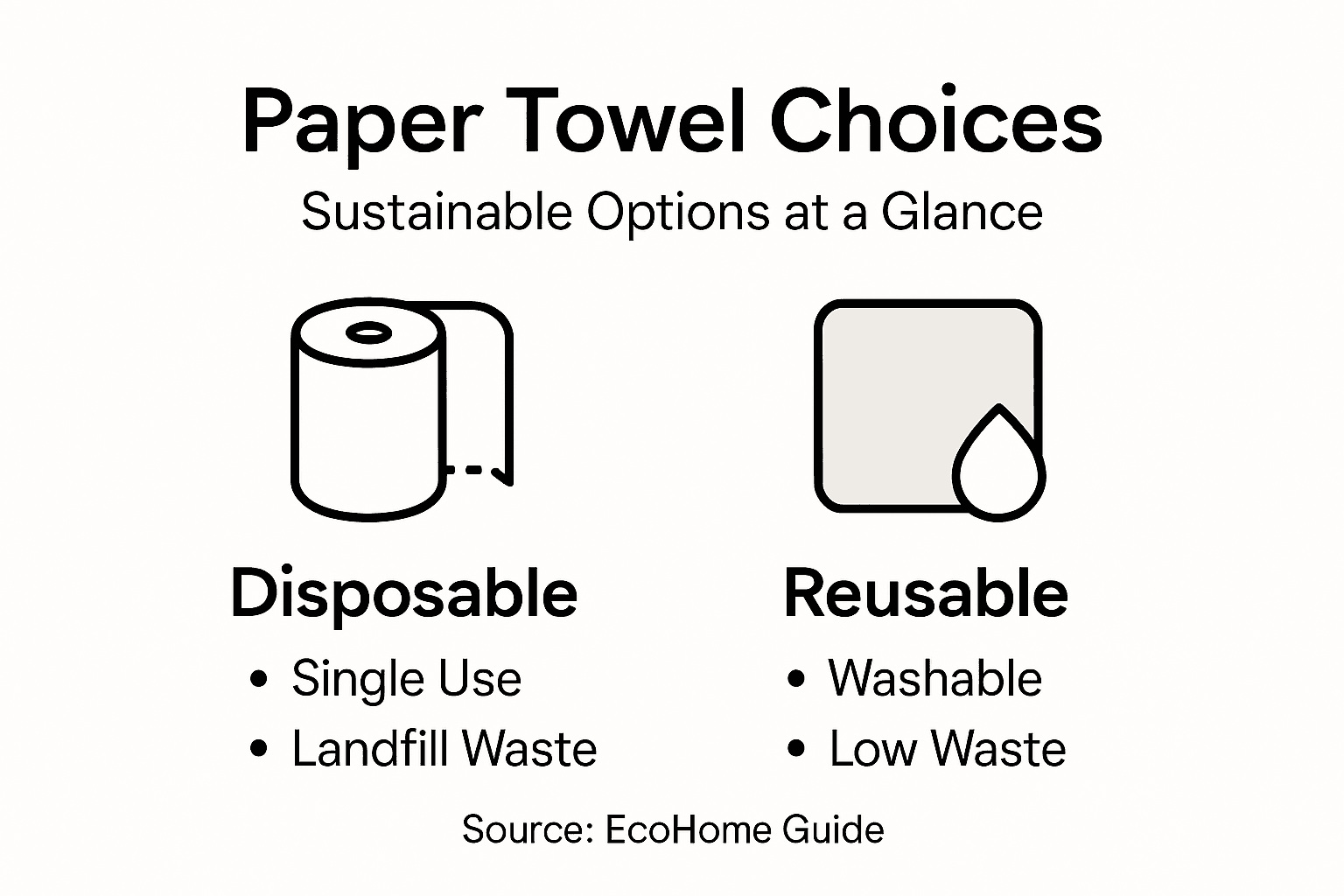
Review this summary of environmental performance for each towel option for informed decision-making:
| Towel Option | Waste Generation | Upfront Cost | Carbon Footprint | Maintenance Needs |
|---|---|---|---|---|
| Disposable | Highest | Lowest | Highest | None |
| Recycled Paper | Moderate | Slightly higher | Lower | None |
| Reusable Cloth | Lowest | Highest | Lowest over time | Regular washing required |
Sustainability is not about perfect choices, but about making progressively better decisions.
Comparing environmental performance across different towel types:
Pro tip: Conduct a personal waste audit to determine which paper towel option best matches your specific environmental and practical needs.
Sustainable paper towel workflows face multiple complex challenges that require strategic, multifaceted solutions. Waste management strategies are critical for transforming current consumption patterns and reducing environmental impact.
Common challenges in sustainable paper towel usage include:
Addressing these challenges requires a comprehensive approach that combines technological innovation, consumer education, and systemic policy changes. Waste reduction is not just about switching products but fundamentally reimagining our relationship with disposable materials.
Sustainable transformation happens one conscious choice at a time.
Practical waste reduction tips for individuals and organizations:
Pro tip: Track your monthly paper towel consumption to identify specific areas where you can reduce waste and make more sustainable choices.
If you are committed to reducing waste and embracing a truly sustainable paper towel workflow at home or in your business, Cozee Bay has the perfect eco-friendly solutions crafted just for you. The article highlights challenges such as minimizing consumption and choosing renewable, biodegradable materials. Our Cozee Bay Paper Towel Dispenser with Adapter and Top Lid is made from fast-growing bamboo wood and designed to complement any environment while helping you reduce plastic waste. It aligns perfectly with the article’s emphasis on cutting carbon footprints and optimizing material use.

Take the next step to transform your everyday paper towel use into a sustainable practice. Explore our curated Commercial Paper Towel Dispensers | Cozee Bay® for durable, stylish, and environmentally conscious options trusted in restaurants, schools, and offices. Visit Cozee Bay now for premium bamboo products that blend function and eco-consciousness seamlessly. Act now to make sustainable choices easier and more beautiful in your space.
A sustainable paper towel workflow is a systematic approach to managing paper towel production, consumption, and disposal in an environmentally responsible way, focusing on reducing waste, conserving resources, and supporting ecological balance.
The key components include raw material selection, manufacturing efficiency, usage optimization, and effective waste management strategies like recycling and composting.
Bamboo dispensers are made from a rapidly renewable resource that requires minimal water and land to produce. They are biodegradable, have lower carbon emissions, and generally offer a longer lifespan than plastic alternatives.
Disposable towels generate the most waste and have the highest long-term environmental impact. Recycled paper towels reduce raw material consumption and have a lower carbon footprint. Reusable towels create the least waste over time but require regular maintenance and a higher initial investment.
Comments will be approved before showing up.