Your Cart is Empty

TL;DR:
- Bamboo fabric’s environmental impact depends more on its manufacturing process than on the plant itself, with chemical treatments often reducing its eco-friendliness. Consumers should verify fiber types, certifications, and brand transparency to ensure sustainable and safe bamboo products. Understanding these factors empowers eco-conscious choices for home, business, and personal use.
Bamboo fabric has earned a devoted following among eco-conscious consumers, and the advantages of bamboo fabric are real. But here’s what most shoppers don’t realize: the sustainability story depends far less on the bamboo plant itself and far more on how that plant becomes a shirt, sheet, or towel. Many buyers assume bamboo products are automatically green and antibacterial, when the manufacturing process can tell a very different story. This guide cuts through the marketing noise to show you exactly what bamboo fabric is, what it genuinely delivers, and how to buy it with confidence.
Before weighing bamboo fibre benefits, you need to understand what you’re actually buying. The soft, silky material labeled “bamboo fabric” in stores is almost never a direct extraction from bamboo stalks. Instead, it is most often a regenerated cellulose fiber, meaning bamboo pulp is dissolved using chemicals and then reformed into fiber threads. This process is chemically similar to how conventional rayon or viscose is made.
There are three main types of bamboo fabric on the market today:
The fiber type you end up with shapes the environmental impact more than the bamboo plant’s impressive growing credentials. Understanding these differences is your first step, and our eco-friendly bamboo explained guide goes deeper if you want to build on this foundation.
Now that we understand what bamboo fabric is, let’s explore the key advantages that make it appealing.
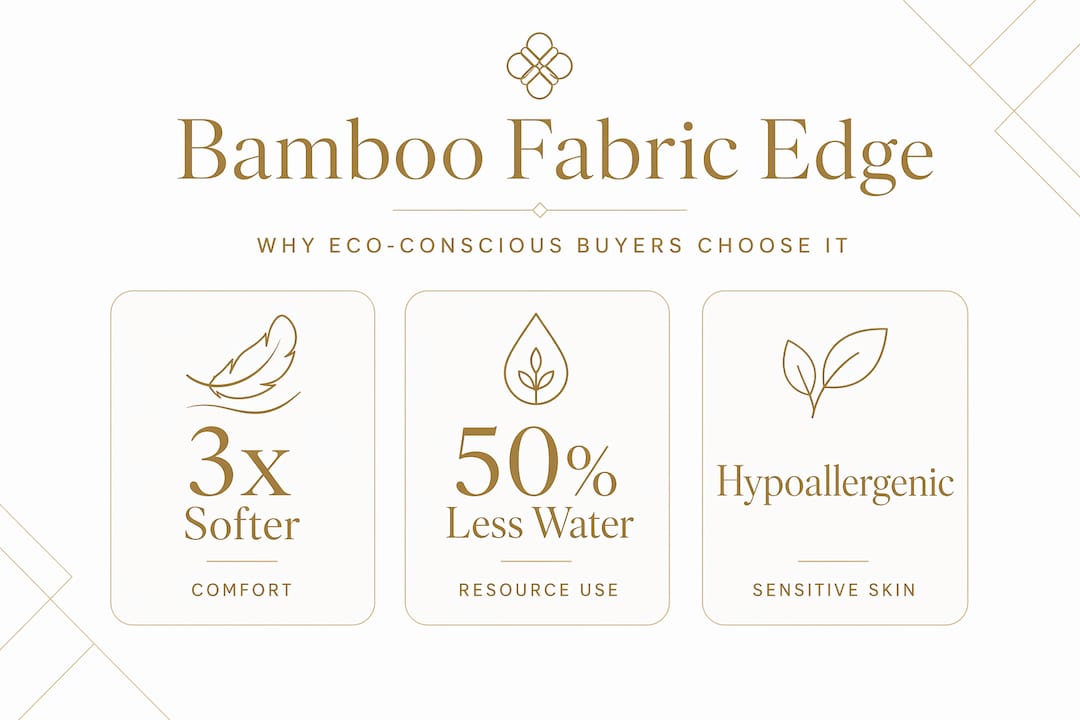
Beyond understanding what bamboo fabric is, let’s explore its practical, everyday advantages. Whether you’re outfitting a hotel, a senior living center, or your own bedroom, these bamboo fabric benefits translate directly into comfort and usability.
The consumer-facing performance advantages of bamboo fabric are genuinely impressive, and they hold up across a wide range of applications:
Pro Tip: If you’re shopping for children’s clothing or bedding for someone with sensitive skin, bamboo viscose is widely regarded as a hypoallergenic choice. Its smooth fibers are far less likely to irritate than rougher natural fibers like wool or untreated cotton.
Having seen bamboo fabric’s benefits, it is crucial to understand the environmental trade-offs behind those fibers.
Bamboo the plant is genuinely impressive from an environmental standpoint. It grows extraordinarily fast (some species add several feet per day), requires no pesticides in most growing conditions, uses far less water than cotton, and sequesters carbon efficiently. It also regenerates from its own root system without replanting. These are real advantages of organic bamboo cultivation that no one disputes.
The manufacturing stage is where the picture gets complicated. The environmental impact depends entirely on the processing method: conventional viscose introduces significant chemical pollution, while lyocell uses closed-loop recovery to reduce impacts dramatically.
Conventional viscose processing can use toxic chemicals, including carbon disulfide, which is harmful to workers and can contaminate water supplies when waste management is inadequate. Bamboo lyocell, by contrast, recycles the vast majority of its solvents, resulting in a dramatically smaller chemical footprint.
| Factor | Bamboo cultivation | Conventional viscose processing | Bamboo lyocell processing |
|---|---|---|---|
| Water use | Very low | Moderate to high | Low |
| Chemical inputs | None (no pesticides) | High (toxic solvents) | Low (recycled solvents) |
| Carbon sequestration | Strong | Neutral (post-harvest) | Neutral |
| Waste/pollution risk | Minimal | Significant if unmanaged | Minimal |
| Certification availability | Organic farming certs | OEKO-TEX for finished goods | OEKO-TEX, Tencel-type certs |
Third-party certification programs like OEKO-TEX Standard 100 test finished textiles for harmful chemical residues. Seeing this label on a finished bamboo product gives you real assurance that whatever processing was used, the end result is safe for your skin and less burdensome on the environment. Our eco-friendly bamboo processing guide breaks down exactly what these certifications cover.
In addition to sustainability and comfort, it’s important to approach certain bamboo claims with cautious awareness.
One of the most frequently repeated selling points for bamboo fabric is its natural antibacterial property. This claim originates from a real compound called bamboo kun, a naturally occurring bio-agent found in the living bamboo plant. The problem? Chemical processing often destroys bamboo’s natural bioactive properties, meaning antibacterial claims require product testing and verification rather than relying solely on plant origin.
Here’s what that means for you as a buyer:
Pro Tip: When researching bamboo clothing advantages for your business or home, skip past the front-page marketing and go straight to the product specifications or certifications tab. That’s where the verifiable information lives.
Finally, let’s look at how to apply this knowledge to make smarter, greener bamboo fabric purchases.
Knowing why choose bamboo fabric is only half the job. The other half is knowing how to choose it well. Follow these steps every time you evaluate a bamboo textile purchase:
| Verification step | What to look for | Why it matters |
|---|---|---|
| Fiber label | “Viscose/rayon” vs “lyocell” vs “linen” | Tells you the processing route |
| Certifications | OEKO-TEX Standard 100 | Confirms chemical safety |
| Brand transparency | Closed-loop vs open-loop disclosure | Separates green claims from greenwashing |
| Performance data | Lab-tested UPF, moisture wicking, odor control | Verifies product-specific claims |
| Price point | Higher cost often signals cleaner processing | Lyocell costs more to produce |
For deeper guidance on sourcing, our resource on ethically sourced bamboo choices walks through exactly what to look for from suppliers committed to responsible manufacturing.
Here’s the thing most bamboo fabric marketing doesn’t want you to sit with too long: the bamboo plant is not the product. The fabric is the product. And the journey from fast-growing grass to soft bedsheet involves steps that can either protect the environment or quietly undermine it.
The real advantage for eco-conscious consumers is the ability to verify the process, choosing brands that prove closed-loop chemistry and rigorous certification rather than relying on bamboo plant claims alone. Buying a bamboo-labeled product without checking the processing method is roughly like buying “organic” produce without checking whether it’s certified. The label gestures toward a value without guaranteeing it.
We’ve seen this pattern come up repeatedly, especially in hospitality and commercial purchasing where buyers order bedding or uniforms in volume. A restaurant outfitting 200 staff members in “bamboo” aprons, for example, has a far larger environmental footprint than they think if those aprons are standard viscose from a facility with no closed-loop processing. The math changes fast at scale.
The encouraging news is that the tools to make genuinely better decisions are right there in front of you. Fiber labels, OEKO-TEX certification, and supply chain transparency disclosures are all accessible to any buyer willing to spend five extra minutes on due diligence. Brands that do the right thing tend to talk about it openly because it costs them more and they want credit for it. If a brand is quiet about how their bamboo becomes fabric, that silence is telling.
Pro Tip: When evaluating a supplier or brand for your business, ask directly: “Can you share your fiber processing documentation and certifications?” A trustworthy brand answers immediately. An evasive answer tells you everything you need to know.
With this perspective in mind, you’re better equipped to confidently choose bamboo fabrics that align with your values.
Now that you know what to look for, discover how Cozee Bay supports your sustainable living journey. At Cozee Bay, we believe eco-conscious shopping shouldn’t require a chemistry degree. Our curated selection of bamboo products emphasizes real transparency, from clear fiber content labeling to verified certifications that confirm what’s actually in what you’re buying.
Whether you’re upgrading your home, stocking a coffee shop, or outfitting a senior living center, Cozee Bay’s bamboo offerings are built around the same values you just read about: honest materials, responsible sourcing, and products that genuinely deliver on their promises. Browse our collection and use our blog resources to keep building your knowledge about bamboo fabric benefits, care, and sustainability. Your next eco-conscious purchase just got a lot easier to make with confidence.
No, bamboo fabric’s eco-friendliness depends on how it’s processed; conventional viscose pollutes significantly while closed-loop lyocell dramatically reduces chemical impact. Always check the fiber type and certifications before assuming a bamboo product is green.
Not reliably, because chemical processing destroys bamboo’s natural antibacterial compound, bamboo kun. Look for lab-verified testing or third-party certifications before trusting antibacterial claims on any bamboo textile.
OEKO-TEX Standard 100 is the most widely recognized label, confirming that a finished bamboo textile meets chemical safety standards and is free from harmful residues. It doesn’t certify the entire production process but is a strong starting point for safety assurance.
Check the product label for exact fiber terminology such as “viscose from bamboo” versus “bamboo lyocell,” and look for OEKO-TEX certification verification on finished goods. Brands committed to sustainability make this information easy to find without you having to dig.
Comments will be approved before showing up.