Your Cart is Empty


TL;DR:
- Organizing a cutlery drawer improves efficiency by decluttering and properly grouping utensils based on usage. Choosing the right size, material, and layout for the organizer ensures stability and ease of maintenance. Regular quick tidies and periodic reassessment keep the system functional and effortless to sustain.
If you’ve ever yanked open your kitchen drawer looking for a fork and found a tangled mess of spoons, mystery gadgets, and that one rogue spatula that belongs somewhere else entirely, you already know how to arrange a cutlery drawer matters more than most people think. A disorganized drawer doesn’t just look bad. It slows you down, frustrates your cooking flow, and makes every meal prep feel harder than it needs to be. This guide walks you through the exact steps to declutter, organize, and maintain a cutlery drawer that actually works for your kitchen and your life.
| Point | Details |
|---|---|
| Declutter before organizing | Up to 50% of kitchen drawer items are rarely used, so remove them before choosing an organizer. |
| Measure your drawer first | Accurate length, width, and depth measurements prevent wasted money on ill-fitting trays. |
| Match organizer type to your needs | Bamboo, plastic, metal, and acrylic organizers each suit different drawer sizes, budgets, and styles. |
| Group by frequency of use | Place everyday cutlery in the most accessible spots and specialty tools in secondary compartments. |
| Maintain with a simple routine | A 30-second daily tidy and a quarterly declutter keep your system working long-term. |
Before you buy a single tray or sort a single spoon, you need to empty everything out. Pull the drawer completely and dump the contents on your counter. You’ll probably find things you forgot you owned, rubber bands, a pen cap, and at least one piece of cutlery you haven’t used in two years.
Studies show that up to 50% of kitchen clutter is made up of items that are rarely or never used. That statistic hits differently when you’re staring at your counter piled high with random kitchen knick-knacks. The goal here is not to reorganize the clutter. It’s to get rid of what doesn’t belong.
Follow these steps to prepare your drawer properly:
When it comes to getting kitchen drawers organized efficiently, the prep work is always where the real gains happen. Most people skip it and go straight to buying an organizer, which is why they end up rearranging the same clutter into a slightly more expensive drawer tray.
Pro Tip: Be ruthless during your declutter. If you haven’t used it in six months and it’s not seasonal, it doesn’t earn a spot in the main drawer. Give it away or box it.
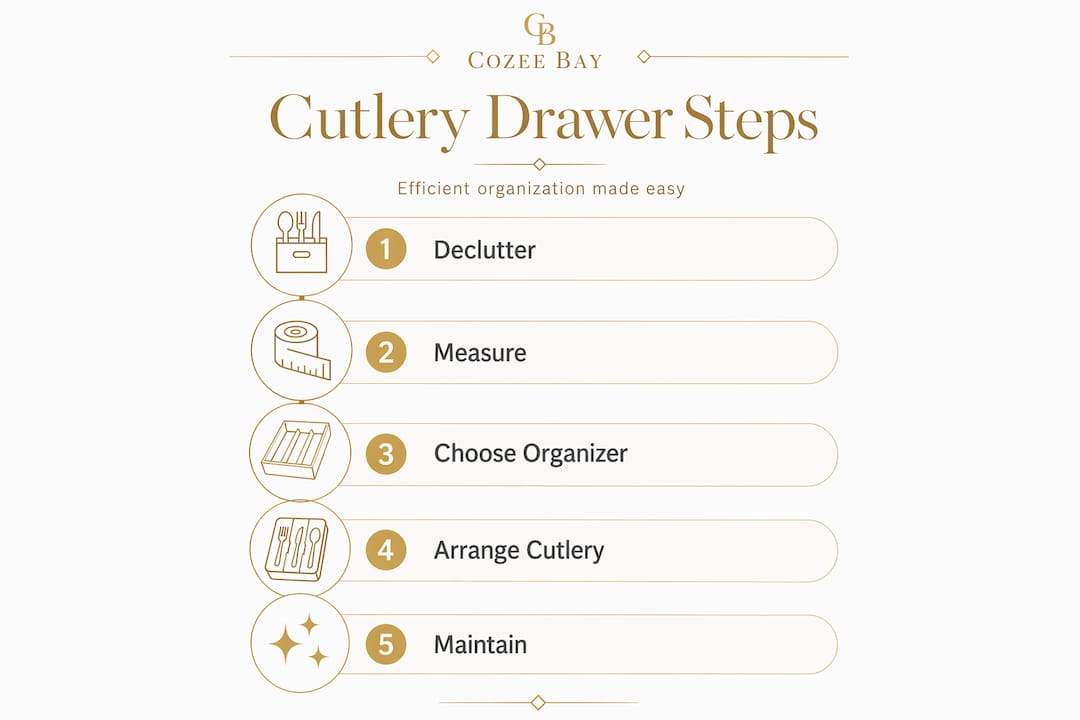
Now that you know your drawer’s exact measurements and what you’re storing, you can choose an organizer that actually fits. This is where most people spend money on the wrong thing.
Here’s a quick comparison of the four most common types:
| Organizer type | Material | Best for | Price range | Drawback |
|---|---|---|---|---|
| Standard plastic tray | Plastic | Small budgets, rental kitchens | $10-$20 | Slides around, looks cheap |
| Bamboo tray | Natural bamboo | Eco-conscious buyers, style-forward kitchens | $20-$45 | Fixed compartment sizes |
| Expandable metal | Stainless steel | Odd-sized or wide drawers | $25-$50 | Can feel cold or industrial |
| Custom acrylic insert | Acrylic | Luxury kitchens, specific layouts | $50-$120+ | Expensive, inflexible |
Expandable bamboo organizers typically run between $30 and $45 and offer the best combination of durability, aesthetic warmth, and compartment flexibility. They’re a particularly good choice if you have an irregular drawer width, because you can adjust the organizer to span the full interior without leaving awkward gaps.
A few things to look for when shopping:
Pro Tip: Always buy an organizer that fits snugly side-to-side. Lateral movement is what causes shifting and noise. A friction fit matters more than a perfect compartment layout.
Here’s where most guides stop at “put forks on the left, spoons in the middle, knives on the right.” That works, but it’s only one approach, and it may not be the right one for your household. The best arrangement is the one your whole household will actually maintain, not the one that looks best in a photo.
For deep or narrow drawers, the standard flat tray approach can waste enormous amounts of vertical space. Two-level drawer systems with inner drawers maximize that depth by separating everyday cutlery on top from less-used items stored below. You can pull out the top layer and instantly access the second tier without digging.
For narrow drawers specifically, vertical dividers and magnetic strips work better than traditional compartments. A magnetic knife strip mounted inside a deep drawer keeps blades protected and off the floor of the drawer entirely, freeing up horizontal space for spoons and forks.

Non-slip liners and silicone containers also make a real difference for both stability and noise. If your drawer rattles every time someone opens it, you’ll either tolerate the noise or stop using the system. A simple rubber liner beneath the tray fixes both problems at once.
Pro Tip: Consistency in cutlery placement builds muscle memory. Once every household member knows where the teaspoons live without looking, your kitchen workflow speeds up noticeably.
Getting the drawer organized is the easy part. Keeping it that way is where most people fall short. The good news is that maintenance doesn’t require much if you build the right habits from the start.
The key insight here is that effective storage only works if every person in the household commits to returning items properly. A beautiful system that only one person maintains will unravel within a week. Make it simple enough that anyone in the kitchen can follow it without thinking.
Pro Tip: Take a photo of your fully organized drawer when it looks exactly how you want it. Pin it inside a cabinet nearby. When the drawer drifts, that photo is your reset target.
Even a well-planned drawer runs into issues. Here’s how to handle the most frequent ones without tearing everything apart and starting over.
If you’re organizing a silverware drawer that sees heavy traffic from multiple people daily, simplicity wins every time. The more intuitive the system, the less maintenance it demands.
I’ll be direct: most people overthink this. They spend hours watching organization videos, buy three different trays, and end up with a drawer that looks great for two weeks before reverting to chaos.
What I’ve learned is that simplicity and ease of maintenance always beat aesthetic perfection. A bamboo tray with five compartments that every person in your household actually uses correctly will outperform a custom acrylic insert that only one person understands. Every time.
The other thing I’d push back on is the idea that there’s one “correct” way to place cutlery. Arrangement is personal. If your household grabs dessert spoons five times a day and dinner forks once, put the dessert spoons in the front slot. Mirror your actual habits, not a formal table-setting diagram you found online.
I’ve also seen people position their cutlery drawer across the kitchen from the dishwasher, then wonder why unloading feels like such a chore. Drawer placement near the dishwasher and dining area genuinely reduces steps and effort. It’s one of those small decisions with a surprisingly large payoff.
The goal is a drawer that runs itself. When the system is simple enough, maintenance becomes automatic. That’s when you know you’ve got it right.
— Cozee

If you’re ready to put these tips into practice, the right organizer makes all the difference. At Cozee-bay, our handcrafted bamboo drawer organizers are built for real kitchens. They’re sized for a range of drawer dimensions, expandable to fit irregular spaces, and made from sustainably sourced bamboo that holds up to daily use without warping or cracking.
We know that a kitchen organizer needs to be as functional as it is beautiful. That’s why every Cozee-bay product combines natural warmth with practical design. Whether you’re setting up your first organized drawer or upgrading an existing system, our bamboo drawer organizers are a choice you won’t second-guess. Free shipping within the contiguous U.S. and a money-back guarantee mean you can order with confidence.
Start by decluttering aggressively, since up to 50% of drawer items are rarely used. Then choose a compact expandable bamboo tray that fits the full width of your drawer, and limit stored cutlery to your most-used pieces only.
Group cutlery by type in dedicated compartments, place the most frequently used pieces closest to the front, and use a non-slip liner to keep the organizer stable. Consistency in placement builds the muscle memory that makes your kitchen routine faster.
Place a rubber non-slip liner beneath the tray, or choose an expandable organizer that fits snugly against the drawer walls. Non-slip liners and silicone containers also reduce rattling noise when the drawer opens and closes.
Yes. Two-level drawer systems with inner drawers use vertical depth effectively by keeping everyday cutlery on top and less-used items stored below. This approach prevents the bottom of deep drawers from becoming a forgotten dumping zone.
A quick 30-second tidy daily and a monthly tray clean are enough for regular upkeep. A full reassessment of what belongs in the drawer every three months keeps the system current as your cooking habits and utensil collection change.
Comments will be approved before showing up.