Your Cart is Empty


Sustainable packaging is packaging designed to protect its product while minimizing environmental harm across its entire lifecycle, from sourcing to disposal. It usually takes the form of recycled, compostable, or reusable materials engineered to use less of everything, less plastic, less energy, less waste. For businesses, that translates to lower costs and stronger customer loyalty; for consumers, it means fewer guilty feelings at the trash can.
TL;DR:
- Reducing material volume and weight should precede material switching because it often delivers faster cost savings and lower environmental impact.
- Life cycle assessments are essential to accurately compare the environmental footprint of packaging options, considering transport, disposal, and local recycling infrastructure.
- Clear labeling, such as specifying industrial versus home compostability, is vital to prevent contamination that can undermine recycling and composting systems.
- The most sustainable material choice depends heavily on local recycling and composting infrastructure and the specific use case or product function.
- Implementing measurable goals, starting with small pilots, and monitoring performance are key steps to building an effective, sustainable packaging program.
Sustainable packaging isn’t a material. It’s a system of decisions, from what a box is made of to how a customer disposes of it. Every choice, the fiber source, the ink, the adhesive, the shipping weight, adds up across the product’s full life, and that’s the piece most companies skip when they slap a green leaf on a label.
Packaging always has a job to do first: keep food safe, protect glass from breaking, survive a five-day truck ride. Sustainability has to work within those functional limits, not override them. A fully recyclable box that lets your product arrive crushed isn’t sustainable. It’s a return you’ll have to ship again.
Context changes the right answer, too. A lightweight plastic pouch might beat a heavier glass jar on carbon footprint if it survives transport with fewer losses, but only if your region actually recycles that plastic. This is where the EPA’s Sustainable Materials Management framework comes in: it pushes companies to evaluate packaging across its whole lifecycle rather than judging a single material in isolation. Life cycle assessment, or LCA, is the tool that makes those comparisons rigorous instead of guesswork.
The Sustainable Packaging Coalition built a framework worth borrowing even if you’re not writing corporate sustainability reports. It boils down to five checkpoints: a systems approach that looks past one box to the whole supply chain, material health (nothing toxic leaching into food or soil), accessibility for the infrastructure your customers actually have, reduction of material weight and volume, and life-cycle thinking at every design stage.

The prioritization underneath it matters more than the acronym: reduce first, reuse second, recycle third, and only then consider recovery methods like composting or incineration. Skipping straight to “recyclable” without asking whether you could simply use less material is the most common mistake we see. Practical application means checking who actually has access to composting or recycling near your customers, not just what’s technically possible in a lab.
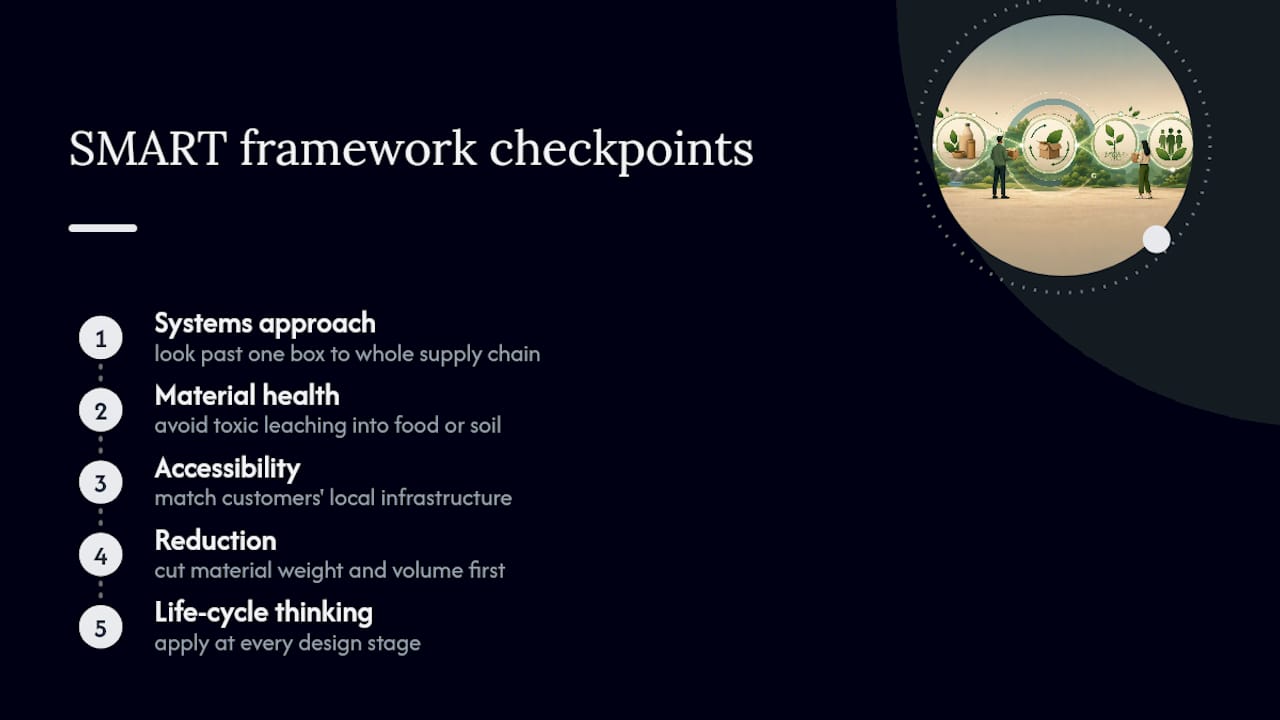
No single material wins across every use case. What counts as sustainable packaging depends on function, local infrastructure, and how the item ends its life.
The demand for these options is real and growing. As of 2025, 73% of consumers say they’re willing to pay more for products in sustainable packaging, and over 60% of Gen Z and Millennial shoppers say packaging influences what they buy.
An LCA measures a package’s environmental footprint from raw material extraction through manufacturing, transport, use, and disposal. It typically tracks greenhouse gas emissions, water consumption, toxicity, and resource depletion, then assigns each option a comparable score instead of a gut feeling.

This is where intuition often gets it backward. A heavier glass bottle might feel more “natural” than plastic, but if it requires double the transport fuel and breaks more often in shipping, a lightweight recycled plastic bottle can post a smaller lifecycle footprint depending on your specific supply chain and end-of-life infrastructure. That’s not a universal rule. It’s exactly why LCA exists instead of a simple ranked list of “good” and “bad” materials.
Before rolling out a packaging change at scale, ask suppliers for their LCA data or a third-party study. Redesign efforts like bottle lightweighting have delivered measurable material and cost savings in applied research, but only when backed by real numbers, not marketing copy.
These terms get used interchangeably, and that’s where good intentions go to landfill. Recyclable means a material can be reprocessed into new material through an established stream. Industrial compostable means it breaks down under high heat and controlled conditions found only at commercial facilities. Home compostable is a stricter standard that works in your backyard bin. Biodegradable just means it eventually breaks down, with no timeline or environmental condition guaranteed. Reusable means multiple use cycles before disposal at all.
Mixing these up causes real damage. A compostable clamshell tossed into a recycling bin can contaminate an entire batch of recyclables, and industry guidance on packaging logistics flags this contamination risk as one of the most common failures in sustainable packaging programs.
The business case isn’t theoretical anymore. That same consumer research shows 73% of shoppers will pay a premium for sustainable packaging, which directly affects margin and shelf placement, not just brand image.
Operationally, lightweighting and right-sizing reduce shipping costs and cut damage-related returns, since packaging that fits the product tightly survives transit better than an oversized box padded with air. Retailers increasingly require sustainability documentation before granting shelf space, and regulatory pressure on single-use plastics keeps expanding across jurisdictions. Companies that adapt early build supply-chain resilience instead of scrambling when a new rule lands. Restaurants and hospitality businesses in particular see measurable operational gains from switching early, both in cost and customer perception.
Moving from “we should probably do something” to a working sustainable packaging program takes a sequence, not a single swap.
Pro Tip: Start with a small pilot on your highest-volume SKU rather than redesigning your entire line at once. Right-sizing that single product often pays for itself within a few months in reduced shipping costs, giving you real data before you commit budget elsewhere.
Businesses weighing which materials to switch to first can find a practical breakdown in this eco-friendly packaging switching guide.
Certifications exist because “eco-friendly” on a label means nothing without proof behind it. FSC certification confirms fiber comes from responsibly managed forests, which matters if your packaging uses any paper or cardboard at all. Recognized compostability standards confirm a material actually breaks down under stated conditions, not just in theory.
Before you make a claim, request the documentation: certification numbers, LCA summaries, and any third-party test results your supplier can provide. A short internal checklist helps: does the claim specify a condition (industrial compost, not “biodegradable” alone)? Is it backed by a document you could show a regulator? If not, soften the language or skip the claim entirely.
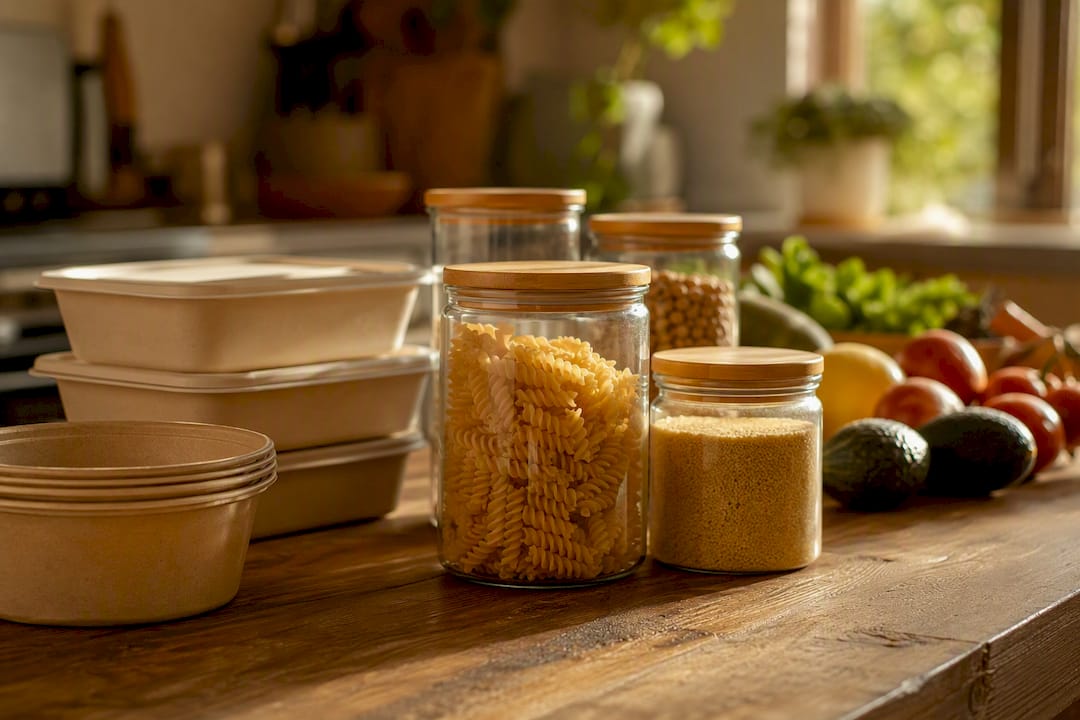
Food packaging carries the tightest constraints. Barrier requirements for moisture and oxygen often rule out fully compostable options unless a coating solves the food-safety problem, though compostable containers work well for takeout where contamination risk is lower.
Fashion and retail brands increasingly use branded reusable mailers and refill systems, cutting packaging volume per repeat purchase rather than chasing a single “green” material.
Shipping and direct-to-consumer businesses get the fastest wins from right-sizing boxes and switching to paper-based cushioning instead of plastic air pillows, alongside returnable mailer programs for repeat customers. The checklist for choosing eco-friendly products applies across all three, adjusted for each sector’s constraints.
We built Cozee-bay around bamboo for a reason: it’s a fast-renewing material that holds up in demanding commercial settings, restaurants, schools, churches, coffee shops, and senior living centers, without relying on virgin plastic. Our paper towel dispensers and organizers get evaluated the same way we’d ask any packaging designer to evaluate their materials: does it perform its function well, and does it minimize impact across its life?
We’ve written more on the practical side of this at our biodegradable packaging resource, and coffee and food brands weighing similar fiber sourcing decisions may find this sustainable packaging checklist from our partners at The Moustache Coffee Club useful too. If you’re curious where bamboo fits into your own space, our full catalog is worth a look.
— Cozee
Comments will be approved before showing up.