Your Cart is Empty

Bamboo is everywhere right now, from kitchen countertops to drawer organizers, and nearly every product claims to be “eco-friendly.” But here’s something that trips up even the most careful shoppers: bamboo is technically a grass, not a tree, yet it can carry the same FSC certification you’d find on sustainably harvested timber. That gap between what the label says and what it actually means leaves a lot of eco-conscious buyers guessing. This guide breaks down exactly what FSC certified bamboo means, how the certification process works, why it matters for your home or business, and how to spot the real thing from the greenwashing noise.
| Point | Details |
|---|---|
| Clear FSC definition | FSC certified bamboo means the product meets responsible sourcing standards verified by an independent chain of custody. |
| Certification matters | FSC certification is currently the best way to ensure the bamboo you buy truly supports environmental and ethical goals. |
| Spotting real claims | Genuine FSC products display the official FSC label, and certification can be verified online. |
| Application advice | Look for brands that provide traceable sourcing and supply chain transparency for bamboo goods. |
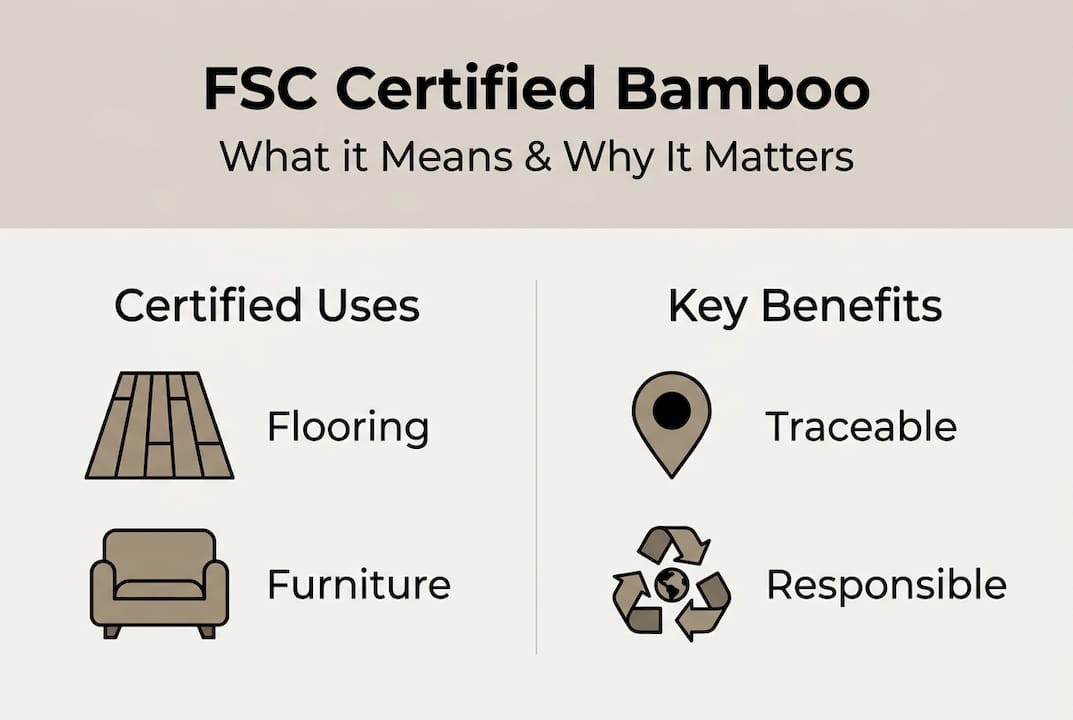
FSC stands for Forest Stewardship Council, an international nonprofit that sets standards for responsible forest management. Most people associate FSC with timber, but the certification goes further than that. Bamboo, despite being a grass, qualifies as a non-timber forest product (NTFP) under FSC rules and is fully eligible for certification. That distinction matters because it means bamboo products can carry the same credible, third-party verified sustainability claims as wood products.
So what does “FSC certified bamboo” actually mean for a product you’re holding in your hand? It means the bamboo was sourced from a project that met FSC’s environmental, social, and economic standards, and that every step of the supply chain was documented and audited. Nothing slips through undocumented.
Here’s a quick look at the types of bamboo products that can earn FSC certification:
| Product category | FSC eligible? | Common use |
|---|---|---|
| Natural bamboo poles | Yes | Construction, crafts |
| Bamboo plywood | Yes | Furniture, flooring |
| Bamboo flooring | Yes | Residential, commercial |
| Bamboo textiles | Yes | Apparel, home linens |
| Bamboo kitchenware | Yes | Home, restaurant use |
In 2026, the first FSC-certified bamboo project in Malaysia set a new benchmark, proving that community-based bamboo sourcing can meet rigorous international standards. That milestone signals a growing movement toward traceable, certified bamboo across global supply chains. If you’re already making sustainable choices for eco homes, understanding this certification is the next logical step. And if you’re still on the fence about choosing bamboo products in general, certified options give you a much stronger foundation for confidence.
To truly understand FSC certified bamboo, it’s helpful to see how the certification process unfolds from start to finish. It’s more involved than slapping a label on a box, and that’s exactly the point.
Here’s how a bamboo product earns its FSC certification:
One real-world example worth noting: Plyboo became the first FSC-certified bamboo plywood brand, and in 2026, a Malaysian community project achieved FSC certification through a group model, making the process more accessible for smaller operations.
| Certification type | Best for | Key advantage |
|---|---|---|
| Individual CoC | Large manufacturers | Full control over documentation |
| Group CoC | Small businesses, co-ops | Shared auditing costs, easier access |
For businesses sourcing commercial grade bamboo, understanding whether your supplier holds a valid CoC certificate is non-negotiable. Without it, any FSC claim on the final product is invalid.
Pro Tip: Ask your bamboo supplier for their FSC certificate number before placing a bulk order. You can verify it instantly using FSC’s public database, and it takes less than two minutes.
With the certification steps clear, let’s look at why FSC certification matters for the environmental and social outcomes of bamboo products. The benefits go well beyond a marketing badge.
Environmental benefits:
Social and economic benefits:
As one industry account puts it, FSC certification is imperfect but the best available system for ensuring traceable, responsibly sourced bamboo, even as auditing challenges and monoculture risks remain real concerns.
“FSC addresses sourcing but not the full lifecycle. It combats greenwashing when used properly, but buyers should still ask questions about processing methods.”
That’s an honest take. FSC does not cover what happens after the bamboo leaves the certified supply chain, meaning chemical processing for textiles or finishes applied to furniture falls outside its scope. Still, for why choose bamboo home products decisions, FSC certification is the strongest signal of responsible sourcing available today.
The benefits of bamboo for homes are well documented, from durability to natural aesthetics. Pairing those inherent advantages with FSC certification means you’re getting a product that’s good for your space and for the planet.

Once you understand the benefits, it’s important to ensure you’re actually getting genuine FSC certified bamboo. Here’s how to make the smartest sustainable choices without getting tripped up by vague eco-labels.
For practical inspiration, browsing top bamboo products for home gives you a solid starting point for comparing certified options across categories. You can also explore food bag organizers and other household items where certified bamboo makes a real difference. And if you want a broader view of what responsible sourcing looks like in practice, sustainable bamboo product examples is worth a read.
Pro Tip: Beware of terms like “natural bamboo,” “eco bamboo,” or “green certified” without a specific FSC number attached. These phrases have no standardized meaning and are often used to imply certification that doesn’t exist.
With all the facts in view, here’s a deeper perspective you won’t hear from just any eco-friendly brand.
A lot of people assume that any bamboo product is automatically a green choice. Bamboo grows fast, needs no pesticides, and regenerates without replanting. Those facts are real. But they don’t tell the whole story. Monoculture bamboo plantations can strip biodiversity just like any other industrial crop. Bamboo processed into viscose or rayon fabric involves heavy chemical treatments that offset many of the environmental gains. And without a certified supply chain, there’s no way to know where your bamboo actually came from or how it was handled.
FSC certification, while not flawless, is the strongest traceable system we have right now. It doesn’t cover every stage of a product’s life, but it does address the sourcing and supply chain in a way that sustainability can otherwise be undermined by monocultures or chemical processing. That’s a meaningful guarantee.
Our take: don’t just buy bamboo because it sounds green. Buy bamboo that can prove it. Look beyond the label, ask about the full lifecycle, and support brands that invest in handcrafted bamboo wood advantages and transparent sourcing. That’s how you make your purchasing power count.
Ready to put this knowledge into action? Ethically sourcing your bamboo products is easier than you think, especially when you know what to look for and where to start.
At Cozee Bay, we believe that beautiful, functional bamboo products should also be responsible ones. Whether you’re outfitting a home kitchen, a coffee shop, or a senior living center, our guides and product resources help you make smarter, greener choices with confidence. Explore our ethically sourced bamboo choices to find options that align with your values, your space, and your sustainability goals. The right bamboo product is out there, and now you have the knowledge to find it.
FSC certified bamboo includes natural bamboo poles, plywood, flooring, furniture, textiles, and household articles like kitchenware and organizers. If a product can be traced through a certified supply chain, it qualifies.
Yes, FSC certified bamboo is more responsibly sourced and traceable, meaning you can trust the environmental and social claims attached to it far more than uncertified alternatives.
Look for the official FSC logo on the packaging and verify the certificate code using the FSC certificate search tool at connect.fsc.org. It’s free and takes under two minutes.
FSC certification reduces greenwashing by requiring supply chain audits and documented sourcing, ensuring bamboo products meet genuine environmental and social responsibility standards.
No. Terms like “natural,” “eco,” or “green” on bamboo packaging carry no standardized meaning. Only products displaying the official FSC trademark with a verifiable certificate number can legitimately claim FSC certification.
Comments will be approved before showing up.