Your Cart is Empty


Most people know bamboo grows fast, but few realize that certain commercial grade bamboo products possess tensile strength greater than steel. This surprising fact challenges common assumptions about bamboo as merely decorative or suitable only for light residential use. Commercial grade bamboo represents a category of high-performance, sustainably sourced bamboo engineered for demanding applications in restaurants, offices, schools, and other high-traffic commercial environments. Understanding what distinguishes commercial grade bamboo from standard residential varieties empowers eco-conscious business owners and property managers to make informed decisions about durable, sustainable materials that align with both environmental values and practical performance requirements.
| Point | Details |
|---|---|
| High strength advantage | Commercial grade bamboo can exceed steel in tensile strength when properly processed, enabling demanding applications. |
| No universal grading | There is no single standard for commercial bamboo, so buyers must verify performance data and rely on certifications and manufacturer specifications. |
| Important certifications | Certifications such as FSC and CARB Phase 2 help ensure quality and sustainability in bamboo products. |
| Manufacturing boosts performance | Strand weaving and controlled kiln drying improve hardness, moisture resistance, and overall durability of commercial grade bamboo. |
Commercial grade bamboo refers to high-quality bamboo products engineered for durability in high-traffic commercial applications, such as strand-woven flooring, solid Tam Vong poles, or structural Guadua and Tre-Gai species. Unlike residential bamboo products designed for moderate home use, commercial grade varieties undergo specialized processing and selection to meet demanding performance standards in restaurants, retail spaces, offices, and public buildings.
Several species excel in commercial applications. Tam Vong, Guadua, and Tre-Gai provide exceptional structural integrity for poles and beams. Moso bamboo (Phyllostachys edulis) dominates the flooring market due to its rapid growth cycle and excellent processing characteristics. Strand-woven bamboo, created by shredding bamboo fibers and compressing them under extreme heat and pressure with resins, achieves hardness ratings between 3000 and 5000 lbf on the Janka scale, far exceeding traditional hardwoods like red oak (1290 lbf) or even Brazilian cherry (2350 lbf).
Bamboo’s tensile strength can exceed 28,000 pounds per square inch, surpassing steel’s 23,000 psi, making properly processed commercial bamboo remarkably resilient under stress.
Key characteristics distinguish commercial grade bamboo from residential alternatives:
The absence of universal grading standards creates variability in the commercial bamboo market. Unlike hardwood flooring governed by National Wood Flooring Association standards, bamboo relies on manufacturer protocols and third-party certifications. This variability makes it essential for buyers to verify specific performance data rather than assume all products labeled “commercial grade” meet identical standards. Understanding these distinctions helps eco-conscious businesses select bamboo products that truly deliver on durability and sustainability promises.
Commercial grade bamboo production begins with harvesting mature culms at 4-7 years of age, when bamboo reaches optimal density and strength. Moso bamboo dominates commercial production due to its widespread cultivation and excellent mechanical properties. Harvesting at the correct maturity ensures maximum hardness and dimensional stability in finished products.
Manufacturing processes transform raw bamboo into commercial grade materials through several critical steps:
Certifications provide crucial quality assurance in the absence of universal grading standards. Forest Stewardship Council (FSC) certification verifies sustainable harvesting practices, responsible forest management, and chain-of-custody tracking from harvest to finished product. For eco-conscious buyers pursuing LEED credits or demonstrating environmental commitment, FSC certification offers third-party validation of sustainability claims.
CARB Phase 2 certification addresses formaldehyde emissions from adhesives used in manufacturing. California Air Resources Board Phase 2 standards limit formaldehyde to 0.05 parts per million for composite wood products, protecting indoor air quality in commercial spaces. Products meeting CARB Phase 2 standards ensure healthier environments for employees and customers.
Performance testing validates commercial grade claims through standardized methods. Janka hardness testing measures resistance to denting and wear by pressing a steel ball into the material surface. ASTM E648 evaluates critical radiant flux (fire spread rating), while ASTM E662 measures smoke density. Commercial grade bamboo typically achieves Class A fire ratings (flame spread 0-25) and low smoke development, meeting stringent commercial building codes.
Pro Tip: Request copies of actual test reports from independent laboratories rather than accepting manufacturer summaries. Verify that testing was performed on the specific product you’re purchasing, not just similar products from the same manufacturer.
Moisture control during manufacturing directly impacts long-term performance. Kiln-drying to 6-9% moisture content matches typical indoor commercial environments, minimizing expansion and contraction. Products installed in high-humidity areas like restaurants or near building entrances require additional moisture barriers and acclimation periods to prevent cupping or gapping. Understanding these manufacturing and certification processes helps buyers evaluate product quality and select appropriate bamboo for specific commercial applications, ensuring sustainable choices deliver expected performance.
Commercial buyers evaluating flooring and structural materials benefit from understanding how commercial grade bamboo compares to natural bamboo and traditional hardwood alternatives. Each material offers distinct advantages depending on application requirements, budget constraints, and sustainability priorities.
| Feature | Natural Bamboo | Commercial Grade Bamboo | Hardwood (Red Oak) |
|---|---|---|---|
| Janka Hardness | 1200-1800 lbf | 3000-5000 lbf | 1290 lbf |
| Durability Rating | Light commercial | Heavy commercial | Moderate commercial |
| Typical Cost per sq ft | $3-5 | $5-8 | $6-12 |
| Fire Rating | Class C | Class A/B | Class C |
| Appearance Consistency | High variation | Moderate variation | Excellent consistency |
| Warranty Period | 5-10 years | 15-30 years | 10-25 years |
Natural bamboo products, including horizontal and vertical grain flooring, suit protected indoor applications with moderate foot traffic. These products preserve bamboo’s natural appearance with visible nodes and grain patterns. However, natural bamboo performs poorly in high-abuse environments or areas with moisture exposure. Restaurants, retail stores, and building lobbies typically exceed natural bamboo’s durability threshold.
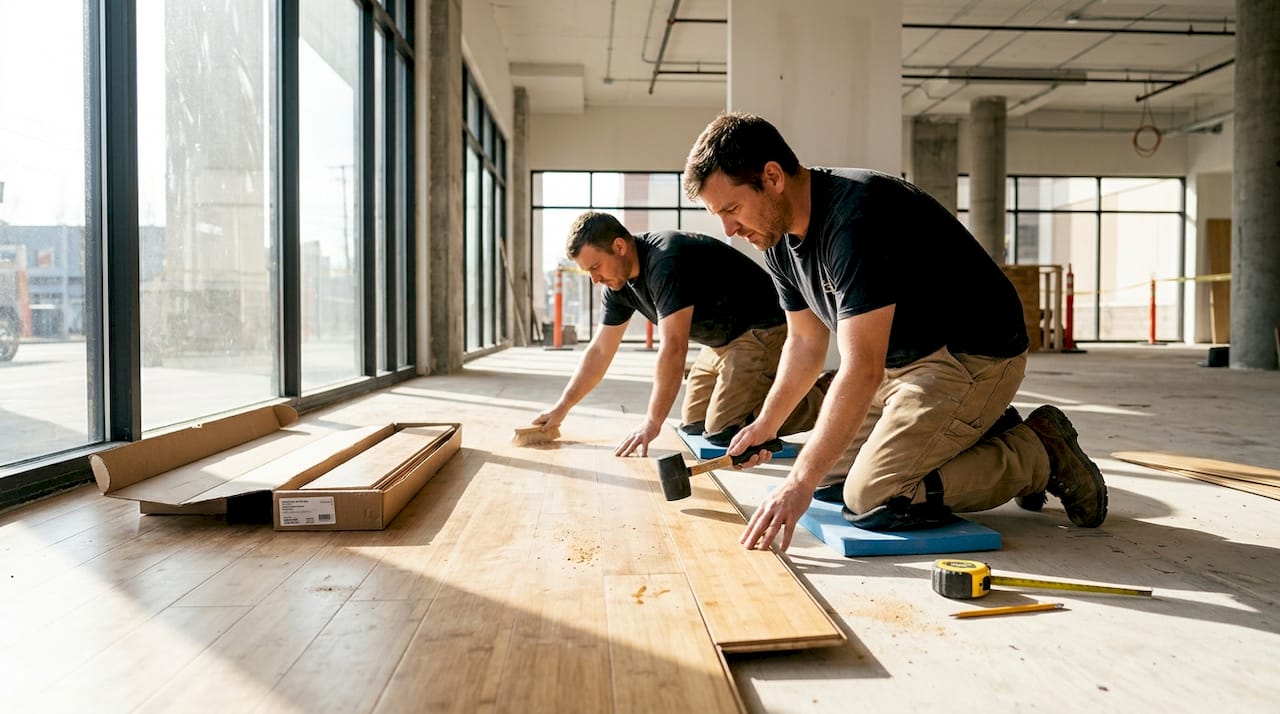
Commercial grade strand-woven bamboo handles demanding conditions through engineered density and hardness. The manufacturing process eliminates natural weaknesses while creating uniform performance characteristics. This processing trades some aesthetic appeal for superior durability. Strand-woven bamboo accepts stains less consistently than hardwood, sometimes resulting in blotchy appearance when attempting custom colors. For commercial applications prioritizing performance over custom aesthetics, this trade-off proves acceptable.
Key benefits of commercial grade bamboo over alternatives:
Pro Tip: Specify installation conditions including subfloor moisture levels, expected humidity ranges, and traffic patterns when consulting with suppliers. Commercial bamboo performs best when product selection matches actual exposure conditions, particularly in mixed-use buildings with varying environmental zones.
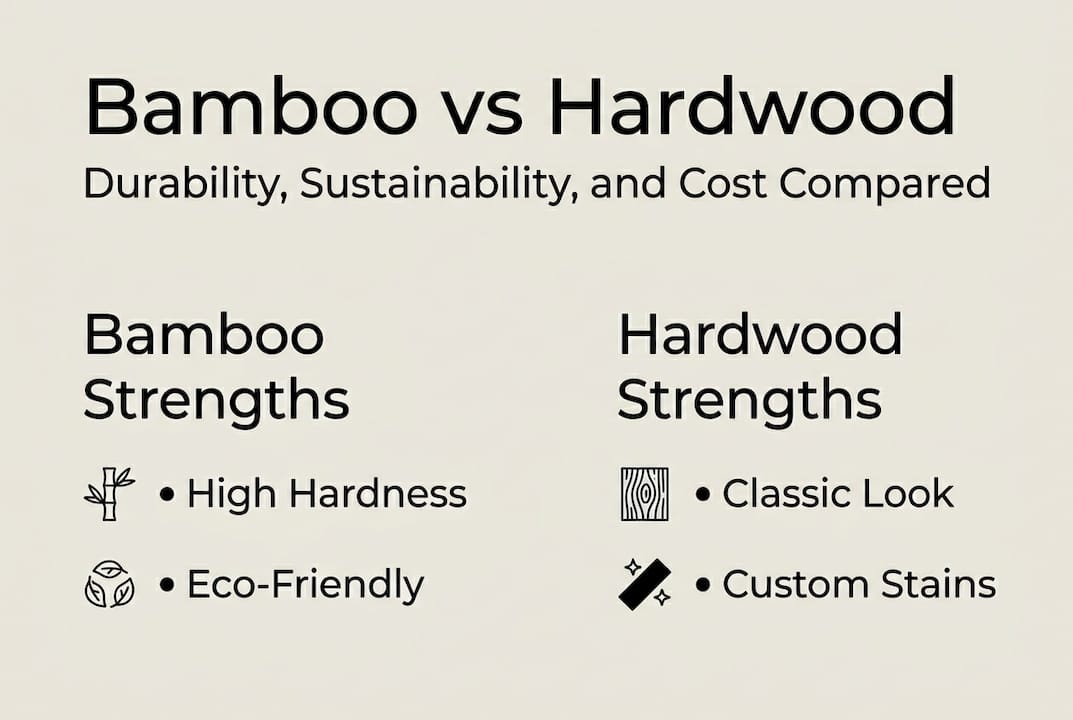
Hardwood maintains advantages in custom staining and traditional aesthetics. Clients seeking specific wood tones or grain patterns find hardwood more predictable. However, hardwood’s lower hardness rating and higher environmental impact make it less suitable for eco-conscious businesses prioritizing sustainability and long-term durability.
Cost considerations extend beyond initial material prices. Commercial bamboo’s extended warranties (often 25-30 years for heavy commercial use) reduce long-term replacement costs. Strand-woven bamboo flooring typically costs $5-8 per square foot installed, competing favorably with premium hardwoods while offering superior performance metrics.
For structural applications, solid bamboo poles (Guadua, Tam Vong) provide excellent strength-to-weight ratios for beams, columns, and decorative elements. These applications require careful engineering and connection detailing but offer unique aesthetic and sustainability benefits. Natural bamboo poles suit protected indoor structural roles, while treated commercial grade poles handle limited outdoor exposure when properly maintained.
Understanding these comparisons helps property managers and business owners select materials aligned with both performance requirements and sustainability goals, ensuring commercial bamboo products deliver expected value throughout their service life.
Selecting appropriate commercial grade bamboo requires evaluating multiple factors beyond initial cost. Eco-conscious owners and managers should prioritize FSC and CARB-certified products to ensure both sustainability credentials and indoor air quality standards. Strand-woven varieties or solid structural species provide the durability needed for high-traffic commercial applications while supporting LEED credit requirements.
Critical selection criteria include:
Verifying product claims protects against substandard materials marketed as commercial grade. Request copies of actual laboratory test reports for hardness, fire resistance, and formaldehyde emissions. Test reports should identify the specific product tested, not just similar products from the manufacturer’s line. Independent testing by recognized laboratories (Intertek, SGS, UL) carries more weight than manufacturer in-house testing.
Application suitability depends on exposure conditions and usage patterns. Indoor flooring in climate-controlled spaces represents ideal conditions for commercial bamboo. High-traffic areas like building lobbies, restaurant dining rooms, and retail floors benefit from strand-woven bamboo’s exceptional hardness. Moisture-prone areas including restaurant kitchens, building entrances, and bathrooms require additional waterproofing measures and more frequent maintenance.
Structural applications using solid bamboo poles demand engineering expertise and proper connection detailing. Guadua and Tam Vong species provide excellent compression and tension strength for columns, beams, and truss elements. These applications typically remain indoors or under protective coverings, as prolonged outdoor exposure degrades bamboo despite treatments. Consult structural engineers experienced with bamboo to ensure proper load calculations and connection designs.
Pro Tip: Avoid suppliers who rely exclusively on self-reported specifications without providing independent verification. Reputable manufacturers readily share third-party test results and certification documentation. Reluctance to provide this information signals potential quality concerns.
Installation best practices extend product life and maintain appearance. Acclimate flooring materials to installation site conditions for 72 hours minimum before installation. Maintain subfloor moisture content below 12% and within 4% of flooring moisture content. Use manufacturer-recommended adhesives and installation methods to preserve warranty coverage. Install expansion gaps at walls and transitions to accommodate seasonal movement.
Maintenance requirements for commercial bamboo remain straightforward but essential. Sweep or vacuum daily to remove abrasive dirt and debris. Damp mop weekly with pH-neutral cleaners specifically formulated for bamboo or hardwood. Avoid excessive water, steam cleaning, or harsh chemicals that damage protective finishes. Recoat high-traffic areas every 3-5 years to maintain appearance and protection.
Sustainability benefits extend beyond material selection to business practices and building certifications. LEED projects earn points for rapidly renewable materials (bamboo qualifies with its 4-7 year growth cycle), FSC-certified products, and low-emitting materials meeting CARB Phase 2 standards. These credits contribute to overall building certification while demonstrating environmental commitment to customers and stakeholders.
Selection steps for commercial bamboo:
Successful commercial bamboo applications require matching product capabilities to actual conditions. Durable bamboo products deliver expected performance when properly specified, installed, and maintained. Taking time to verify quality through independent testing and certifications protects your investment and ensures sustainable choices meet both environmental and performance goals.
Finding reliable sources for sustainably produced, commercial grade bamboo products simplifies your material selection process. Cozee Bay specializes in eco-friendly bamboo products crafted with attention to durability, functionality, and environmental responsibility. Our curated selection meets the needs of eco-conscious business owners and property managers seeking sustainable alternatives without compromising on quality or performance.
Whether you’re outfitting a restaurant, office, retail space, or residential property, Cozee Bay offers bamboo products designed for daily use in demanding environments. Our commitment to sustainability extends throughout our supply chain, with products meeting rigorous environmental and safety standards. Explore our collection and discover how premium bamboo products enhance your space while supporting your environmental values. Visit Cozee Bay today to find the perfect sustainable solutions for your commercial or residential needs.
Commercial grade bamboo describes high-performance bamboo products engineered or selected for durability in demanding commercial applications like high-traffic flooring, structural elements, and commercial furnishings. These products undergo specialized processing (such as strand weaving) and testing to achieve superior hardness, moisture resistance, and fire ratings compared to residential bamboo varieties.
No universal grading standards exist for bamboo like those governing hardwood flooring. Instead, commercial grade bamboo relies on third-party certifications (FSC for sustainability, CARB Phase 2 for emissions) and performance testing (Janka hardness, ASTM fire ratings). Buyers should verify independent test results rather than relying solely on manufacturer claims.
Strand-woven Moso bamboo dominates commercial flooring due to exceptional hardness (3000-5000 lbf Janka rating) and moisture resistance. For structural applications, solid Guadua, Tam Vong, and Tre-Gai species provide excellent strength-to-weight ratios. Species selection depends on specific application requirements, exposure conditions, and desired aesthetic characteristics.
Commercial grade strand-woven bamboo typically exceeds hardwood in hardness ratings (3000-5000 lbf vs 1290 lbf for red oak), fire resistance (Class A vs Class C), and sustainability (4-7 year growth cycle vs 50+ years). Hardwood offers more consistent custom staining and traditional aesthetics. Commercial bamboo provides superior durability and lower lifecycle costs for high-traffic applications.
Prioritize FSC (Forest Stewardship Council) certification verifying sustainable harvesting and CARB Phase 2 certification ensuring low formaldehyde emissions. Additionally, request independent laboratory test reports documenting Janka hardness ratings, fire resistance (ASTM E648/E662), and moisture content. These certifications and tests validate performance claims and support LEED credit requirements for green building projects.
Comments will be approved before showing up.