Your Cart is Empty


Biodegradable packing peanuts are made from plant-based starches, most often cornstarch, wheat starch, potato starch, or grain sorghum. These starches replace the petroleum used in traditional expanded polystyrene (EPS) foam, giving you loose fill that behaves very differently once it hits water, compost, or a landfill.
Biodegradable packing peanuts get their cushioning from cornstarch, wheat starch, potato starch, or grain sorghum, and correct disposal determines whether that plant-based promise actually pays off.
| Point | Details |
|---|---|
| Core materials | Cornstarch, wheat starch, potato starch, and grain sorghum are the primary sources used. |
| Manufacturing basics | Starch mixed with water is heated and extruded into light, puffed loose-fill shapes. |
| Quick identification | Drop a few in water; starch-based peanuts dissolve, polystyrene floats and stays intact. |
| Weight trade-off | Starch-based peanuts run roughly 6.5 to 13 grams per liter versus about 3 for EPS. |
| Disposal rule | Dissolve small batches in water or compost certified products; avoid draining large volumes at once. |
Manufacturers pull from a short list of crops to make these peanuts, and each one brings something slightly different to the table.
The manufacturing process starts simply: starch gets mixed with water and other formulation components, then heated and pushed through an extruder that puffs it into light, curled shapes. This is essentially the same puffing action that turns corn kernels into cereal, just tuned for cushioning instead of eating. The extrusion process controls how dense, springy, or water-sensitive the final peanut turns out to be, which is why one brand’s peanuts might dissolve in seconds while another holds up through a humid summer in a warehouse.
Formulation is the real variable here. Two bags labeled “biodegradable” can behave completely differently based on the starch blend and additives, which affects everything from how well they cushion a fragile vase to how fast they turn to mush in your recycling bin.
Pro Tip: If you’re stocking up on loose fill for shipping, buy a small test bag first and run the water-dissolve check before committing to a bulk order. Formulations vary enough between suppliers that “biodegradable” on the label doesn’t guarantee the same performance twice.

You don’t need lab equipment for this. A glass of water and your own eyes will tell you almost everything.
Pro Tip: Test with a small handful, not a whole bag. Dissolving peanuts by the pound in your kitchen sink can clog a drain even when the material itself is harmless.
Neither option wins across the board, so the right choice depends on what you’re shipping and how far it’s going.
Advantages of starch-based peanuts:
Drawbacks worth knowing:
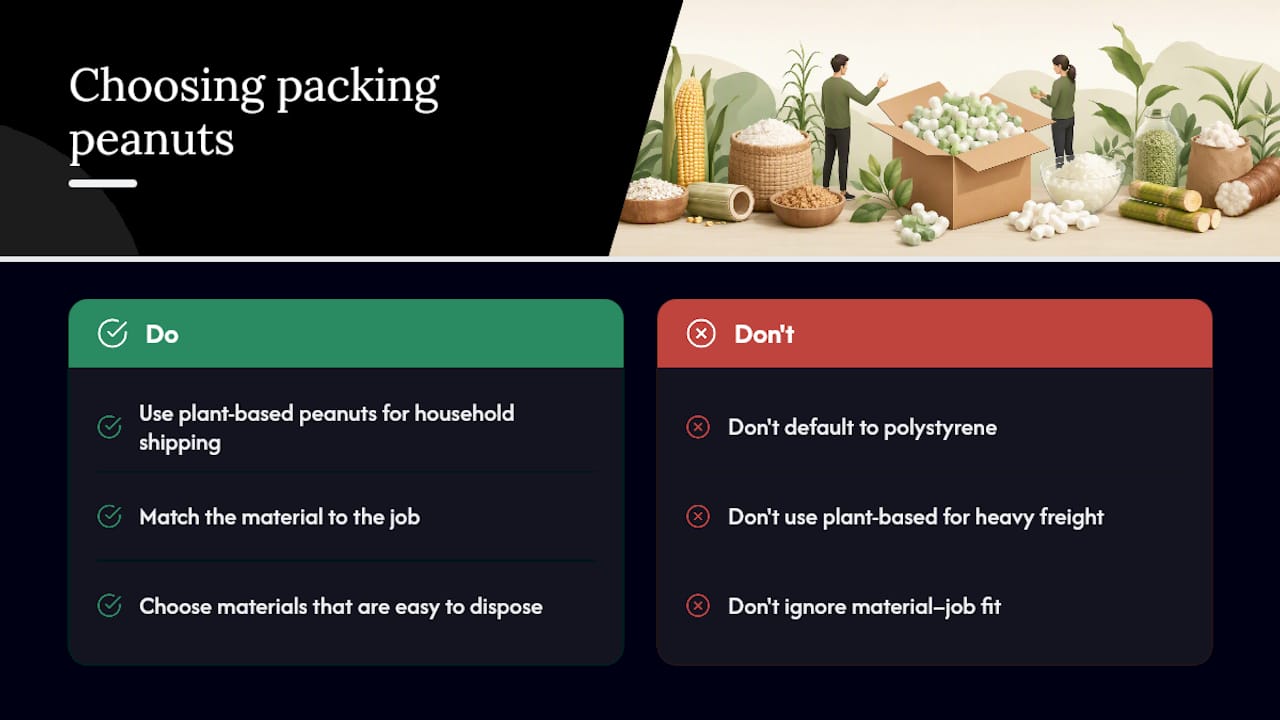
Starch-based peanuts make sense for household shipments, fragile electronics, and anything going out for a single-leg trip. Heavy freight or long-term humid storage still leans toward EPS.
Disposal depends on the formulation, so check the packaging before choosing a method.
The environmental payoff is real, but it depends entirely on correct handling. These materials break down without leaving microplastics behind, unlike EPS foam, which can persist in landfills for centuries. That said, dumping large volumes down a drain can strain local wastewater systems even though the material itself is nontoxic. If you’re clearing out a big box shipment’s worth of loose fill, spread the dissolving out over a few sink loads instead of forcing it all through at once. For more on how compostable materials perform in home systems, Cozee-bay’s guide to bamboo product disposal covers similar principles for other biodegradable goods.
Field reports back up what the water test shows at home. Starch-based peanuts genuinely protect electronics well thanks to their static-free surface, but that same softness means they compress more under repeated handling or heavy, multi-leg freight routes.
Pro Tip: For humid climates or storage that stretches past a few weeks, EPS still holds up better. Save starch-based peanuts for shipments moving within days.
Plant-based packing peanuts are the better default for most household and small business shipping, where lower resilience rarely matters and easy disposal does. Match the material to the job. Save polystyrene for the rare heavy-freight exception. For more on sourcing sustainable materials, see our bio-based plastic guide.
What are biodegradable packing peanuts made of? They’re made from plant-based starches, most commonly cornstarch, wheat starch, potato starch, or grain sorghum, processed into a light, puffed loose fill.
Are packing peanuts compostable? Some are, depending on the formulation and certification. Look for labels like NF T51-800 or ASTM D6400 for confirmation rather than assuming “biodegradable” means compostable in your backyard bin.
Can I just throw biodegradable peanuts down the sink? Small amounts dissolve fine in water. Large volumes can strain local wastewater systems, so spread disposal out or compost instead.
Do starch-based peanuts protect items as well as Styrofoam? They perform well for lighter household shipments and electronics, thanks to zero static cling, but they compress more than EPS under heavy or long-distance freight conditions.
Comments will be approved before showing up.