Your Cart is Empty


A biodegradable polymer is a material that microorganisms can break down into simpler substances, measured by a genuine drop in molecular weight rather than just visible crumbling. Depending on the environment, the end products are carbon dioxide, water, methane, or new microbial biomass. Being “bio-based” (made from plants) doesn’t guarantee this outcome. What actually matters is chemical structure, specifically whether the polymer chain contains bonds that water and enzymes can break apart.
TL;DR:
- Many biodegradable polymers only break down efficiently under industrial composting conditions involving high heat and humidity, not in landfills or the ocean.
- Degradation depends on chemical structure, with ester bonds being the primary vulnerability, meaning some fossil-fuel plastics like PBAT and PCL can still biodegrade.
- Environmental factors such as temperature, moisture, and surface area play critical roles in determining how fast a polymer material actually degrades in real-world settings.
- Certification standards specify whether a product is suitable for industrial or home composting, so consumers should verify claims and disposal pathways carefully.
- Advances in research now focus on tuning degradation rates through copolymerization and blending, matching material lifespan to specific application needs.
If you’ve ever stood in a store aisle squinting at a bag labeled “eco-friendly,” you already know the terminology here is a mess. So let’s clear it up properly, because the type of biodegradable polymer you’re looking at determines everything about how, where, and how fast it disappears.
The most useful way to sort these materials isn’t by where they came from, but by what holds their molecules together. According to a PMC review on biodegradable polymers, biodegradability depends on chemical structure rather than raw-material origin. Ester bonds are the key vulnerability. They’re the chemical “seams” that water molecules and microbial enzymes can pry open. Common petrochemical plastics like polyethylene and polypropylene lack these seams entirely, which is why they resist microbial attack for decades regardless of how thin you make them.
With that in mind, here’s how the major categories break down:
That last category deserves a second look, because it upends a common assumption. A polymer made from crude oil can still be biodegradable if its backbone contains the right chemical bonds. PCL and PBAT are both synthetic and petroleum-derived in many commercial formulations, yet both break down under the right microbial conditions. Meanwhile, some bio-based plastics like bio-polyethylene are chemically identical to their fossil-fuel twins and just as resistant to degradation. Our own breakdown of what bio-based plastic actually means digs deeper into that distinction if you want the retail-label version of this same principle.
Pro Tip: Don’t trust a label just because it says “plant-based” or “natural.” Check whether the product also carries a biodegradability or compostability certification. Feedstock and function are two separate questions.
For a closer look at how these classifications translate into real-world examples, our guide to biodegradable polymers with student-friendly examples walks through several side by side.
Degradation isn’t a single event. It’s a sequence, and understanding the stages explains why some products vanish in weeks while others linger for years even though both are technically “biodegradable.”
One nuance trips up a lot of people: lab results and real-world results often diverge sharply. A material that mineralizes completely in 90 days inside an industrial composting chamber running at 140°F might sit almost unchanged in a backyard compost pile or a cool landfill for years. The chemistry hasn’t changed. The environment has, and the environment is doing most of the work.
If you’re designing a product, sourcing packaging, or just trying to predict how long something will actually take to disappear, four variables matter more than any marketing claim on the package.
Material-level factors set the baseline. Chemical bond type comes first, since ester-rich polymers hydrolyze while carbon-carbon backbones (like those in PE and PP) essentially don’t. Crystallinity is next: tightly packed crystalline regions resist water penetration far better than amorphous, disordered regions, so a highly crystalline PLA part degrades slower than an amorphous one of identical weight. Molecular weight matters too, since longer chains take more cleavage events to reach a size microbes can consume. And additives or protective coatings can either accelerate or completely block degradation depending on their chemistry.
Environmental factors often matter even more than material choice:
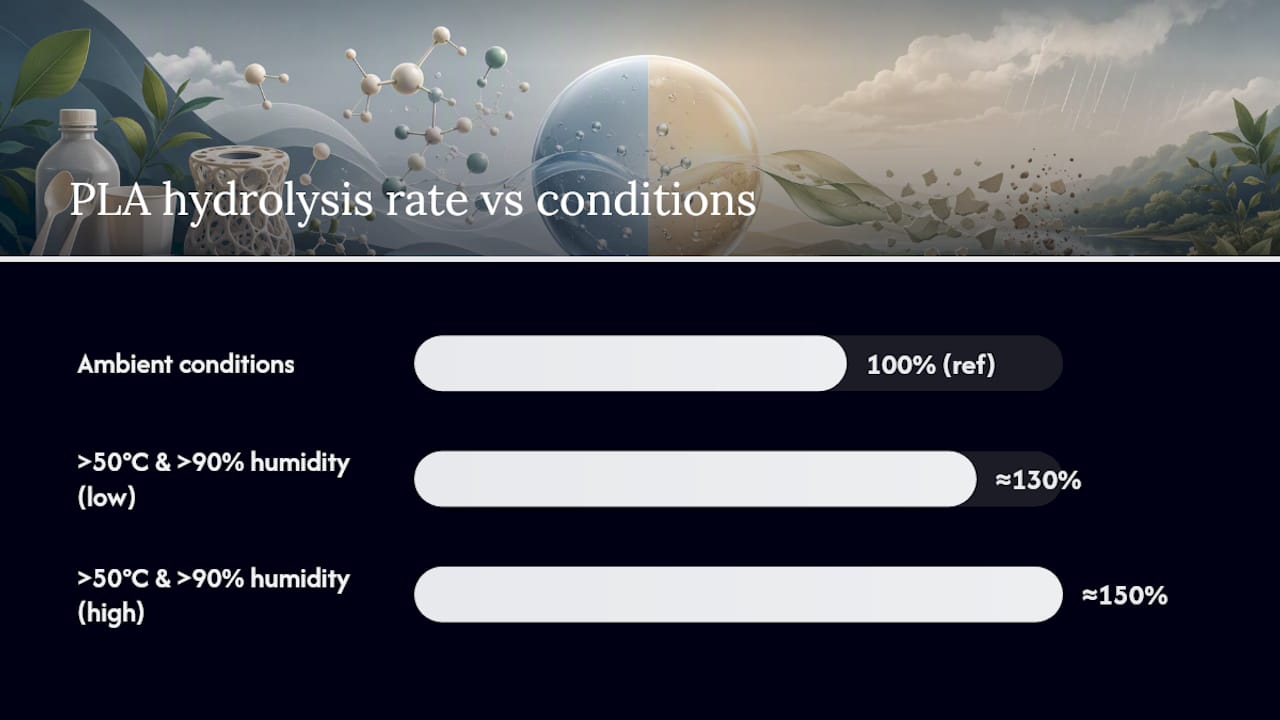
By the numbers: Environmental conditions above 50°C combined with humidity over 90% can accelerate PLA hydrolysis by roughly 30 to 50 percent compared with ambient conditions. That’s the difference between an industrial composting facility and your kitchen counter, and it’s why “compostable” almost never means “will vanish in your backyard bin.”
Form factor rounds out the list, and it’s the one most people overlook entirely. Surface-area-to-volume ratio often decides degradation speed more than chemistry does. A thin film with enormous surface area relative to its mass will degrade far faster than a thick molded part made from the exact same polymer, simply because more of the material is exposed to water and enzymes at once.
Not all biodegradable polymers behave the same way, and mixing them up leads to real disappointment, like assuming a 3D-printed PLA figurine will vanish in your garden the way a compostable coffee cup lid does. Here’s what you’re actually working with in each major family.
Across all of these, the same underlying chemistry applies. Aliphatic polyesters remain the leading candidates as biodegradable materials precisely because their ester bonds hydrolyze into hydroxycarboxylic acids, compounds ordinary soil and gut microbes already know how to metabolize.
Picking the right biodegradable polymer for a job isn’t about grabbing the “greenest sounding” option. It’s about matching a material’s degradation timeline to what the application actually needs, the same way you wouldn’t build a deck out of balsa wood just because it’s technically wood.
Pro Tip: If you’re specifying a biodegradable material for a product, ask your supplier for the specific degradation timeframe under your actual disposal conditions, not just a generic “biodegradable” claim. A material that degrades beautifully in an industrial composter tells you nothing about how it behaves in a landfill or the ocean.
Here’s where a lot of well-meaning shoppers get misled, sometimes by design. “Biodegradable” and “compostable” are not interchangeable terms, and the testing standards behind each one tell you exactly what conditions a claim actually applies to.
Certification testing generally falls into three buckets: mineralization tests (measuring actual CO2 output to confirm real biodegradation, not just fragmentation), disintegration tests (checking whether visible pieces break down to a certain size within a set timeframe), and ecotoxicity tests (confirming the residue doesn’t harm plant growth or soil organisms). Standards bodies including ASTM, ISO, and EN publish specific protocols for each, and a legitimate compostable certification will typically reference one of these directly.
The catch is that most compostable certifications are calibrated for industrial composting facilities running sustained high heat and humidity, not the backyard bin in your yard. A product labeled “compostable” without specifying “industrial” or “home compostable” is telling you less than it seems to.
Watch especially for “oxo-biodegradable” claims. These typically describe conventional plastics with additives that promote fragmentation, breaking the plastic into smaller pieces without necessarily achieving true mineralization. Regulatory guidance like the FTC’s Revised Green Guides specifically warns against ambiguous biodegradability marketing that could mislead consumers or contaminate recycling and composting systems.
A quick label-reading checklist:
The single biggest misunderstanding about biodegradable plastics is confusing disintegration with biodegradation. A plastic bag that photodegrades into thousands of invisible fragments has disintegrated. It hasn’t biodegraded unless microbes actually mineralize those fragments into CO2, water, or biomass. Review literature is blunt about this risk: materials that visually disappear can still leave behind persistent microplastic residue if metabolic mineralization never actually happens.
By the numbers: Environmental conditions above 50°C and 90% humidity accelerate PLA hydrolysis by 30 to 50 percent, a gap that explains why the same “biodegradable” plastic behaves like ordinary trash in a landfill and like compost in an industrial facility.
Mis-specified disposal is the second problem. A biodegradable polymer sent to a landfill gets buried under anaerobic, low-moisture conditions that can stall degradation for years. Sent to the ocean, it faces cold temperatures and inconsistent microbial populations that slow the process even further. Sent to an industrial composter, the same material might fully mineralize within months. The polymer never changes. Only the outcome does.
Life-cycle thinking adds one more wrinkle worth knowing: circularity requires matching a product’s end-of-life pathway to its actual degradability, and growing the feedstock crop for a bio-based plastic carries its own water, land, and fertilizer costs that a simple “it’s plant-based” claim glosses over entirely.
Practical steps that actually help:
Cost remains the biggest barrier standing between biodegradable polymers and mainstream adoption. PHAs, despite their impressive environmental versatility, cost more to produce than conventional plastics because microbial fermentation at commercial scale requires more capital and process control than petroleum refining. PLA has closed much of that gap thanks to decades of production scaling, particularly in food-service packaging and 3D printing filament, where it now competes on price with some conventional plastics in high-volume categories.
Availability varies a lot by polymer type and region. Starch blends and PLA are widely available through mainstream packaging suppliers, while PHAs and specialty medical-grade PCL formulations remain more specialized and pricier, often sourced through niche manufacturers rather than commodity plastics distributors.
For businesses evaluating a switch, the calculation usually comes down to three questions: does your waste stream actually support the disposal route this material needs, does the price premium fit your margins, and does the material perform well enough mechanically for your application. A biodegradable polymer that costs more but ends up in a landfill anyway, where it can’t degrade properly, delivers no environmental benefit to offset that added cost. Matching material to genuine end-of-life infrastructure isn’t just an environmental question. It’s an economic one too.
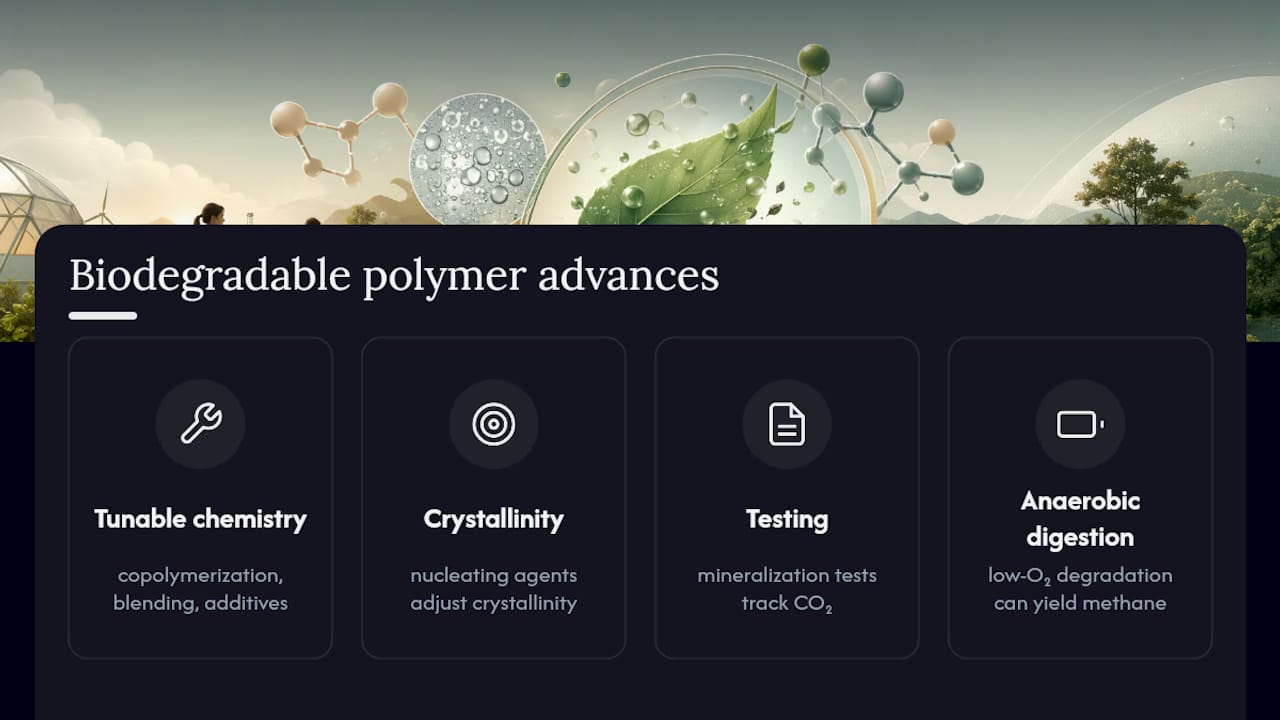
The most active area of research right now isn’t inventing entirely new polymers. It’s making existing ones smarter through tunable chemistry. Researchers increasingly treat degradation rate as an adjustable design parameter rather than a fixed material property, using copolymerization, blending, and additive selection to dial degradation speed up or down for a specific application.
Copolymerizing PLA with glycolide, for instance, accelerates hydrolysis compared with pure PLA, useful when a faster-degrading medical device is the goal. Adding nucleating agents changes crystallinity, which in turn slows or speeds degradation depending on the target. This kind of structural fine-tuning is what lets a single polymer family, like PLA, serve applications as different as rigid cold cups and resorbable surgical implants.
On the testing side, laboratories increasingly favor mineralization testing, tracking actual carbon dioxide evolution, over older weight-loss or visual disintegration methods, since visual disappearance alone can’t confirm true biodegradation. Better testing methodology is arguably as important an advance as new chemistry, because it closes the gap between marketing claims and lab-verified reality.
Anaerobic digestion research has also gained attention, since biodegradation in low-oxygen environments can produce methane rather than carbon dioxide, opening a path toward capturing that methane for energy recovery instead of treating it as a waste byproduct.
Picking a material because it sounds sustainable is easy. Picking one that actually degrades the way you’re promised requires paying attention to the same variables covered here: chemical structure, environmental match, and honest labeling. We approach bamboo and natural materials with that same standard, favoring products whose disposal path matches the infrastructure customers actually have access to, rather than materials that only perform well in a lab, as explained in our guide on authentic natural-fiber products.
If you want retailer-focused breakdowns of specific claims, our Cozee Bay blog covers the practical side of sustainable material choices in more depth. And if you’re wondering how to properly dispose of a specific product you’ve purchased from us, reach out to our customer support team directly. Disposal instructions vary by material, and we’d rather give you a straight answer than a vague one.
— Cozee
For readers who want to check the primary science behind these claims, a few sources stand out. The IUPAC Gold Book settles terminology disputes with its formal definition. The PMC review on biodegradable polymers covers PHA biosynthesis and applications in detail. The MDPI review on properties and environmental impact offers the most comprehensive classification framework available. And the FTC Green Guides summary explains the regulatory logic behind labeling rules.
They’re polymers that microorganisms can break down through biological activity, resulting in a measurable drop in molecular weight and end products like carbon dioxide, water, methane, or biomass, according to the IUPAC definition.
It depends on whether their disposal pathway matches their degradation requirements; a compostable item sent to a landfill delivers little environmental benefit despite its bio-based origin.
Biodegradable means microorganisms can break a material down eventually, while compostable specifies a defined timeframe and set of conditions, often industrial composting heat and humidity, under a recognized standard.
Yes. Biodegradability depends on chemical bonds like esters, not feedstock origin, so some petroleum-derived polyesters such as PCL and PBAT are biodegradable despite their fossil-fuel source.
Usually because they end up in the wrong environment. PLA, for instance, needs sustained heat above roughly 50°C and high humidity to degrade at a meaningful rate, conditions a landfill or backyard bin rarely provides.
Comments will be approved before showing up.