Your Cart is Empty


TL;DR:
- Upcycled wood preserves its original structure, making it stronger and more durable than recycled alternatives.
- It significantly reduces environmental impact by lowering carbon emissions and preventing deforestation.
- Common applications include flooring, wall panels, furniture, and outdoor structures, adding unique aesthetic value.
Many people assume eco-friendly wood means compressed sawdust, particleboard, or shredded fibers pressed together with glue. That assumption sells upcycled wood seriously short. Upcycled wood transforms salvaged timber, reclaimed beams, and discarded structural wood into high-value, beautiful products that often outperform brand-new timber in both strength and character. As upcycled wood retains value and structural integrity unlike traditional recycling, it represents a genuinely smarter choice for eco-conscious homeowners and property managers who want style without compromise. This article breaks down what upcycled wood actually is, how it is made, why it matters environmentally and economically, and how you can put it to work in your space.
| Point | Details |
|---|---|
| Upcycled vs. recycled | Upcycled wood preserves structure and value, unlike recycled wood, which is broken down. |
| Environmental advantage | Opting for upcycled wood greatly lowers carbon emissions and supports the circular economy. |
| Stylish, durable solutions | Upcycled wood delivers superior durability and distinctive looks for both homes and businesses. |
| Modern applications | From custom furniture to accent beams, upcycled wood fits many design and practical uses. |
Upcycled wood is salvaged timber that is cleaned, processed, and repurposed into a product of equal or greater value than its original form. Think old barn beams becoming a dining table, or structural joists from a demolished factory becoming rich hardwood flooring. The key is that the wood keeps its physical structure throughout the process. Nothing is ground down, melted, or reconstituted.
This is where the distinction from recycled wood becomes critical. Upcycled wood retains structure and value, while recycled wood is broken down and reconstituted into composite panels or fiberboard. Recycled wood products often rely on adhesives and fillers to hold the material together, whereas upcycled wood is stronger because it preserves the original grain, density, and fiber alignment.
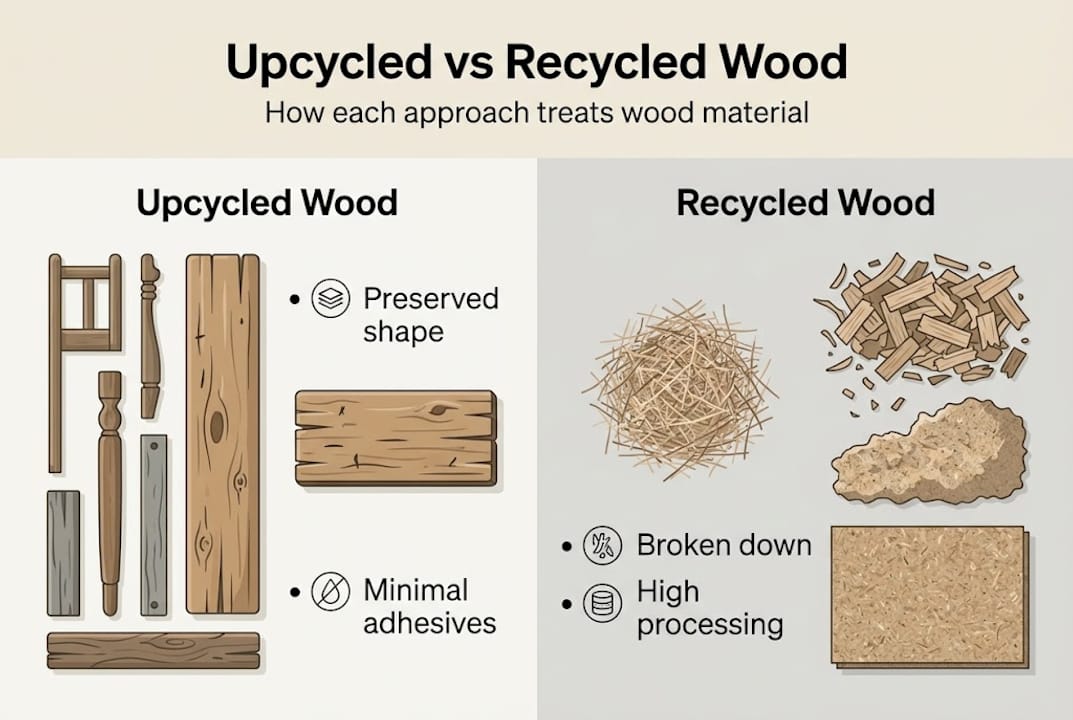
Here is a quick comparison to make that difference clear:
| Feature | Upcycled wood | Recycled wood |
|---|---|---|
| Material integrity | Preserved | Broken down |
| Adhesives required | Minimal to none | Often required |
| Strength | High, often old-growth density | Variable, usually lower |
| Aesthetic character | Unique grain, patina | Uniform, manufactured look |
| Environmental impact | Very low carbon footprint | Low, but higher than upcycled |
For eco-conscious property owners, this distinction matters a lot. You are not just choosing a material. You are choosing how that material performs over decades, how it looks, and how safely it can be used in your home or commercial space. Upcycled wood also tends to be free of the volatile organic compounds (VOCs) found in some composite wood products, since it skips the adhesive-heavy manufacturing process.
Why does this matter for bamboo wood advantages and other sustainable materials? Because understanding the spectrum of types of sustainable materials helps you make smarter purchasing decisions, not just greener-sounding ones.
Worth knowing: Upcycled wood often comes from old-growth trees that were harvested decades or even centuries ago. That means the grain is tighter and the wood is denser than most timber available today, giving you a material that is genuinely harder to replicate with new lumber.
Now that we have defined upcycled wood, let us look at how it moves from waste to new life. The journey is more involved than most people expect, and that is actually a good thing. The care put into the process is what makes the end product so reliable.
Common sources of upcycled wood include:
Once sourced, the wood goes through a careful transformation process. Here is a simplified breakdown of the typical steps:
Modern upcycling operations are also getting smarter. Sophisticated methods like 3D scanning and algorithmic aggregation are now used to process irregular reclaimed wood, maximizing yield from each piece and reducing waste even further.
| Processing stage | Key challenge | Modern solution |
|---|---|---|
| Sorting | Inconsistent sizes and species | AI-assisted grading |
| Contaminant removal | Hidden treatments | Chemical testing protocols |
| Milling | Irregular shapes | 3D scanning and CNC cutting |
| Quality control | Structural variability | Load and stress testing |
Pro Tip: When sourcing upcycled wood products, always ask suppliers for documentation on contaminant testing. A reputable supplier will have records showing the wood has been cleared of lead paint, chemical treatments, and other hazards. This is especially important for upcycled home products used in kitchens or children’s spaces.
The main challenges in upcycled wood supply are labor intensity, inconsistent supply volumes, and the time required for proper processing. These factors can affect pricing, but the quality and environmental payoff make it worthwhile.
Understanding the process highlights why upcycled wood is more than just a trend. Let us break down its real-world impact, because the numbers are genuinely impressive.
On the environmental side, the benefits stack up fast:
Life cycle assessments (LCAs) are scientific evaluations that measure a product’s environmental impact from creation to disposal. Benchmarks show that upcycling and recycling wood vastly reduces global warming potential (GWP) compared to sending wood waste to landfill. For property managers pursuing green building certifications like LEED or WELL, this data is exactly what you need to back your material choices.
Statistic to know: Using upcycled wood can cut embodied carbon by up to 90%, making it one of the most impactful single swaps you can make in a renovation or build.
Economically, upcycled wood also holds its own. While the upfront cost can be higher than standard lumber, the lifecycle value is stronger. Upcycled wood tends to be more dimensionally stable, meaning it is less likely to warp, shrink, or crack over time. That translates to lower maintenance costs and longer replacement cycles.
For homeowners, incorporating upcycled wood into a renovation can boost property appeal and resale value. Buyers increasingly look for authentic, sustainable materials, and a reclaimed wood feature wall or floor is a genuine selling point. For commercial property managers, using sustainable building products supports green certifications and tenant attraction.
Pro Tip: If you are selecting eco-friendly products for a renovation, ask for LCA data from your supplier. Products with verified environmental impact data give you a concrete foundation for any green certification application.
With these benefits in mind, let us explore how you can apply upcycled wood in your space. The range of applications is broader than most people realize, and the aesthetic results are often stunning.
Popular uses for upcycled wood include:
One of the most compelling selling points is the patina. Aged wood develops a surface character over decades that gives it depth, color variation, and a lived-in quality. Upcycled wood is often stronger and features the density of old-growth material, which means it holds up better under heavy use than much of today’s commercially grown timber.

Bamboo fits naturally into this conversation. While technically a grass, bamboo is processed in ways that align closely with upcycled wood principles. Exploring bamboo upcycling solutions opens up a whole category of fast-growing, renewable materials that deliver the same warmth and durability as hardwood with a dramatically lower environmental footprint.
Pro Tip: Before finalizing any upcycled wood purchase for a commercial space, run through an eco home product checklist to confirm the material meets your safety, aesthetic, and sustainability requirements. A little due diligence upfront saves a lot of headaches later.
For workspace upgrades, upcycled wood brings warmth to otherwise sterile environments. Coffee shops, co-working spaces, restaurants, and senior living centers have all embraced reclaimed wood for its ability to create a welcoming, grounded atmosphere that synthetic materials just cannot achieve.
After seeing the diverse applications, it is worth stepping back for a deeper perspective. We have watched a lot of eco trends come and go, and most of them share a common flaw: they prioritize the appearance of sustainability over its substance. A product stamped with a green label is not automatically a responsible choice.
Upcycled wood is different, and here is why we believe that. It does not just reduce harm. It actively creates value from what was already lost. Every piece carries a verifiable history, a measurable carbon benefit, and a physical quality that often surpasses what you can buy new. That is a rare combination.
Architects and interior designers who work on serious green projects are increasingly turning to upcycled wood not because it is fashionable, but because it passes scrutiny. It holds up under LCA analysis, it satisfies certification requirements, and it genuinely looks better over time rather than worse. The lasting impact of eco decor choices like upcycled wood is that they age with grace, not obsolescence. Invest in authenticity, not just labels.
If reading about upcycled wood has you thinking about the materials throughout your own home or property, that is exactly the right instinct. Bringing sustainable style into your space does not have to mean a full renovation.

At Cozee Bay, we design handcrafted bamboo products that share the same philosophy as upcycled wood: real materials, real craftsmanship, and real environmental responsibility. From our popular bamboo paper towel dispenser to our full range of home and commercial organizers, every product is built to last and designed to look great doing it. Browse our full collection at Cozee Bay and find the sustainable pieces that fit your space, with free shipping across the contiguous U.S.
Upcycled wood is remanufactured without losing its structural integrity, while recycled wood is broken down into fibers and reconstituted into composite products. The key difference is that upcycled wood retains its original grain, density, and strength throughout the process.
Yes, when professionally cleaned and tested. Removal of treatments and safety testing are critical steps that reputable suppliers follow, making properly processed upcycled wood safe and often more stable than new wood.
Upcycled wood reduces waste, lowers your carbon footprint, and adds distinctive character to any space. It also supports property sustainability credentials, which matters for green certifications and resale value.
Upcycled wood reduces carbon by up to 90% compared to new timber production, and it eliminates the need for fresh logging, making it significantly better for deforestation and emissions.
Yes, but quality and structural integrity testing is essential before outdoor use. The wood must also be appropriately sealed and treated for weather exposure to ensure long-term durability.
Comments will be approved before showing up.