Your Cart is Empty


TL;DR:
- Bamboo is a highly renewable, durable, and low-impact material ideal for sustainable offices.
- Using certified bamboo products can improve air quality, reduce energy costs, and boost employee well-being.
- Proper sourcing and certification are crucial to ensure bamboo products are truly sustainable and ethically produced.
Upgrading your office to meet sustainability, budget, and design goals all at once can feel like an impossible juggling act. You want a workspace that looks polished, performs well, and actually holds up under daily use without costing the earth, literally and financially. Bamboo is quietly becoming the material that checks every one of those boxes. It grows up to 36 inches per day, making it one of the fastest-renewing natural resources on the planet. It is strong, low in VOCs, and resistant to warping, which means it works beautifully in everything from flooring to desk accessories. This guide walks you through practical, innovative sustainable office design ideas you can actually implement.
| Point | Details |
|---|---|
| Smart material selection | Choosing FSC-certified bamboo ensures low emissions, durability, and real sustainability in your office. |
| Maximize impact with accessories | Bamboo organizers, lighting, and acoustic solutions boost both comfort and indoor air quality. |
| Proven benefits | Sustainable office designs cut operating costs up to 30% and measurably improve wellbeing and productivity. |
| Real-world success | Case studies show offices using bamboo achieve certifications, lower carbon outputs, and happier employees. |
Before you start sourcing materials, it helps to have a clear set of criteria so you are not just swapping one problem for another. Not every product labeled “eco-friendly” earns that title, and a rushed decision can leave you with materials that look good on paper but underperform in real office conditions.
Here are the key criteria to evaluate any office material before you commit:
Bamboo outperforms hardwood in renewability and often matches or beats it in durability. Compared to synthetic materials, bamboo has a dramatically lower carbon footprint and far fewer chemical off-gassing concerns.
“When evaluating sustainable materials, always request third-party certification documentation, not just marketing claims. FSC and LEED paperwork should be available before any purchase order is signed.” — Sustainable Facilities Consultant
Pro Tip: When sourcing bamboo products, ask suppliers specifically whether soy-based adhesives were used in manufacturing. Products using soy-based adhesives instead of formaldehyde-based glues significantly reduce VOC output, which is a detail that rarely appears on product labels but matters enormously for indoor air quality.
The bottom line is that bamboo, when properly sourced and certified, gives you a material that is renewable, low-impact, and durable enough for heavy commercial use. That combination is hard to beat.
Once you know what to look for, it is time to see what bamboo can actually do in a real office environment. The answer is quite a lot.
Bamboo desks are a natural starting point. They are strong, low in VOCs, and resist warping, which means they hold up in busy workspaces without the chemical off-gassing associated with particleboard or MDF furniture. A solid bamboo desk surface looks clean and modern, pairs well with metal or powder-coated steel frames, and ages gracefully.
Bamboo flooring is another high-impact upgrade. It handles foot traffic well, is easier to maintain than hardwood, and brings warmth to spaces that might otherwise feel cold or corporate. Strand-woven bamboo, in particular, is one of the hardest flooring options available, outperforming many traditional hardwoods on the Janka hardness scale.
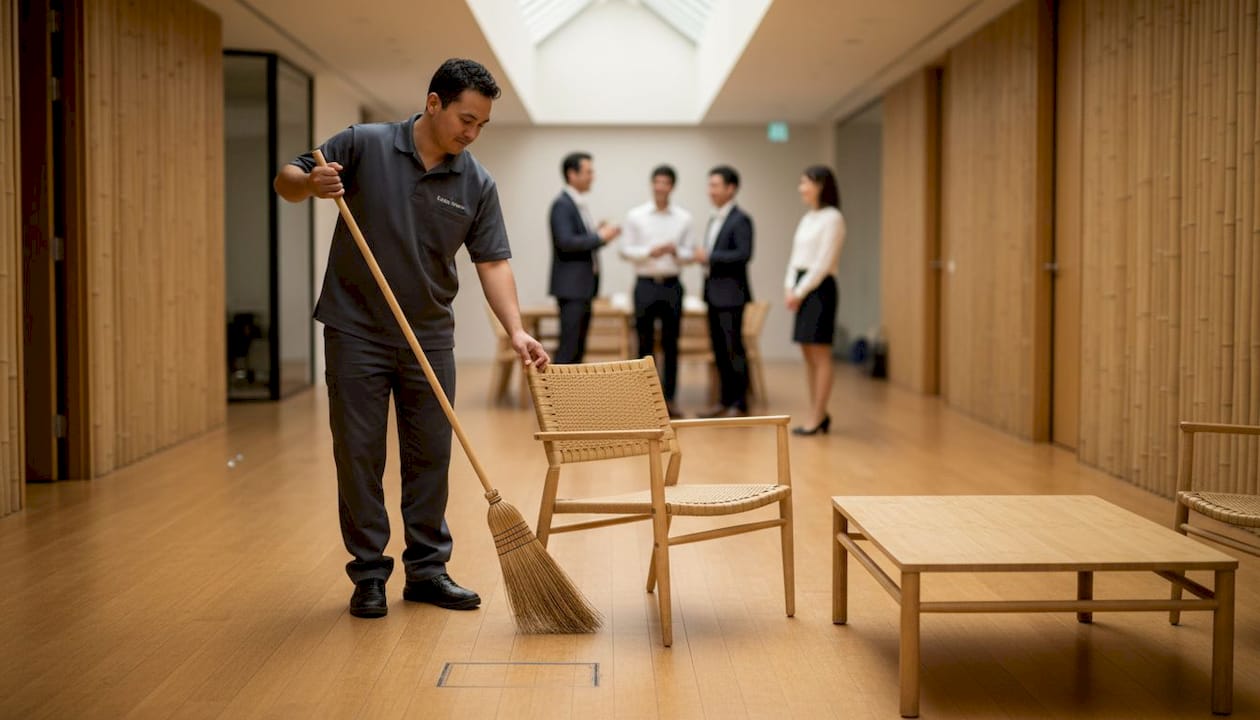
Wall panels and shelving made from bamboo add texture and visual interest without overwhelming a space. They work especially well in reception areas, conference rooms, and collaborative zones where you want to make a design statement without sacrificing sustainability.
Here is a quick breakdown of bamboo’s advantages across these core office elements:
For maintenance, a simple wipe-down with a damp cloth and occasional application of bamboo-safe oil keeps surfaces looking fresh for years. Avoid harsh chemical cleaners, which can strip the natural finish. You can explore more bamboo interior design ideas and practical tips on how to organize with bamboo to get the most out of every surface.
Pro Tip: Pair natural-finish bamboo surfaces with white or light gray walls and matte black hardware. This minimalist combination lets the bamboo’s grain become the visual focal point without the space feeling cluttered or overly rustic.
It is also worth noting that low-VOC bamboo adhesives used in manufacturing play a significant role in keeping indoor air quality healthy, which is something your employees will feel even if they cannot name the reason.
With the big-ticket elements sorted, the smaller upgrades are where your office’s personality really comes through. Bamboo accessories are practical, stylish, and surprisingly effective at improving both organization and air quality.
Here are five bamboo office accessories worth prioritizing:
The air quality angle is worth emphasizing. Bamboo products with soy-based adhesives reduce VOC emissions by 70 to 80% compared to alternatives like cork, keeping indoor air quality well below harmful thresholds. Over time, that matters for employee health and focus.
“Greener workspaces are not just an ethical choice. They are a performance choice. Employees in environments with natural materials and better air quality consistently report higher satisfaction and output.” — Workplace Design Researcher
For more inspiration on styling your space, check out these bamboo decor ideas and bamboo interior decoration tips that work equally well in commercial settings. You can also review bamboo sustainability facts to better understand what you are investing in.
Pro Tip: Layer bamboo accessories intentionally. Use acoustic panels on the wall, a bamboo privacy screen at the desk cluster, and live plants in bamboo planters nearby. This layered approach addresses acoustics, air quality, and aesthetics all at once, without making the space feel overdone.
Real-world results are always more convincing than theory. Several notable office projects have used bamboo as a central design and sustainability strategy, with measurable outcomes to back it up.
T3 Architects Saigon used a bamboo facade to achieve significant energy savings and natural ventilation throughout the building. The design reduced reliance on mechanical cooling, which is a major operating cost in tropical climates. Mission Bay used Plyboo bamboo plywood throughout its fit-out and achieved LEED Gold certification, demonstrating that bamboo can meet the rigorous material standards required for top-tier green building recognition.
Paradise 11, certified under BREEAM standards, achieved low embodied carbon by prioritizing mass timber and bamboo materials throughout the build. The project is now cited as a model for low-carbon commercial fit-outs in the UK.
Post-occupancy research adds another layer of evidence. Timber and bamboo-rich offices correlate with 87% improved mental well-being and 61% improved physical well-being among occupants, along with measurable gains in productivity and collaboration.
| Office project | Bamboo application | Certification | Key outcome |
|---|---|---|---|
| T3 Architects Saigon | Bamboo facade | Energy performance standard | Reduced cooling costs, natural ventilation |
| Mission Bay | Plyboo bamboo plywood | LEED Gold | Verified sustainable material compliance |
| Paradise 11 | Mass timber and bamboo | BREEAM | Low embodied carbon, model fit-out |
You can explore more examples of bamboo in commercial spaces to see how these principles translate across different industries and office types.
Practical lessons from these projects:
Here is something most sustainable design guides will not tell you directly: the label “bamboo” does not automatically mean sustainable. Processed bamboo products, particularly those made into viscose or rayon fabric, go through chemical-heavy manufacturing that strips away most of the environmental benefit. Solid bamboo is superior to plastic and virgin wood when sustainably sourced, but processed forms can be just as problematic as the materials you are trying to replace.
This is why certifications and supply chain documentation matter more than any marketing claim. FSC certification, LEED compliance, and verified soy-based adhesive use are not bureaucratic checkboxes. They are your protection against paying a premium for a product that does not deliver on its promises.
Our honest take: sometimes a well-sourced piece of reclaimed wood from a local supplier beats a flashy “eco-certified” bamboo product shipped across the world. Always factor in transport distance and full lifecycle impact. Prioritize ethically sourced bamboo with documented supply chains, and do not be afraid to ask hard questions before signing any purchase order.
You have done the research. Now it is time to put these ideas into practice in your own workspace.
At Cozee Bay, we specialize in handcrafted, eco-friendly bamboo products built for both style and real-world function. Whether you are outfitting a full office renovation or starting small with desk organizers and accessories, our curated selection makes it easy to source quality bamboo products you can trust. Every item is designed with sustainability, durability, and clean aesthetics in mind. Explore our full range of bamboo office solutions and find the pieces that fit your workspace vision. Free shipping is available within the contiguous U.S., backed by our satisfaction guarantee.
Bamboo is fast-growing and renewable, producing usable material far faster than hardwood trees while emitting low VOCs and delivering excellent durability for desks, flooring, and accessories.
Yes. Cognitive performance improves by up to 25% in green-certified buildings, and bamboo-rich offices show 87% improved mental well-being among occupants based on post-occupancy research.
Look for FSC certification and confirm that soy-based adhesives were used in manufacturing, as these reduce VOC emissions by 70 to 80% compared to standard adhesive alternatives.
Upfront costs are often comparable to conventional materials, and operating savings of 20 to 30% over time make bamboo-based office designs a strong long-term investment.
Both are excellent choices. Solid, FSC-certified bamboo wins on renewability, while locally sourced reclaimed timber reduces transport emissions. The best choice depends on your supply chain and project location.
Comments will be approved before showing up.