Your Cart is Empty


TL;DR:
- Deep kitchen drawers can be transformed from chaotic messes into organized, accessible spaces using eco-friendly dividers, trays, and thoughtful zoning. Regular maintenance, flexible layouts, and choosing sustainable materials like bamboo ensure long-lasting, efficient organization. Proper measurement, zone assignment, and periodic resets prevent clutter from reappearing and maintain an attractive, functional drawer system.
You open the drawer, reach in for the spatula, and pull out a tangled mess of random kitchen tools, half-used bag clips, and a lid that belongs to a pot you haven’t seen in months. Sound familiar? Deep kitchen drawers have incredible storage potential, but without a solid plan, they quickly turn into the one spot in your kitchen you’d rather not think about. The good news is you don’t need a renovation or expensive custom cabinetry to fix this. With the right tools, a little planning, and some eco-friendly choices, you can transform even the most chaotic deep drawer into a space that’s organized, easy to use, and genuinely good-looking.
| Point | Details |
|---|---|
| Measure before shopping | Accurate measurements prevent wasted purchases and ensure organizers fit perfectly in your drawer. |
| Prioritize zones | Assign clear zones by item type or use for long-lasting organization and easy access. |
| Separate lids from pans | Storing lids separately avoids clutter and keeps cookware usable and easy to reach. |
| Sustainable upgrades matter | Using bamboo or recycled organizers supports style, eco goals, and durability. |
| Maintain with resets | Monthly checks and quick resets keep drawers organized and minimize clutter buildup. |
Now that you know what’s possible, let’s make sure you have everything you need to get started. Walking into this without the right supplies is like trying to cook dinner with an empty pantry, so take a moment to gather your materials first.
Here’s what you’ll typically need:
When it comes to material choices, you have a range of options. Plastic bins are widely available, but eco-friendly drawer organization tips point to bamboo and recycled wood as both sustainable and visually clean alternatives. Bamboo, in particular, is a fast-growing renewable resource that feels sturdy and looks polished in any kitchen style, from modern minimalist to warm farmhouse.
One major advantage of choosing modular, uniform organizers is that they click or fit together without gaps, which prevents items from slipping into dead zones at the back of the drawer. Bamboo drawer dividers in matched sets look especially consistent, reducing that visual noise that makes drawers feel chaotic even when things are technically sorted. As noted in a review of the best kitchen drawer organizers, clear, modular organizers and visually consistent materials like matching bamboo organizers reduce the “messy drawer” appearance because everything has defined boundaries and stays visible.
You can also explore bioplastic options and recycled cardboard bins for a lower-cost, eco-conscious setup. Some smart home organization ideas even suggest repurposing existing containers like glass jars or small boxes as temporary organizers while you plan your permanent layout.
Comparison of common organizer materials:
| Material | Eco-friendly | Durability | Visual appeal | Cost range |
|---|---|---|---|---|
| Bamboo | High | High | Warm, natural | Moderate |
| Recycled plastic | Medium | High | Neutral | Low to moderate |
| Bioplastic | High | Medium | Minimal | Moderate |
| Recycled wood | High | Medium to high | Rustic, warm | Moderate to high |
| Standard plastic | Low | High | Varies | Low |
Pro Tip: Before ordering any organizers, measure the interior length, width, and depth of your drawer. Don’t forget to measure from the inside of the drawer front to the back panel, not just the external cabinet width. Organizers that don’t fit properly create gaps where clutter hides and grows.
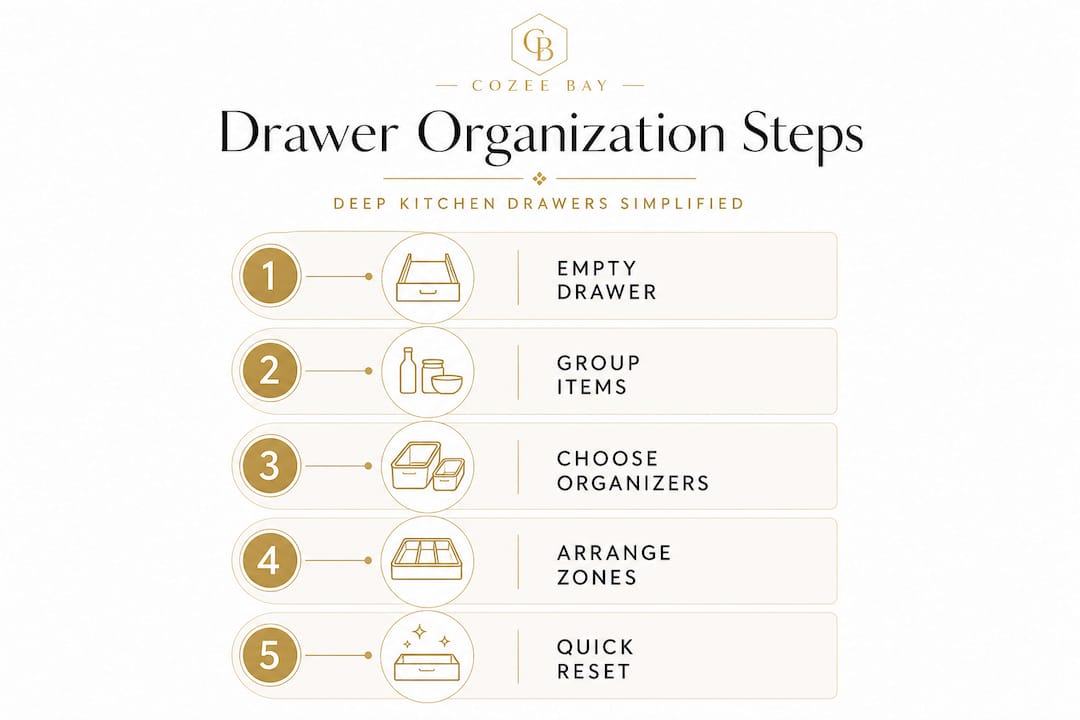
With your materials in hand, it’s time for the main event: actually organizing your deep drawers. Follow these steps in order for the best results.
Clear everything out. Remove every single item from the drawer and lay it on the counter. This is non-negotiable. You can’t plan a space you can’t fully see.
Sort into four piles: keep, rehome, donate, and trash. Be honest. If you haven’t used a tool in over a year, it probably doesn’t belong in a prime kitchen drawer. Items that belong in another room or drawer should be relocated now.
Measure the interior and sketch a rough layout. Note the exact interior dimensions and think about how many zones you need. Deep drawers benefit from being divided lengthwise into sections to spread weight evenly and make items easier to grab without the whole drawer shifting when you pull it open.
Plan zones by task, not just item type. This is where most people go wrong. Instead of one section for “miscellaneous kitchen stuff,” create zones like “baking prep,” “daily cooking tools,” and “serving utensils.” According to Life In Velvet’s deep drawer organizing method, treating deep drawers as zoned systems rather than basic cutlery dividers is what keeps them organized longer.
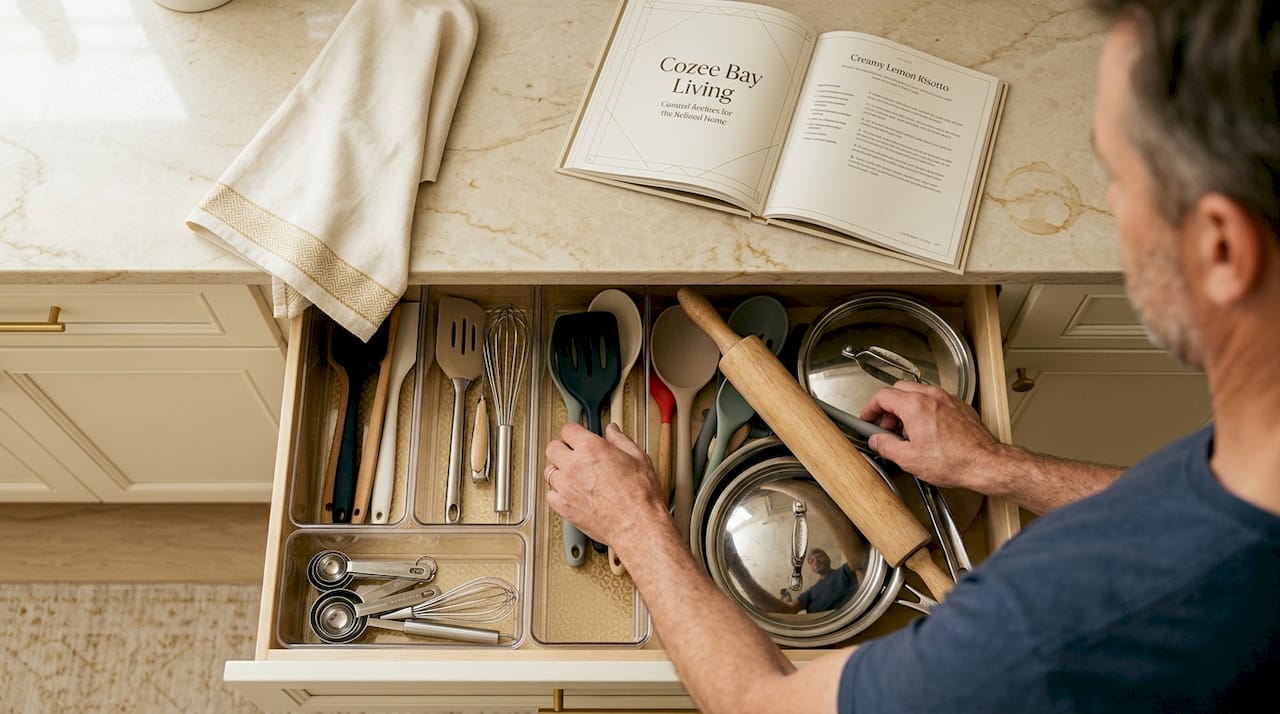
Install your dividers and bins. Place heavier or bulkier items along the sides of the drawer rather than the center. This keeps the weight balanced and prevents the drawer from feeling awkward when opened. You can find detailed guidance on organizing kitchen drawers step-by-step to help map out this phase.
Load items back in by usage frequency. Things you reach for daily, like tongs, wooden spoons, and your main chef’s knife, should be at the front of their zone. Rarely used items go to the back.
Do a test pull. Open and close the drawer a few times. Check that nothing is jamming, that items stay in their zones, and that the overall layout feels intuitive. For more guidance, kitchen drawer efficiency tips offer smart adjustments you can make post-setup.
Before and after comparison:
| Situation | Before organizing | After organizing |
|---|---|---|
| Finding a spatula | Digging through a pile | Grab it instantly from its zone |
| Drawer closing smoothly | Items jamming it open | Everything fits with room to spare |
| Locating a lid | Lifting everything out | Stored separately, always visible |
| Visual appearance | Chaotic, stressful | Tidy, satisfying |
Pro Tip: Group items not just by type but by the meal stage they belong to. Breakfast prep items together, dinner tools together. This mirrors the way you naturally move through your kitchen and makes sustainable kitchen organization feel effortless rather than rigid.
After organizing, you may still face some stubborn drawer problems. Here’s how to solve them efficiently, because even a well-planned system can have a few weak spots.
Preventing the “junk zone” creep. Deep drawers are magnets for random items because they feel like extra space. The fix is simple: every item must have an assigned zone before it enters the drawer. If you can’t figure out where it belongs, it doesn’t belong in that drawer.
Handling mismatched item types. Sometimes a drawer needs to hold both small tools and large serving spoons. Use tiered bins or stacked trays to create visual layers. This lets you use the drawer’s full depth without burying smaller items under larger ones.
Managing pot and pan lids. This is one of the most common pain points in kitchen organization. As highlighted in Life In Velvet’s cookware tip, you should keep lids separate from pots and pans entirely, because nesting lids directly on top of cookware creates chaos and reduces usability. Use a vertical lid holder or a designated bin just for lids within the same drawer.
Adapting to oddly shaped items. Not everything fits neatly into a rectangular bin. For drawer organization for cookware, pegboard-style drawer inserts are a game changer. These inserts use repositionable pegs so you can reconfigure compartments whenever your cookware collection changes. No more cramming things in sideways.
“A well-organized deep drawer isn’t about having fewer things. It’s about knowing exactly where each thing lives so you never waste time hunting.”
Here are a few more targeted solutions to common frustrations:
You can also find creative ideas in smart drawer organization ideas or even draw inspiration from organizing for special occasions, which applies similar zoning principles to shared use spaces.
Now that you know how to solve the biggest issues, let’s make sure your results last with a quick routine. The most beautifully organized drawer can slide back into chaos without a little upkeep.
Do a monthly zone check. Walk through each drawer and look for items that have drifted into the wrong zones. It only takes a few minutes, and catching it early prevents the slow creep back to disorder.
Run a seven-minute reset every few weeks. Empty the drawer, give it a quick wipe, and restock items by category. This refreshes the system and lets you notice if any organizers have shifted or need replacing.
Adapt your zones seasonally. Your kitchen needs shift throughout the year. A baking zone that’s essential in December might be less useful in July when you’re prepping more salads and grilling. Swap zones accordingly rather than fighting a system that no longer fits your routine.
Eco-tip: repurpose or recycle organizers when needs change. If a bamboo divider no longer fits your drawer, move it to a bathroom cabinet, a home office, or a kids’ craft drawer. Quality bamboo and wood organizers are durable enough to travel from room to room. For more ideas, eco-friendly maintenance routines show how to extend the life of your organizers beyond the kitchen.
Prevent clutter before it starts. Set a simple rule: nothing goes into a drawer unless it has a designated zone. This one habit, combined with a clutter-prevention kitchen routine, will do more for long-term tidiness than any single organizer purchase.
Pro Tip: Take a quick photo of each organized drawer after your reset. Next time things get shuffled around, you have a visual reference for exactly how the zones should look.
The reason zoned systems stay organized longer than basic dividers is simple: when every item has a named home, putting things away becomes just as fast as getting them out.
Here’s something most organizational guides won’t say plainly: the biggest reason deep drawer systems fail isn’t laziness or bad products. It’s that people set up the system once, for the version of their life they had at that moment, and never revisit it.
You buy beautiful bamboo dividers, spend a Saturday getting everything perfect, and for a few weeks it holds. Then you start a new meal-prep routine, or someone else in the household starts using the kitchen more, or you buy a new pan that doesn’t fit the old layout. Instead of adjusting the system, most people just start shoving things wherever they fit. Within a month, the drawer looks worse than before.
The real fix is treating organization as a living, evolving setup rather than a one-time project. According to Life In Velvet’s organizing research, the method that tends to stay organized longest treats deep drawers as zoned systems, not just rows of dividers. Zones give you flexibility because you can shift where one zone starts and another ends without buying new products.
Another common mistake is prioritizing appearance over access. Yes, matching bamboo organizers look gorgeous. But if your most-used tools are buried at the back to keep the visual line clean, you’ll start ignoring the system entirely within weeks. The best setup looks good and lets you grab what you need without rearranging half the drawer first. Explore sustainable kitchen organization strategies to find layouts that balance both goals.
Finally, don’t underestimate the value of sustainable materials in keeping a system going long term. Bamboo dividers, unlike cheaper plastic alternatives, don’t crack or warp easily, which means your zones hold their shape even after daily use. When your organizers stay structurally sound, your system stays intact. With these principles, you can avoid the main reasons most deep drawer setups collapse.
Ready to upgrade even further? Explore the best eco-friendly organizers with just a click.
Upgrading your deep kitchen drawers doesn’t require buying the most expensive products on the market. It requires choosing the right products, ones that are built to last, sized for your actual space, and made from materials you can feel good about. That’s exactly what we focus on at Cozee Bay.

From bamboo drawer divider ranges that slot cleanly into any drawer size to modular bins that stack and reconfigure as your needs shift, our handcrafted bamboo products are designed for real kitchens and real routines. Small upgrades like switching from plastic bins to natural bamboo organizers create a surprisingly big difference in how your kitchen looks and feels every day. If you’re ready to see what’s possible, browse our collection for more eco-friendly deep drawer ideas and find the solutions that match your style and values.
Divide drawers lengthwise into sections and assign clear zones for each item type rather than generic dividers, so items are easier to reach and the weight stays balanced when opening the drawer.
Store lids separately from cookware and use a pegboard-style insert with repositionable pegs. As the Life In Velvet cookware tip confirms, nesting lids directly on top of pots and pans creates chaos and makes everything harder to access.
Both are excellent sustainable choices, but bamboo edges ahead because it grows faster and resists warping. Matching bamboo organizers also reduce the visual clutter of a drawer by creating consistent, defined boundaries for every item category.
Set up clear item zones, run a monthly quick reset, and update your layout whenever your kitchen routine changes. The key is treating your drawer system as something you maintain and adjust, not something you set up once and forget.
Comments will be approved before showing up.