Your Cart is Empty


TL;DR:
- Bamboo drawer dividers offer durability, natural beauty, and eco-friendliness over plastic options.
- Proper measurement and moisture considerations are key to fitting bamboo dividers securely.
- Choosing bamboo reduces plastic waste and supports sustainable, long-lasting drawer organization.
Most people assume getting organized just means buying more bins and boxes, usually plastic ones that crack, fade, and end up in a landfill within a few years. That thinking keeps us stuck in a cycle of replacing cheap storage solutions that never really solve the mess. But bamboo drawer dividers are flipping that script. They bring together real durability, natural beauty, and a genuine eco-friendly footprint that plastic simply cannot match. In this guide, you’ll learn what makes bamboo dividers stand apart from the rest, how to pick the right ones for your space, smart ways to use them, and why they matter for the planet over the long haul.
| Point | Details |
|---|---|
| Sustainable choice | Bamboo dividers offer stylish, eco-friendly alternatives to plastic and help reduce landfill waste. |
| Versatile and durable | Adjustable bamboo dividers fit most drawers and last up to 15 years with proper care. |
| Easy tool-free setup | Spring-loaded mechanisms and non-slip pads make installation quick and safe for your furniture. |
| Commercial and home use | Bamboo dividers work well in kitchens, offices, and retail for customizable, organized spaces. |
Open most kitchen or office drawers and you’ll find the same scene: a tangle of utensils, loose pens, and random knick-knacks all sliding into each other every time you pull the drawer open. Standard plastic dividers help a little, but they scratch easily, feel flimsy, and rarely look like anything you’d want in a space you care about. That’s where bamboo drawer dividers change everything.
First, let’s talk about setup. Best adjustable dividers from reputable sources highlight how the spring-loaded design with foam or rubber non-slip pads makes installation completely tool-free. You simply press the divider into place, let the spring tension do the work, and it holds firm without scratching your drawer walls. No drilling, no adhesives, no frustration.
Now consider the material itself. Made from renewable bamboo, these dividers are biodegradable, naturally antimicrobial, and food-safe, making them an obvious fit for kitchen drawers. The grain patterns give each piece a character that plastic could never replicate. Over time, bamboo develops a warm patina that actually makes it look better with age rather than worse.
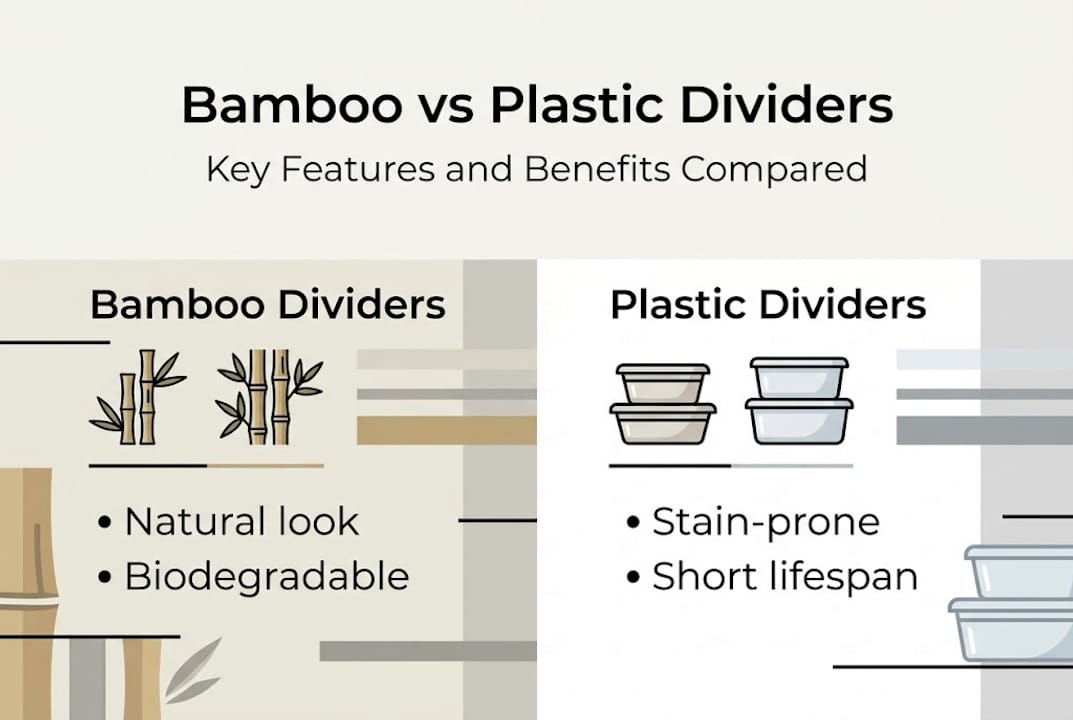
Here’s a side-by-side look at how bamboo stacks up against the competition:
| Feature | bamboo dividers | plastic dividers | MDF/particleboard |
|---|---|---|---|
| Material source | renewable grass | petroleum-based | wood composite |
| Weight capacity | up to 15 lbs/section | 5–8 lbs | 8–12 lbs |
| Environmental impact | biodegrades in 1–5 yrs | centuries in landfill | moderate |
| Natural antimicrobial | yes | no | no |
| Average lifespan | 7–15 years | 2–5 years | 3–8 years |
| Visual appeal | warm, natural grain | flat, generic | plain |
The numbers matter. When you choose bamboo over plastic, you cut roughly 2–4 lbs of plastic waste per household over 12 years. That might not sound dramatic, but multiplied across an office building or a senior living center with dozens of shared spaces, it adds up fast.
Exploring the bamboo dividers’ benefits in detail reveals another advantage most guides skip over: bamboo is technically a grass, not a wood, which means it grows back in three to five years compared to decades for hardwood trees. It’s a genuinely renewable resource, not just a marketing claim.
Worth knowing: Unlike wood, bamboo does not require replanting after harvest. The root system regenerates the plant naturally, making it one of the most sustainably sourced materials available for home and commercial use.
With the basics of why bamboo dividers are a stand-out choice established, let’s get hands-on about finding your ideal fit.
Now that you know what makes bamboo dividers unique, let’s make sure you choose the perfect fit for your needs. Getting this wrong is more common than you’d think, mostly because people skip the measuring step and assume one size fits all. It doesn’t.
Follow these steps before you buy:
Here’s a quick reference for common use cases:
| use case | expansion range | key feature | ideal for |
|---|---|---|---|
| Kitchen utensils | 13–22 in | tall walls, sturdy tension | spatulas, ladles, tongs |
| Office supplies | 11–17 in | shallow profile | pens, clips, notepads |
| Deep pantry drawers | 14–22 in | stackable design | spice packets, small bags |
| Small retail displays | 12–18 in | modular layout | product samples, cards |
| Kids’ activity drawers | 12–20 in | smooth edges | crayons, scissors, markers |
If you want to compare top bamboo organizers side by side, doing so before purchasing saves you from the frustrating experience of returns.
One more thing worth mentioning: humidity affects bamboo. In bathrooms or spaces near dishwashers, always wipe the divider dry before installation. A wet surface will cause the bamboo to swell slightly, which can throw off the fit and, over time, lead to minor warping.
Pro tip: For deeper drawers, look for designs that organize deep drawers with a stackable configuration. Two dividers placed parallel to each other create distinct zones for large and small items without wasting vertical space.
Once you’ve selected your ideal divider, it’s time to maximize every inch of storage. This is where a little creativity goes a long way, and bamboo’s modular nature makes it easier than you might expect.
Bamboo dividers handle a wider range of settings than most people realize. Perfect for kitchens, offices, and retail alike, their food-safe, non-toxic surface means you’re not limited to just utensils. Here’s where else they shine:
Speaking of labels, adding small label inserts to each compartment is one of the easiest ways to make a system stick, especially in shared spaces. When every person in the office knows exactly where the stapler goes, it stays there.
Pro tip: In commercial environments like break rooms, hotel supply closets, or school workrooms, label inserts do double duty. They reduce restocking time and eliminate the “where does this go?” confusion that makes shared spaces messy within a day of organizing.
For your best eco storage ideas, think modular from the start. Place dividers both horizontally and vertically within a single drawer to create a grid-style layout that multiplies your compartment count without adding any extra furniture.
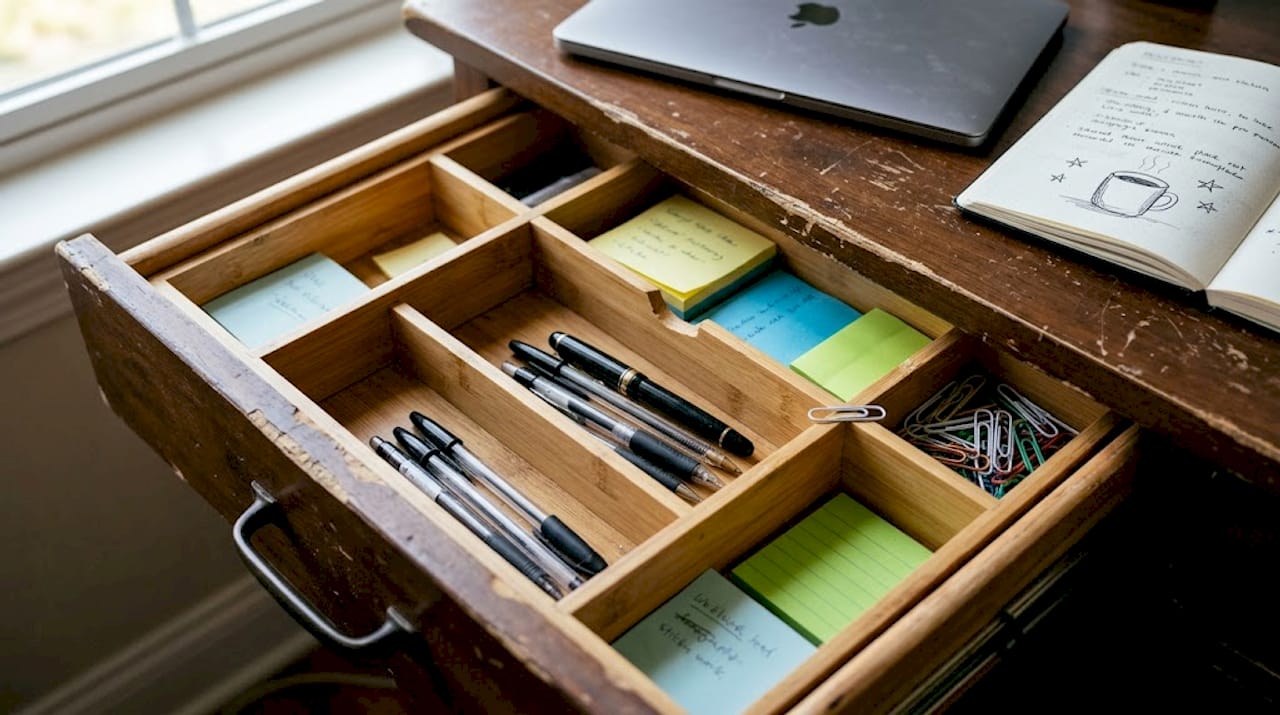
The lifespan advantage is real. Most bamboo dividers last between 7 and 15 years, far outpacing the 2 to 5 year average for plastic alternatives. That means if you set up your drawers thoughtfully this year, you won’t be tearing everything apart and starting over anytime soon. You can find more eco-friendly organization strategies that pair well with bamboo dividers to build a system that’s consistent across your whole home or facility.
And if you want to dig into the specific payoffs of going this route, checking out drawer organizer benefits breaks down the practical case clearly.
Understanding the best organizing strategies is only part of the equation. The material behind the dividers has its own story, and it’s one worth knowing before you buy.
Plastic drawer inserts look similar on the shelf, but they carry a hidden cost. Once cracked or discolored, they head straight to the landfill where they’ll sit for centuries. A bamboo divider, by contrast, biodegrades in 1–5 years at end of life and can last up to 15 years before that moment even arrives. That’s the kind of lifecycle that makes a real difference.
Here’s what choosing bamboo over plastic means in practice:
“Every bamboo divider that replaces a plastic one keeps roughly 2–4 lbs of plastic waste out of the waste stream over a 12-year household lifespan.”
For commercial property managers especially, this adds up across dozens or even hundreds of drawers in a facility. A hotel with 80 rooms, a school with 40 staff desks, or a senior living center with multiple shared kitchens can each prevent meaningful quantities of plastic from entering the waste stream simply by switching their drawer organization to bamboo.
Bamboo also develops a rich patina over time rather than yellowing or brittling like plastic. Each piece becomes visually unique, which is something you’ll never get from a mass-produced plastic tray. For those who value a sustainable drawer workflow, bamboo naturally supports a long-term approach rather than a replace-it-every-few-years mentality.
Exploring all the types of bamboo storage available today shows just how broad the shift toward natural materials has become, from drawer dividers to wrap organizers and beyond.
With the big sustainability picture explored, here’s our direct insight from working with eco-minded clients and spaces. Most guides will tell you bamboo dividers are worth it and leave it there. We want to be a little more honest.
Bamboo is genuinely durable and beautiful, but expert tests confirm that plastic holds up better in high-moisture environments, like bathrooms with consistently wet surfaces. That’s not a reason to avoid bamboo; it’s a reason to use it thoughtfully. Keep bamboo dividers dry, don’t overload sections past their rated weight, and they’ll serve you for well over a decade.
What most guides miss entirely is the quiet satisfaction of a system that just works, year after year. There’s no replacing cracked pieces, no faded color, and no guilt about adding more plastic to the world. That consistency is where bamboo’s real value lives. If you want a fresh dose of bamboo organizer inspiration before making your final decisions, it’s well worth exploring what’s possible before you commit to a layout.
If sorting through your drawers has felt like a chore you keep putting off, bamboo dividers make it a project worth starting today. They’re easy to install, built to last, and genuinely good for the planet in a way that cheap plastic simply isn’t.

At cozee-bay.com, you’ll find sustainable organizers carefully crafted from natural bamboo to fit a wide range of drawers in kitchens, offices, retail spaces, and more. With free shipping within the contiguous U.S. and a money-back guarantee, finding the right fit for your space is straightforward and risk-free. Browse the collection, pick your size, and give your drawers the upgrade they deserve.
Most bamboo dividers use a spring-loaded mechanism with foam or rubber non-slip pads that lock securely into place without any drilling or adhesives needed.
Yes. High-quality bamboo is naturally antimicrobial and food-safe, making it a reliable choice for kitchen drawers where utensils and food-related items are stored.
Many models are stackable and adjustable, and expandable stackable designs accommodate a wide range of drawer widths and depths, including deeper configurations that standard organizers can’t reach.
Absolutely. 2–4 lbs of plastic can be kept out of landfills per household over 12 years simply by choosing bamboo dividers, which are renewable, biodegradable, and free from toxic manufacturing byproducts.
Comments will be approved before showing up.