Your Cart is Empty


Most commercial biodegradable golf balls are built from a water-soluble resin called polyvinyl alcohol (PVA) combined with starch-based fillers and a short list of benign additives. The goal is simple: a ball that flies, then disappears safely in water without leaving microplastics behind.
Here is the typical composition by function:
Vendor and product pages commonly cite dissolution windows of a few days to a few weeks, though actual breakdown speed depends on water temperature, salinity, and microbial activity. Great Lakes Echo’s independent reporting confirms that the two main ingredients across most available products are corn starch and PVA, both of which dissolve in water and carry a non-toxic profile.
Biodegradable golf balls built from verified PVA and starch formulations offer genuine environmental benefits for marine and waterfront use, but only when backed by OECD 301B test data and transparent ingredient disclosure.
| Point | Details |
|---|---|
| Primary materials | PVA plus corn starch, glycerin, and calcium carbonate make up most formulations. |
| Mineralization matters | True environmental benefit requires mineralization to CO2 and water, not just fragmentation into smaller pieces. |
| Verify before you buy | Look for OECD 301B test reports, published ingredient concentrations, and an available MSDS. |
| Performance trade-off | These balls are practice and novelty grade; expect shorter distance and humidity sensitivity in storage. |
| Right context only | Marine and waterfront use is the intended application; competitive or retrieval-based play is not. |
PVA is the workhorse. It is a synthetic polymer, but one with an unusual property: it dissolves in water through hydrolysis and is then broken down by soil and aquatic microbes. PlayGreenly reports that many eco golf balls are formulated with roughly 95% PVA plus small percentages of natural plasticizers, making PVA the dominant material by a wide margin. The Zero® Ball Environmental Fact Sheet identifies PVA as the primary ingredient and cites ecotoxicity data showing it is classified as practically non-toxic to aquatic organisms.
Starch-based fillers, typically corn starch, serve a different purpose. They add mass to hit a usable weight target and contribute to the ball’s core structure. Because corn starch is food-grade, it carries a naturally non-toxic profile and breaks down readily in wet environments. Some marine-targeted products go further, blending in fish-food ingredients such as minerals, oils, and proteins so that any residue actually feeds local aquatic life rather than harming it.
Beyond PVA and starch, patent literature documents a broader range of biodegradable polymers that manufacturers experiment with. WIPO Patentscope records formulations using polylactic acid (PLA), polyhydroxybutyrate (PHB), and other polyhydroxyalkanoates (PHAs). These materials tend to appear in more specialized or next-generation products, where engineers need tighter control over rebound and durability than PVA alone provides.
One product specification from Biodegradable Golf Canada publishes ingredient concentrations directly: PVA in the majority, with glycerin, calcium carbonate, and water as minor components. That level of transparency is exactly what you should look for when shopping.
| Material | Key property | Role in the ball |
|---|---|---|
| Polyvinyl alcohol (PVA) | Water-soluble, film-forming | Structural binder; dissolves in water |
| Corn starch | Biodegradable, food-grade | Core filler; adds weight and bulk |
| Glycerin | Plasticizer, hygroscopic | Keeps material pliable; aids molding |
| Calcium carbonate | Inert mineral, density adjuster | Tunes weight; food-safe |
| PLA / PHAs | Biodegradable polyesters | Alternative binders in specialty formulations |
Pro Tip: When evaluating any eco golf ball, look for a published MSDS (Material Safety Data Sheet) or ingredient list with approximate percentages. A brand that only says “natural materials” is not.
The outcome you want is mineralization, not fragmentation. Mineralization means the polymer chains break all the way down to carbon dioxide and water, leaving nothing solid behind. Fragmentation, by contrast, just means a material breaks into smaller pieces, which can still accumulate as microplastics in sediment and food chains.
PVA and starch both follow a mineralization pathway. Water triggers hydrolysis, which unravels the polymer chains. Aquatic and soil microbes then consume the resulting smaller molecules, completing the breakdown. The end products are CO2, water, and trace biomass. No persistent residue.
The critical distinction for buyers: A ball that “breaks down” is not the same as a ball that mineralizes. Fragmentation into microplastics is still breakdown, technically. Only mineralization verified by a recognized test protocol gives you confidence that nothing harmful remains.
To confirm mineralization rather than mere fragmentation, look for OECD 301B test results. OECD 301B is the industry-standard protocol for demonstrating that a material reaches true biodegradation thresholds under controlled aquatic conditions. It measures the percentage of carbon converted to CO2 over a set period, which is a direct measure of mineralization.
Here is how to read the process in sequence:
Pro Tip: Ask any manufacturer for their OECD 301B test report, not just a claim that the ball is “biodegradable.” The report should show the percentage of carbon converted to CO2 and the test conditions used, including water type and temperature.
The core resin and filler get you most of the way there, but manufacturers add a short list of functional ingredients to make the ball moldable, durable enough for a round, and properly weighted.
From patent literature: WIPO Patentscope records formulations that use interpenetrating polymer networks and blends of ester-containing biodegradable compounds with thermoplastic resins. The engineering goal is to achieve both acceptable rebound and reliable biodegradation, two properties that are genuinely difficult to optimize simultaneously.
The tradeoff is real. Adding more plasticizer improves moldability but can slow dissolution. Adding more calcium carbonate improves weight consistency but reduces the proportion of biodegradable material. Every formulation is a negotiation between performance and environmental outcome, which is why published ingredient concentrations matter so much when you are comparing products.
Biodegradable golf balls are intentionally lower performance than the multi-layer urethane balls used in competitive play. That is a design choice, not a flaw. The same water-soluble chemistry that makes them dissolve safely also limits their compression, rebound, and distance.
Practical use cases where they make real sense:
A clear warning: Do not use biodegradable balls for competitive rounds, high-swing-speed practice where distance accuracy matters, or in conditions where you expect to retrieve and reuse them. Once they absorb moisture, their structural integrity drops quickly.
Storage sensitivity is a real concern. Because PVA is hygroscopic, meaning it absorbs moisture from the air, balls stored in humid conditions can soften or warp before you ever hit them. Keep them sealed in their original packaging in a dry, climate-controlled space. A garage in a humid Southern summer is not ideal storage.
Great Lakes Echo notes that manufacturers intentionally limit flight performance to keep these products positioned as practice and novelty items rather than competitive-grade equipment. For golfers curious about the broader world of golf club personalization and eco-conscious gear choices, that context matters when setting expectations.
Greenwashing is common in the eco-products space, and golf balls are no exception. Here is a practical checklist before you buy:
Specific questions worth asking any manufacturer:
Biodegradable Golf Canada’s product page is a good example of healthy disclosure: it publishes ingredient concentrations directly on the product listing. That kind of transparency is a strong signal. A vague claim like “eco-friendly” or “dissolves naturally” with no supporting data is a weak one.
Understanding the difference between “biodegradable” and “compostable” also helps here. Cozee-bay’s guide on biodegradable versus compostable breaks down those distinctions clearly, which is useful context when reading manufacturer claims.
Pro Tip: Product specification pages that publish ingredient concentrations and MSDS documents are the best immediate indicators of a transparent supply chain. If a brand hides its formulation behind vague marketing language, treat that as a red flag.
The short answer is yes, if the product is specifically engineered for marine use and you have confirmed it mineralizes rather than fragments. Balls formulated with PVA and food-grade starch are designed to dissolve in seawater and leave no microplastic residue. That said, conditions matter.
Environmental considerations for marine use:
On legal and regulatory use: There is no single federal rule in the United States governing golf balls in public waters, but local ordinances, state environmental regulations, and marina rules vary widely. Always check with your local harbor authority or state environmental agency before hitting balls into public waterways.
Pro Tip: Use biodegradable marine golf balls only in designated areas or open ocean, never in protected marine reserves, shallow reefs, or areas with visible wildlife activity. Responsible use means choosing the right location, not just the right ball.
The manufacturing process for PVA-based biodegradable golf balls follows a path similar to conventional injection molding, with some important differences driven by the material’s sensitivity to heat and moisture.
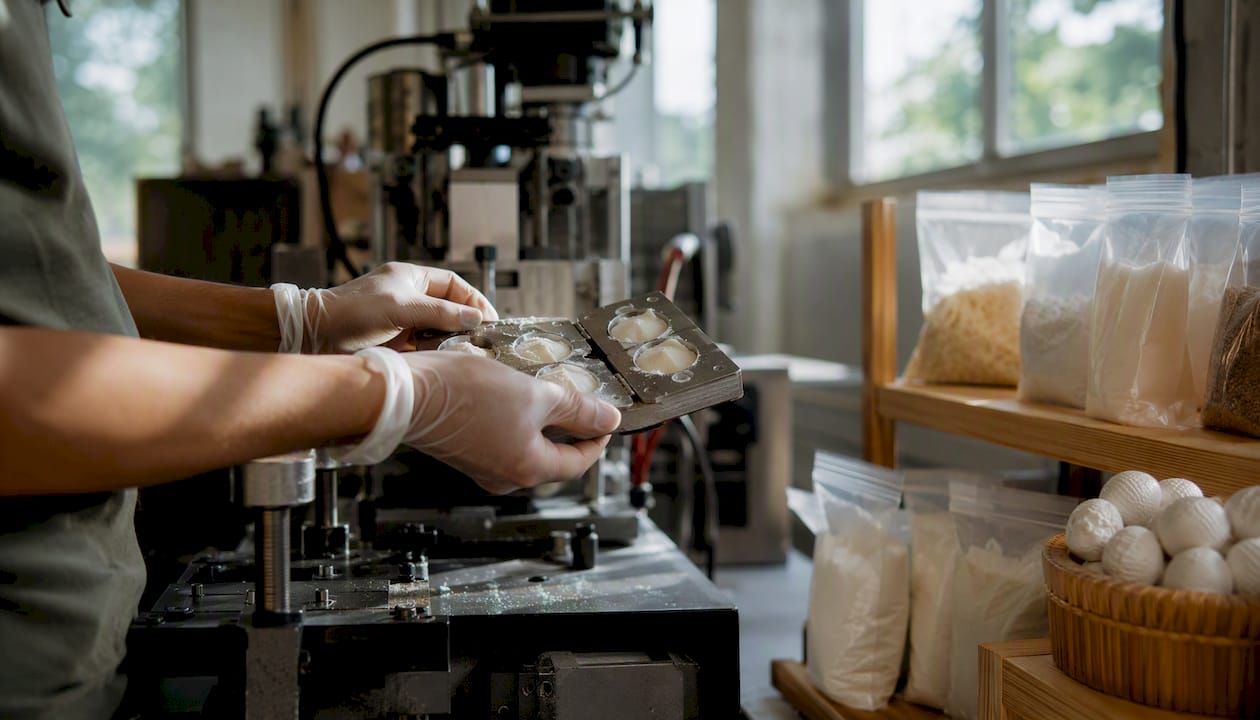
Manufacturers start by blending dry PVA resin with starch, calcium carbonate, and glycerin in precise ratios. The mixture is then compounded, meaning it is melted and mixed under controlled heat and shear to create a homogeneous moldable mass. Glycerin plays a critical role here: without it, PVA becomes brittle under the heat of processing.
The compounded material is then injection-molded into spherical shells or solid cores, depending on the product design. Because PVA absorbs moisture readily, the entire process takes place in low-humidity conditions. Finished balls are immediately sealed in moisture-barrier packaging to preserve shelf life.
Some manufacturers apply a thin outer coating to improve surface feel and slow initial moisture absorption during play. That coating is typically also biodegradable, though its dissolution rate may differ from the core material. Patent literature on WIPO Patentscope documents several approaches to coating biodegradable cores with compatible outer layers that maintain ball roundness and surface texture without compromising overall dissolution.
Traditional golf balls are built from synthetic rubber cores (typically polybutadiene), surlyn or urethane covers, and multi-layer windings. None of those materials biodegrade meaningfully in a human timeframe. A conventional golf ball lost in a water hazard can persist for decades.
The contrast in materials is stark:
| Dimension | Traditional golf ball | Biodegradable golf ball |
|---|---|---|
| Core material | Polybutadiene rubber | PVA resin or starch blend |
| Cover material | Surlyn or urethane | PVA or biodegradable polymer |
| Environmental fate | Persists for decades | Mineralizes in water (weeks to months) |
| Microplastic risk | High (rubber and polymer fragments) | Low to none with verified mineralization |
| Performance | Tour-grade distance and spin | Limited distance; practice-grade |
| Toxicity profile | Synthetic rubber; not food-safe | Non-toxic; food-grade ingredients |
The environmental gap is significant. Millions of golf balls are lost in water hazards, oceans, and rough terrain every year in the United States. Conventional balls shed microplastics as they degrade slowly. A verified biodegradable ball eliminates that residue entirely, provided it actually mineralizes. That distinction, between a ball that fragments and one that mineralizes, is the whole ballgame environmentally speaking.
For golfers who want to explore sustainable golf ball options alongside other eco-conscious gear, the performance trade-off is worth understanding before purchase.
The marketing around eco golf balls has gotten ahead of the science in some cases. You will find products labeled “biodegradable” that offer no test data, no ingredient list, and no dissolution timeframe. That is not transparency; it is a label.
The golfers who get the most out of biodegradable balls are the ones who treat them as the specialized tool they are: a product designed for a specific context (marine and waterfront use) with a specific environmental benefit (no microplastic accumulation) and real performance limits (shorter distance, humidity sensitivity).
A few practical habits worth building:
Cozee-bay’s commitment to sustainable materials extends well beyond golf. If you are building a more eco-conscious lifestyle across the board, exploring eco-friendly product choices is a natural next step.

Comments will be approved before showing up.