Your Cart is Empty


Finding elegant, planet-friendly solutions for your Canadian or American restaurant can feel like a challenge when sustainability and style both matter. Bamboo, recognized for its rapid renewability and strength, brings fresh possibilities to commercial spaces seeking greener alternatives to traditional products. With advancements in engineered bamboo materials, more North American restaurant owners are discovering creative ways to showcase their sustainable values while delivering a memorable customer experience.
| Point | Details |
|---|---|
| Sustainable Material | Bamboo is a rapidly renewable resource with diverse commercial applications, offering significant environmental advantages. |
| Innovative Applications | Industries are utilizing bamboo in biotech, sustainable packaging, and advanced materials, pushing the boundaries of traditional uses. |
| Mechanical Performance | Bamboo’s high tensile strength and flexibility make it suitable for various sectors, including construction and manufacturing. |
| Regulatory Compliance | Businesses must adhere to strict legal standards and certifications to ensure the safety and sustainability of bamboo products. |
Bamboo represents a revolutionary sustainable material with extraordinary potential for commercial applications across multiple industries. Rapid growth characteristics make bamboo a unique renewable resource, transforming how businesses approach environmental sustainability and material sourcing.
Commercial bamboo applications have expanded dramatically, moving far beyond traditional uses like handicrafts and construction. Modern industries now leverage bamboo’s remarkable properties for advanced purposes including:
The plant’s exceptional growth rate allows bamboo to reach up to 1 meter per day, with global cultivation spanning approximately 37 million hectares. This rapid renewability makes bamboo an attractive alternative to slower-growing timber and synthetic materials. Versatile commercial potential positions bamboo as a key sustainable resource, offering environmental and economic advantages.
Bamboo’s commercial viability stems from its outstanding mechanical properties, including high tensile strength and remarkable flexibility. These characteristics enable its use across diverse sectors - from restaurant supplies to construction equipment. Manufacturers increasingly recognize bamboo as a green innovation platform that simultaneously addresses sustainability goals and delivers high-performance solutions.
Pro tip: When exploring bamboo for commercial applications, prioritize species with proven performance metrics and verify mechanical consistency across your intended use case.
Bamboo’s versatility has transformed it into a powerhouse material for commercial applications across numerous industries. Engineered bamboo building materials represent a significant commercial innovation, offering sustainable alternatives to traditional construction resources.
The global bamboo product landscape encompasses a wide range of commercial applications, including:
Engineered bamboo products have particularly gained traction in commercial sectors. These specialized materials include:
Global bamboo trade spans over 12 distinct product categories, highlighting the material’s remarkable economic potential. Manufacturers are increasingly recognizing bamboo’s ability to deliver high-performance solutions while maintaining strong environmental credentials.
Below is a summary of engineered bamboo products and their primary commercial use cases:
| Product Type | Main Use Case | Key Advantage |
|---|---|---|
| Laminated Bamboo Lumber | Structural framing, flooring | Consistent performance |
| Parallel Strand Bamboo | Beams, load-bearing elements | High strength-to-weight |
| Bamboo Mat Boards | Wall panels, decorative layers | Dimensional stability |
| Bamboo Particleboards | Furniture, cabinetry | Cost-effective alternative |
| Laminated Bamboo Sheets | Countertops, tabletops | Smooth finish, durability |
The commercial potential of bamboo extends beyond traditional uses, with industries discovering innovative applications in biotechnology, sustainable packaging, and advanced material manufacturing. Its exceptional strength-to-weight ratio, rapid renewability, and minimal environmental impact make bamboo an attractive option for businesses seeking sustainable alternatives.
Pro tip: When selecting bamboo products for commercial use, prioritize suppliers who provide detailed mechanical performance data and sustainability certifications.
Bamboo’s functional advantages offer transformative potential for businesses seeking sustainable and high-performance materials. Its unique properties extend far beyond traditional resource applications, providing companies with innovative solutions across multiple commercial sectors.
The key functional advantages of bamboo in business settings include:
Businesses can leverage bamboo’s functional benefits across diverse industrial applications, such as:
Industrial applications demonstrate bamboo’s potential for business resilience, enabling companies to simultaneously address environmental sustainability and economic performance. Mechanical properties and rapid renewability make bamboo an attractive alternative to traditional materials.

The strategic advantages of bamboo extend beyond environmental considerations. Its versatility supports human-centric business models, creating opportunities for economic development while maintaining strong ecological principles. Innovative companies are discovering that bamboo can simultaneously reduce carbon footprints and enhance product performance across multiple industries.
Pro tip: Conduct comprehensive material testing to fully understand bamboo’s specific performance characteristics for your unique business application.
Bamboo product regulations require comprehensive compliance strategies that address multiple legal and safety considerations for commercial applications. Businesses must navigate a complex landscape of international standards to ensure their bamboo products meet rigorous environmental and safety requirements.
Key legal and safety considerations for bamboo commercial products include:
The regulatory framework for bamboo products involves several critical compliance mechanisms:
Certification standards play a crucial role in demonstrating product legitimacy. Companies can validate their bamboo products through recognized certifications like:
Effective compliance requires businesses to implement robust documentation processes, conduct thorough risk assessments, and maintain transparent supply chain records. Importers and manufacturers must proactively manage regulatory requirements to successfully integrate bamboo products into commercial markets.
Pro tip: Develop a comprehensive compliance checklist that tracks regulatory requirements across different international markets to streamline your bamboo product certification process.
Bamboo construction economics reveal compelling advantages over traditional building materials, challenging existing perceptions about renewable resources. Its unique characteristics position bamboo as a transformative material for environmentally conscious businesses and industries.
Key comparative advantages of bamboo include:
Material comparisons demonstrate bamboo’s competitive edge across several dimensions:
Lumber alternatives show bamboo’s remarkable sustainability potential, particularly in seismic-resistant construction. Lifecycle cost-effectiveness remains a critical consideration, with bamboo offering significant economic advantages pending supportive policy frameworks and technical infrastructure development.
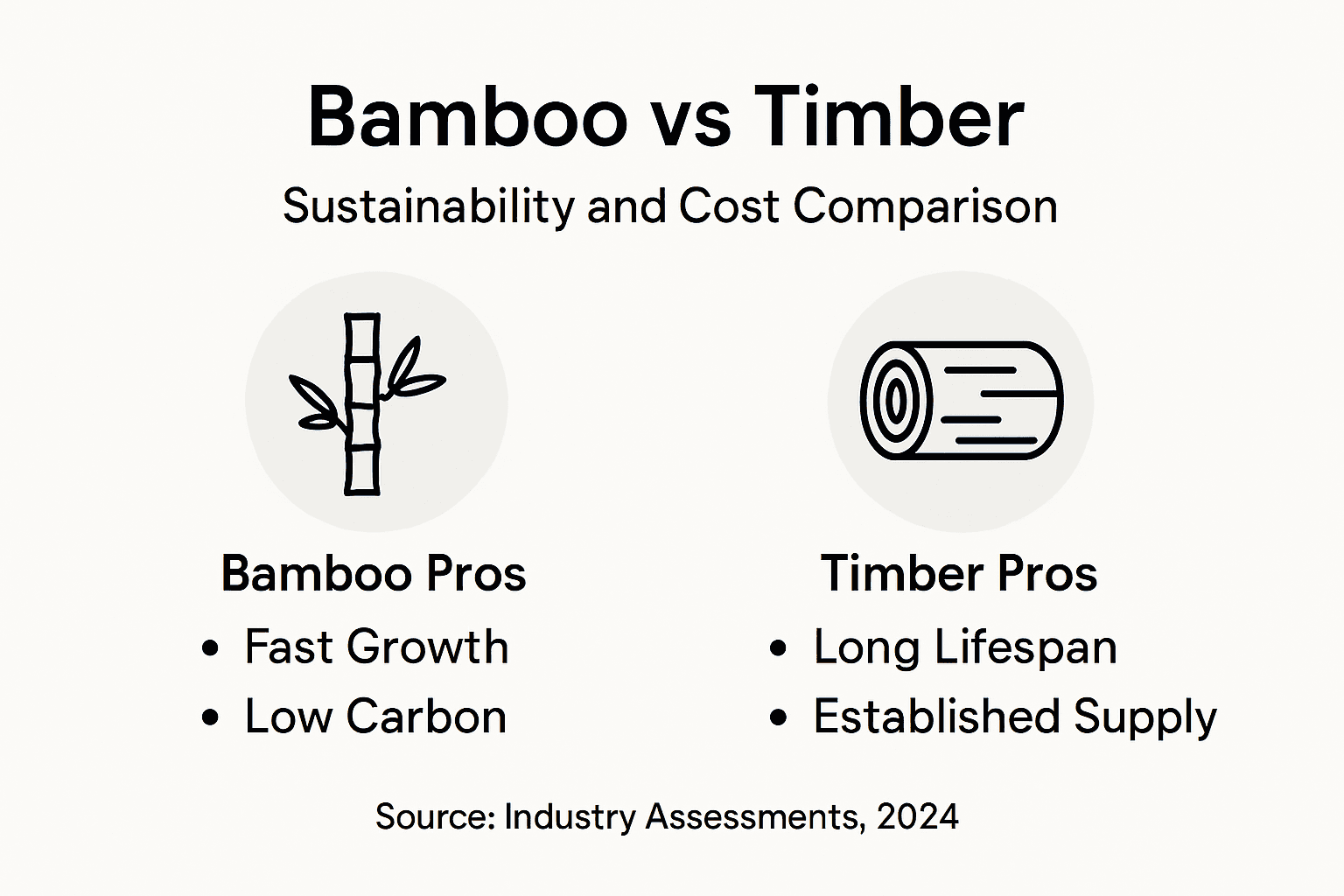
While challenges exist in market acceptance and regulatory standards, bamboo represents an increasingly attractive alternative to conventional materials. Its combination of environmental benefits, rapid renewability, and competitive pricing makes it an innovative solution for forward-thinking commercial applications.
Here is a comparison of bamboo versus traditional timber for commercial material sourcing:
| Criterion | Bamboo | Traditional Timber |
|---|---|---|
| Growth Cycle | 3-5 years | 6-12 years |
| Carbon Footprint | Low | Moderate to high |
| Structural Strength | High tensile, flexible | High compressive strength |
| Production Cost Trend | Decreasing with scale | Fluctuates with demand |
| Environmental Impact | Regenerates quickly, low input | Deforestation risks present |
| Material Versatility | Diverse modern applications | Construction and furniture |
Pro tip: Conduct comprehensive cost-benefit analyses that incorporate both short-term expenses and long-term sustainability metrics when evaluating bamboo as a material option.
If you are inspired by bamboo’s rapid renewability and impressive strength to reduce environmental impact in your commercial space, Cozee Bay offers expertly crafted products designed to meet those needs. Our Commercial Paper Towel Dispensers | Cozee Bay® combine functionality with eco-conscious design, perfect for restaurants, schools, senior living centers, and more. These dispensers not only showcase bamboo’s durability and sleek style but also align with your goal to choose sustainable, high-performance materials.
Make the switch today and support your commitment to sustainability without compromising quality. Explore our full range of bamboo products including the elegant Bamboo Paper Towel Dispenser- A Sleek Look Home or Office and discover how Cozee Bay’s handcrafted bamboo solutions help you meet your environmental goals. Start transforming your space now by visiting Cozee Bay and experience the natural strength and eco-friendly advantages of bamboo.
Bamboo is used in various commercial applications including construction materials, furniture manufacturing, textile production, paper and pulp industry, kitchenware, and even food products like edible bamboo shoots.
Bamboo has a faster growth cycle of 3-5 years compared to 6-12 years for traditional timber. It also has a lower carbon footprint and regenerates quickly, making it a more sustainable choice.
Bamboo possesses high tensile strength, remarkable flexibility, and a favorable strength-to-weight ratio, allowing it to be effectively utilized in construction, advanced materials, and various industrial applications.
Look for recognized certifications such as Forest Stewardship Council (FSC) and Programme for the Endorsement of Forest Certification (PEFC), which verify the product’s sustainability and environmental impact.
Comments will be approved before showing up.