Your Cart is Empty


Finding beautiful, sustainable materials for restaurants and cafes often feels like a balancing act between style and environmental responsibility. For North American property managers, organic bamboo is quickly rising as a favorite thanks to its rapid renewability and minimal environmental footprint. Boldly different from traditional hardwood, this eco-friendly grass matures in just three to five years and thrives without synthetic pesticides or fertilizers, offering an appealing blend of durability, performance, and modern design. Discover how this rapidly renewable resource can transform your commercial space while supporting true sustainability.
| Point | Details |
|---|---|
| Unique Resource | Organic bamboo is a rapidly renewable resource that offers significant environmental advantages. |
| Diverse Applications | Bamboo products range from structural to non-structural categories, enhancing versatility in commercial spaces. |
| Sustainability Benefits | Bamboo supports ecological balance with features like low water consumption and natural carbon sequestration. |
| Cost-Effectiveness | Selecting bamboo can reduce long-term maintenance costs while delivering high performance. |
Organic bamboo represents a sustainable plant resource with unique characteristics that often surprise commercial property managers seeking eco-friendly solutions. Complex biological characteristics distinguish bamboo from traditional timber materials, challenging many preconceived notions about its origin and cultivation.
Contrary to popular belief, bamboo is not a tree but a member of the grass family with extraordinary growth capabilities. Its classification as a rapidly renewable resource stems from its ability to mature quickly, often reaching full height within 3-5 years compared to decades required for traditional hardwood trees. When cultivated organically, bamboo demonstrates remarkable environmental advantages:
Organic certification for bamboo involves stringent standards that go beyond traditional agricultural practices. Sustainable cultivation methods ensure the plant is grown without chemical interventions, maintaining ecological integrity throughout its production cycle. This approach protects soil health, water resources, and surrounding biodiversity.
Many commercial spaces mistakenly view bamboo as a homogeneous material, but organic bamboo encompasses diverse species with unique properties. Some variants excel in durability, while others provide superior aesthetic qualities for interior design. Understanding these nuanced differences allows property managers to make informed sustainable choices that align with both environmental goals and functional requirements.
Pro tip: When evaluating organic bamboo for commercial spaces, request third-party organic certification documentation to verify sustainable cultivation practices and environmental standards.
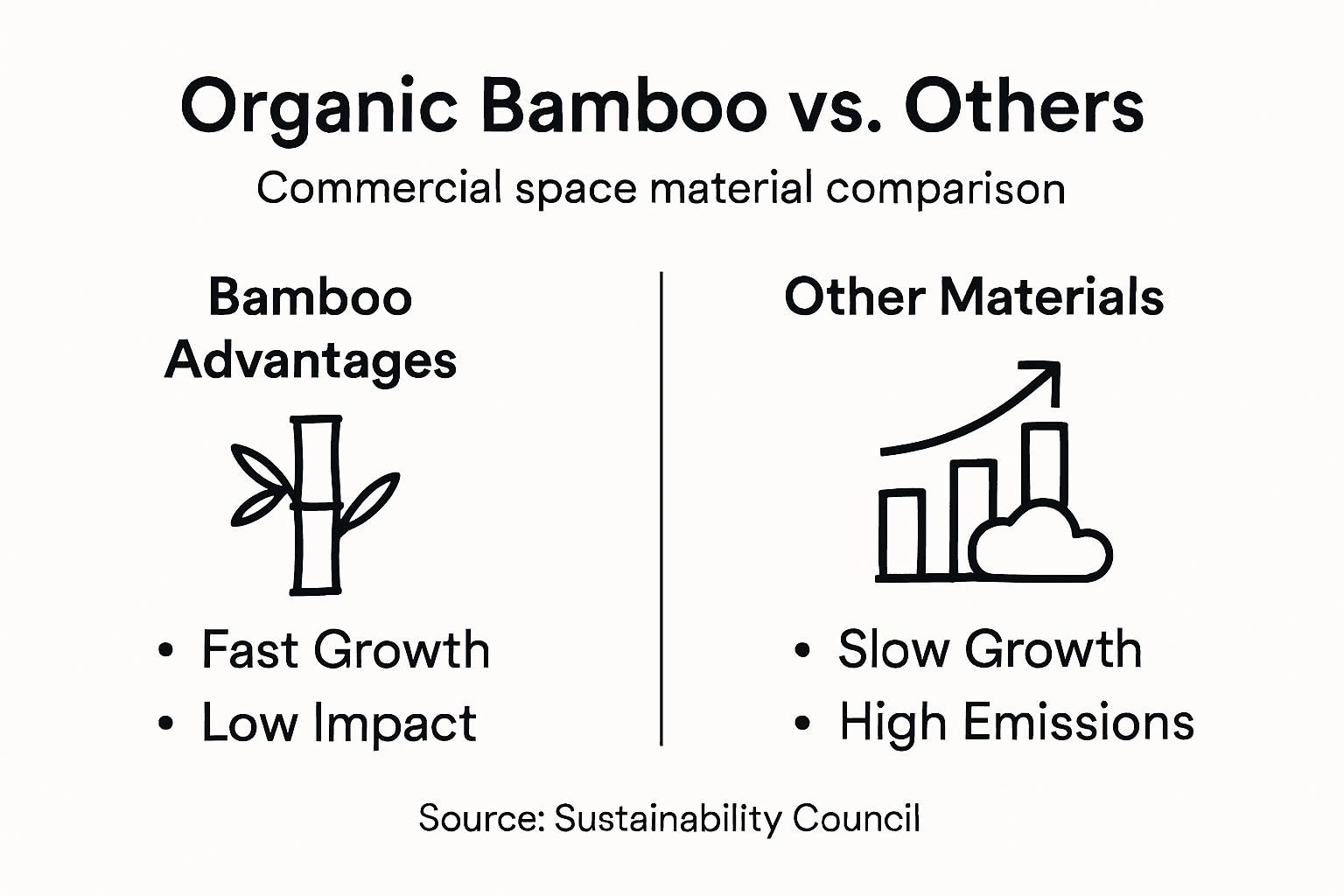
Here’s how organic bamboo compares to common commercial materials:
| Aspect | Organic Bamboo | Traditional Hardwood | Synthetic Materials |
|---|---|---|---|
| Renewal Time | 3-5 years maturity | 20-70 years maturity | Non-renewable |
| Water Requirement | Very low | Moderately high | Varies, usually low |
| Chemical Use in Cultivation | Minimal or none | Frequent pesticides/fertilizers | High for plastics |
| Carbon Sequestration | High (per acre) | Moderate | Often negligible |
| End-of-life Disposal | Biodegradable | Biodegradable | Non-biodegradable |
Commercial spaces are increasingly discovering the versatility of bamboo through an expanding range of innovative product applications. Comprehensive product categories reveal bamboo’s remarkable potential across multiple commercial sectors, transforming traditional design and construction approaches.
Bamboo products for commercial environments can be broadly categorized into several critical classifications:
Structural Products:
Non-Structural Products:
The manufacturing processes for commercial bamboo products involve sophisticated techniques that transform raw bamboo into high-performance materials. Advanced commercial applications demonstrate how raw bamboo culms can be processed into complex, engineered solutions suitable for diverse commercial environments, ranging from hospitality design to sustainable office infrastructure.
Beyond traditional applications, emerging bamboo technologies are expanding commercial possibilities. Innovative sectors are now exploring bamboo for textile production, bioenergy generation, and advanced bio-based materials. These developments suggest that bamboo is not merely an alternative material but a transformative solution capable of addressing complex commercial design and sustainability challenges.
Pro tip: When selecting bamboo products for commercial spaces, request detailed performance specifications and third-party certifications to ensure material quality and sustainability standards.
This table summarizes leading bamboo product categories and their main business use:
| Product Category | Examples | Primary Commercial Use |
|---|---|---|
| Structural | Engineered lumber, Glubam | Walls, beams, building frames |
| Non-Structural | Flooring, wall panels | Interiors, finishes |
| Hospitality & Service | Tableware, utensils, packaging | Restaurants, cafes |
| Advanced Technology | Textiles, bioenergy, composites | Apparel, energy, materials |
Organic bamboo represents a groundbreaking sustainable material with extraordinary environmental attributes that distinguish it from traditional commercial building resources. Comprehensive sustainability analysis reveals multiple ecological advantages that make bamboo an increasingly attractive option for environmentally conscious commercial spaces.
The key sustainability features of organic bamboo can be categorized into several critical dimensions:
Environmental Performance:
Material Characteristics:
Unlike conventional materials, organic bamboo undergoes specialized treatment processes that enhance durability while maintaining ecological integrity. These sophisticated manufacturing techniques minimize environmental impact by reducing chemical interventions and preserving the material’s inherent sustainable properties. The result is a versatile product that offers superior performance with significantly lower environmental consequences compared to traditional commercial building materials.

Commercial spaces adopting organic bamboo contribute to broader sustainability goals by selecting a material that actively supports ecological balance. Beyond its immediate functional benefits, bamboo represents a holistic approach to sustainable design, offering architects and property managers an opportunity to make meaningful environmental choices without compromising on quality or aesthetic standards.
Pro tip: Conduct comprehensive lifecycle assessments when selecting organic bamboo products to understand their complete environmental impact and long-term sustainability benefits.
Culinary sustainability strategies are transforming how restaurants and cafes integrate eco-friendly materials, with bamboo emerging as a revolutionary solution across multiple operational dimensions. Modern foodservice environments are discovering bamboo’s versatility beyond traditional expectations, reimagining everything from ingredient sourcing to dining infrastructure.
Bamboo’s real-world applications in restaurants and cafes span several critical categories:
Ingredient Applications:
Dining Infrastructure:
The integration of bamboo products goes far beyond aesthetic considerations, representing a holistic approach to sustainable gastronomy. Innovative culinary practices demonstrate how bamboo can simultaneously enhance nutritional value, reduce environmental impact, and create unique dining experiences that appeal to environmentally conscious consumers.
Restaurants and cafes are increasingly recognizing bamboo as more than a material - it’s a statement of ecological commitment. By incorporating bamboo-based products, these establishments communicate their dedication to sustainability, attract eco-aware customers, and contribute to broader environmental conservation efforts. The versatility of bamboo allows for seamless integration across different restaurant concepts, from casual coffee shops to high-end dining establishments.
Pro tip: Conduct a comprehensive sustainability audit of your current dining infrastructure to identify potential bamboo replacement opportunities that align with your restaurant’s environmental goals.
Investors and commercial property managers constantly seek materials that balance performance, sustainability, and economic efficiency. Comparative material assessments reveal bamboo as a transformative solution that challenges traditional construction and design material paradigms, offering remarkable advantages across multiple critical dimensions.
When comparing bamboo to conventional alternatives, key performance metrics demonstrate its exceptional value:
Cost Considerations:
Durability Factors:
Ecological Impact:
Beyond raw performance metrics, sustainability research demonstrates bamboo’s potential to revolutionize commercial material selection. Bamboo composites consistently outperform traditional alternatives in life cycle assessments, offering superior durability while maintaining a substantially lower environmental impact. This makes bamboo an increasingly attractive option for forward-thinking organizations prioritizing both economic and ecological considerations.
The economic argument for bamboo extends beyond immediate cost savings. By selecting bamboo, commercial spaces invest in a material that represents a holistic approach to sustainability, signaling organizational commitment to environmental responsibility while delivering high-performance infrastructure solutions.
Pro tip: Conduct a comprehensive cost-benefit analysis comparing bamboo with traditional materials, factoring in long-term sustainability and maintenance expenses.
Managing commercial spaces demands materials that reflect your commitment to sustainability without sacrificing durability or style. This article highlights the importance of choosing organic bamboo, a renewable resource with minimal environmental impact and exceptional strength. Whether you aim to reduce your carbon footprint, minimize chemical use, or create an inviting atmosphere, bamboo products offer the perfect balance. Cozee Bay specializes in handcrafted bamboo essentials like our Bamboo Paper Towel Dispenser, designed for environments ranging from restaurants to office spaces. These dispensers showcase the natural beauty and resilience of bamboo while supporting your eco-conscious goals.
Elevate your commercial space today by choosing eco-friendly bamboo products that blend functionality, style, and sustainability. Explore our full collection at Cozee Bay and enhance your workspace with smart solutions like the Cozee Bay Food Bag Storage Organizers that complement your sustainable lifestyle. Act now to invest in quality craftsmanship that aligns with your environmental vision and delivers long-lasting value.
Organic bamboo offers multiple advantages, including a rapid growth cycle, minimal water consumption, low carbon footprint, and biodegradability. These features make it a sustainable choice for eco-conscious commercial environments.
Organic bamboo matures much faster than traditional hardwood, typically within 3-5 years compared to decades for hardwood trees. Additionally, bamboo grows without the need for synthetic pesticides or fertilizers, making it a more sustainable choice overall.
Organic bamboo can be transformed into a variety of products, including structural materials like engineered lumber and beams, as well as non-structural items such as flooring, furniture, and decorative wall panels.
Organic bamboo boasts a high strength-to-weight ratio and natural durability without heavy chemical treatments, making it comparable to synthetic materials. Additionally, it tends to have a lower ecological impact, contributing to its long-term viability in commercial applications.
Comments will be approved before showing up.