Your Cart is Empty


Biodegradable materials are substances that microbes and enzymes can break down into natural elements. Common examples include food scraps, paper, cotton, bamboo, cork, hemp, and certain bioplastics like PLA. Some of these break down relatively quickly in a backyard compost pile. Others need the controlled heat of an industrial composting facility to fully decompose.
Here’s a quick way to think about it:
Biodegradable does not mean “disappears anywhere, anytime.” The same apple core that composts in three weeks in your backyard bin could sit largely intact in a sealed landfill for months, starved of oxygen and microbial activity.
Biodegradation, as defined by IUPAC, is the enzymatic breakdown of a substance by living organisms, particularly microbes, into simpler compounds like water, carbon dioxide, and organic matter. The key word is enzymatic: microbes secrete enzymes that chemically dismantle molecular bonds in organic material. Without the right microbes, temperature, moisture, and oxygen level, that process stalls.
This is why biodegradability is a process, not a fixed property stamped on a material. A cotton T-shirt will biodegrade in warm, moist soil within a few months. Toss it in a dry, sealed landfill and it could persist for years. The material hasn’t changed. The conditions have.
“Biodegradable” describes what can happen under the right conditions, not what will happen wherever the item ends up.
Pro Tip: When you see “biodegradable” on a label, ask: under what conditions? Look for a specific standard number (ASTM D6400 or EN 13432) or a third-party certification like BPI. A bare “biodegradable” claim with no supporting standard is essentially unverified.
Biodegradable materials generally fall into two broad groups: naturally occurring organic matter and certain human-made biodegradable polymers. Here’s a breakdown by category, with everyday product examples and a note on where each actually breaks down.
Fruit peels, vegetable scraps, coffee grounds, eggshells, and yard waste like leaves and grass clippings are the most straightforward biodegradable examples. They break down within days to a few months in a home compost pile. These are the items your backyard bin handles best.
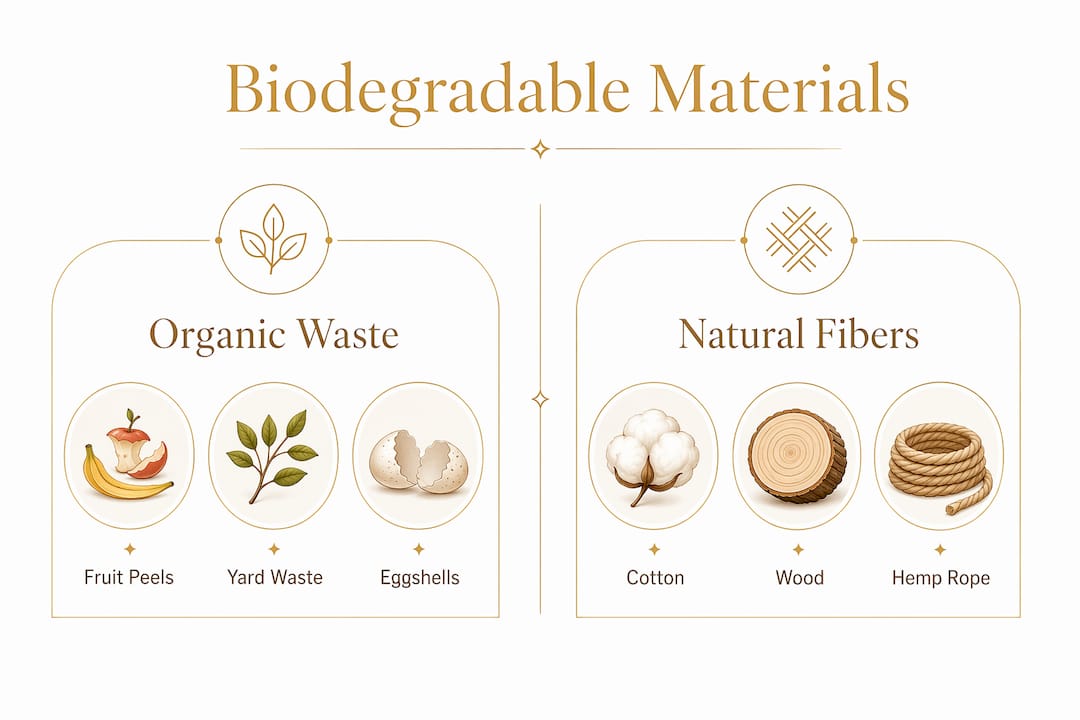
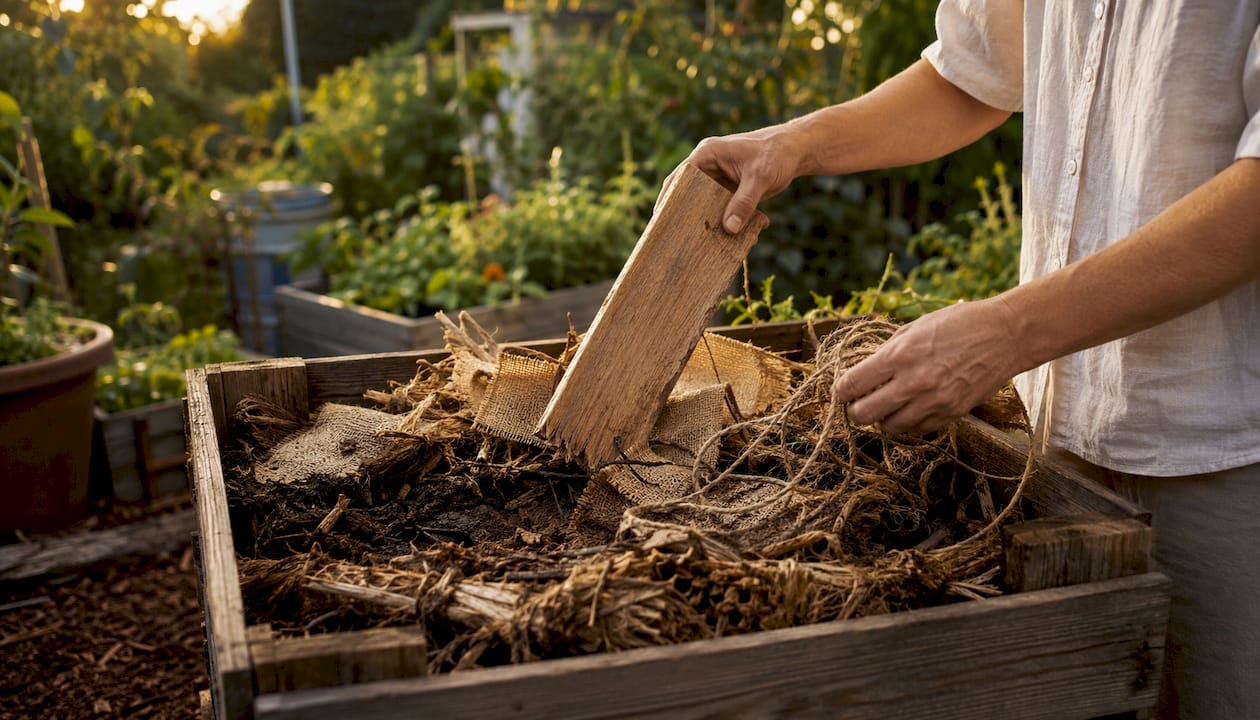
Cotton, wool, linen, wood, and cork all biodegrade in natural conditions. Cork stoppers, hemp rope, and untreated wooden utensils decompose reliably in soil or compost. Hemp is particularly fast-breaking because of its loose fiber structure. Cozee-bay’s bamboo products fit squarely here: bamboo is a fast-growing grass that breaks down in soil without leaving synthetic residues.
Bamboo decomposes in roughly 4–6 months in active compost. Bagasse (the fibrous pulp left after sugarcane processing) is used for plates, bowls, and food containers; it breaks down in industrial composting in about 60–90 days and can handle home compost in warmer conditions. Seaweed-based films and packaging are a newer category that dissolves in water and composts quickly, though commercial availability is still limited.
Mycelium-based packaging (grown from mushroom root structures) is one of the most promising alternatives to polystyrene. It breaks down in home compost within 30–45 days and leaves no toxic residue. You’ll find it used as protective packaging for electronics and fragile goods.
Bioplastics like PLA and PCL are the trickiest category. PLA (polylactic acid), made from corn starch or sugarcane, is used for cold cups, cutlery, and food containers. It looks and feels like conventional plastic but requires industrial composting temperatures to break down within the standard test timeframe. PCL (polycaprolactone) degrades more slowly but can break down in soil and marine environments over time. Cellulose-based materials, derived from wood pulp, are used for films and wraps and generally biodegrade faster than PLA.
| Material Category | Common Products | Typical Decomposition Timeframe | Home vs. Industrial Composting |
|---|---|---|---|
| Food and garden waste | Peels, scraps, leaves, grass | Days to 3 months | Home compost |
| Natural fibers (cotton, wool, hemp) | Clothing, rope, fabric | 1–5 months | Home compost or soil |
| Bamboo | Cutlery, boards, dispensers | 4–6 months | Home compost or soil |
| Bagasse | Plates, bowls, trays | 60–90 days | Industrial (home in warm conditions) |
| Cork | Stoppers, flooring, packaging | 3 years | Soil or home compost |
| Mycelium | Protective packaging | 30–45 days | Home compost |
| PLA bioplastic | Cups, cutlery, containers | 90 days (industrial only) | Industrial composting required |
| PCL bioplastic | Films, medical items | Months to years | Soil or industrial |
| Cellulose-based materials | Wraps, films, bags | Weeks to months | Home or industrial |
| Seaweed-based materials | Films, packaging | Days to weeks | Home compost or water |
Microbes, including bacteria and fungi, produce enzymes that break the chemical bonds in organic material. In aerobic conditions (with oxygen present), this process yields carbon dioxide, water, and stable organic matter. In anaerobic conditions (without oxygen, like a sealed landfill), the process is slower and produces methane instead, which is a potent greenhouse gas. The importance of methane from landfills is a well-documented environmental concern.
Several factors control how fast this happens:
A backyard compost pile with kitchen scraps and yard waste can produce finished compost in 2–3 months with regular turning. An industrial facility running at controlled temperature and humidity can process certified bioplastics within the standard test timeframe. A landfill, by contrast, is designed to contain waste, not decompose it. Even food scraps can persist for years in those conditions, and the methane they generate contributes to climate change rather than enriching soil.
These three terms get used interchangeably, but they mean very different things in practice. Understanding the distinction helps you make choices that actually deliver the environmental outcome you’re after. For a deeper look, Cozee-bay’s guide on biodegradable versus compostable breaks this down with retail examples.
Pro Tip: Check for the BPI logo or the ASTM D6400 / EN 13432 standard number on the packaging before assuming a product is compostable. “Compostable” without a certification number is nearly as vague as “biodegradable.”
Tossing a “biodegradable” item in the trash almost guarantees it won’t biodegrade as intended. Here’s a practical sequence to follow:
Putting a certified compostable item in the recycling bin is worse than putting it in the trash. It contaminates the recycling stream and often causes an entire batch of recyclables to be rejected.
Pro Tip: Visit your city or county’s waste management website and search for “organics” or “food scraps” collection. Many programs accept BPI-certified compostable serviceware alongside food waste, but the accepted items list varies by hauler.
The word “biodegradable” is one of the most misused terms in product marketing. The FTC’s Green Guides specifically address this: unqualified biodegradable claims are deceptive if the product won’t break down in a reasonably short time under typical disposal conditions. Yet plenty of products still carry the label without meeting that bar.
A few things worth keeping in mind:
Pro Tip: Before buying a product marketed as eco-friendly, ask three questions: Is it certified? Can I actually compost it where I live? Is there a reusable version that would serve the same purpose?
Choosing biodegradable products for sustainable living works best when you pair the choice with access to the right disposal pathway. Without that, the “biodegradable” label is mostly aspirational.
Biodegradable materials only deliver their environmental benefit when they reach the right disposal conditions, whether that’s a home compost bin, an industrial facility, or natural soil.
| Point | Details |
|---|---|
| Check the label carefully | “Biodegradable” alone is unverified; look for BPI certification or ASTM D6400/EN 13432 standard numbers. |
| Know your composting access | Home compost handles food scraps, paper, bamboo, and cotton; PLA and most bioplastics need industrial facilities. |
| Reuse beats single-use | A durable bamboo or cork item used repeatedly has a lower footprint than any certified compostable single-use product. |
| Landfills slow everything down | Even food scraps decompose poorly in landfills and generate methane rather than useful compost. |
| Greenwashing is common | Vague biodegradable claims without standards are a marketing tactic; verify before you buy. |
Sorting through biodegradable claims can feel like a lot, but it simplifies quickly once you know what to look for. At Cozee-bay, the focus has always been on materials that genuinely biodegrade without caveats: bamboo, wood, and cork are the kinds of materials that break down in soil, don’t require industrial processing, and don’t leave synthetic residues behind. That’s a very different proposition from a PLA cup that needs a composting facility most households can’t access.
The practical recommendation is this: for items you use daily, choose durable natural materials like bamboo, cork, or hemp over single-use anything. For unavoidable single-use situations, look for BPI-certified compostable products and confirm your local waste program accepts them. And when you’re evaluating a new purchase, the reusable version of almost any product wins on sustainability before you even factor in end-of-life disposal.
These are the primary references worth bookmarking if you want to verify claims or go deeper on any of these topics:
When in doubt, cross-reference a product’s claim against the BPI certifier database and confirm with your local waste hauler what they actually accept. Municipal rules vary widely, and what’s accepted in one city may be rejected in another.
Comments will be approved before showing up.