Your Cart is Empty


The easiest fix is a two-spot system: keep your daily tools visible in a weighted crock by the stove, then stash the overflow in a cabinet using pull-out bins or repurposed dividers. This works because it puts what you grab constantly within arm’s reach and hides the rest. Renter-friendly versions of both exist with zero drilling. Pick your stove-side spot and one cabinet today, and the rest of your kitchen will start falling into place.
TL;DR:
- Wall-mounted options like rails, pegboards, and magnetic strips are best for frequently used tools, with proper hardware for heavy items.
- Reusing and adapting existing drawer organizers or installing pull-out bins can create effective storage for non-drawer cabinets.
- Seal or finish bamboo, ceramic, or stainless steel containers to resist grease and moisture for open storage near heat sources.
- Adhesive-mounted rails, tension rods, and under-shelf baskets offer damage-free, no-drill options especially suitable for renters.
Countertop crocks solve a large portion of utensil storage challenges, but only if you resist the urge to dump every spoon and spatula you own into one. A crock should hold your everyday small set of tools, not your entire utensil collection. Anything beyond that belongs somewhere else, whether that’s a wall rail, a repurposed drawer organizer on a shelf, or a cabinet bin.
Pick a crock based on how it handles weight and grime, not just how it looks. A countertop crock filled with a curated, small set of daily tools stays functional far longer than one crammed to the brim, because overstuffed crocks tip over and turn into a tangled mess every time you reach for the one spoon buried at the bottom.
A few material notes worth knowing before you buy:
Pro Tip: Drop a silicone jar liner or a folded dish towel in the bottom of your crock. It catches crumbs and moisture, and you can pull it out and rinse it in seconds instead of scrubbing the whole container.
Rails, pegboards, hooks, and magnetic strips each solve a slightly different storage problem, and most drawerless kitchens end up using two of the four together.
For installation, adhesive command-style hooks handle light rails and S-hooks just fine, but anything holding a knife or a cast-iron ladle needs actual screws into a stud or drywall anchor. Skimping on hardware for heavy items is how you end up with a rail on the floor.
A cabinet without a drawer insert isn’t dead space, it’s just missing a floor. Old drawer organizers don’t have to die with the drawer they came from. Adapting a drawer organizer to sit on a cabinet shelf recreates that same divided layout you’d normally lose, and the same trick works inside a pantry cabinet if your kitchen is especially tight on space.
A few setups that mimic true drawer function:
Rolling carts earn their keep when you’re short on fixed counter or wall space, or when you rent and don’t want to commit to anything permanent. A cart adds surface area you can wheel next to the stove while cooking, then push back against a wall when you’re done.
You don’t need a single screw hole to get a functional utensil system. Adhesive-mounted shallow rails handle lightweight tools well, but you have to respect the weight rating printed on the packaging rather than guessing.
Exposed storage means grease and dust land on your tools instead of staying hidden in a drawer, so the cleaning cadence has to be tighter. A quick wipe of rails and crocks once a week keeps buildup from setting in, with a deeper clean near the stove monthly, since that’s where grease collects fastest.
Material choice matters more than most people realize here. Sealed bamboo and stainless steel shed grease with a wipe, while raw wood absorbs it and starts to smell over time.
Treat your kitchen like it has zones, because it already does, whether you’ve labeled them or not.
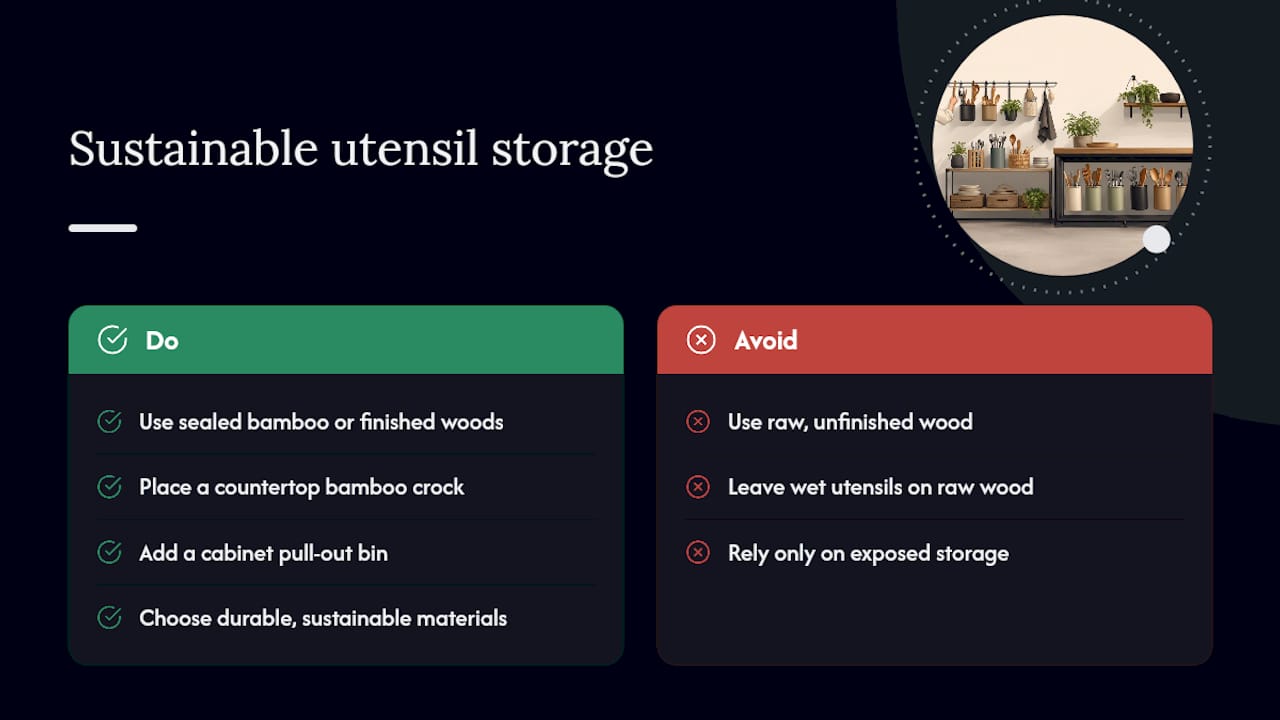
Sealed bamboo and finished woods are recommended for exposed kitchen storage because they clean up fast and hold up to daily contact with wet utensils, unlike raw wood, which stains and absorbs odor. A countertop bamboo crock paired with a cabinet pull-out bin covers both the visible and hidden halves of the two-spot system, and readers who’ve set up this combination report tidier counters and less time hunting for tools mid-recipe. Look for sustainable utensil organizing setups built around the same durable materials.
Not every tool deserves prime real estate on your counter. The ones you touch daily, your main spatula, a wooden spoon, tongs, and a whisk, earn a spot in the crock or on the rail closest to the stove. Everything else should live one step removed, close enough to grab in a few seconds but not cluttering your sightline.
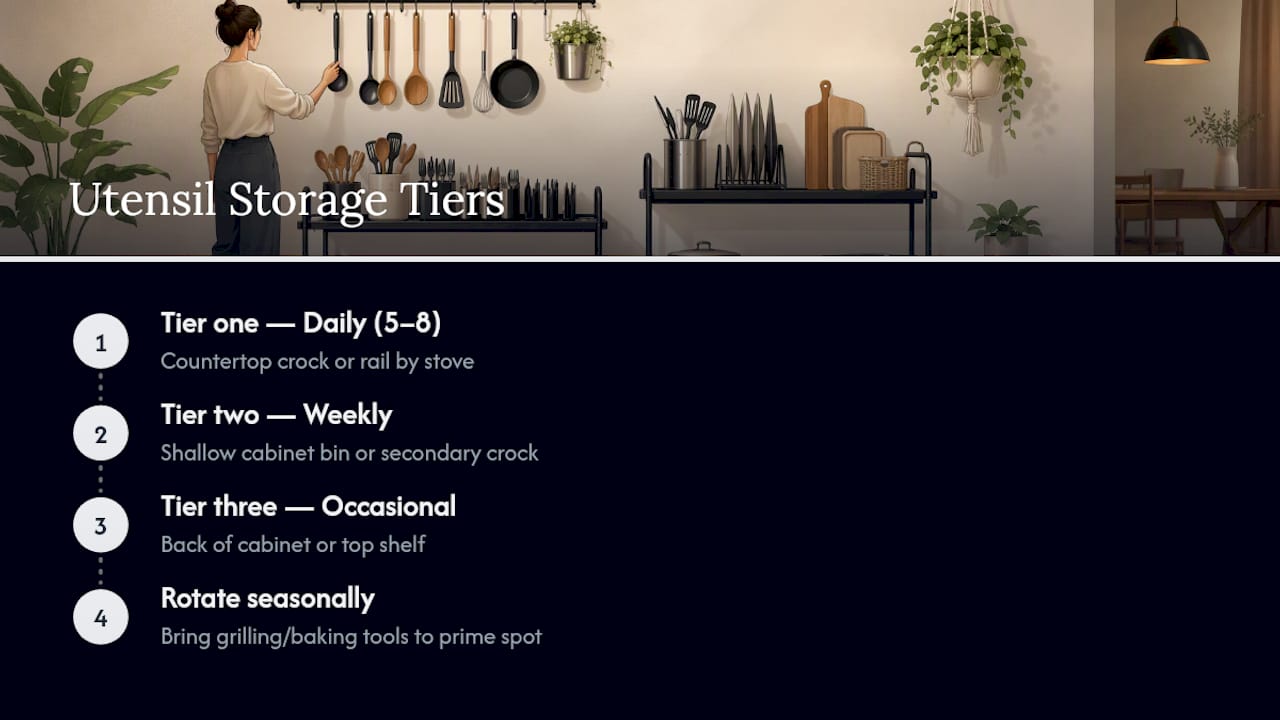
Think in three tiers instead of one flat pile. Tier one is your daily five to eight, the tools you’d notice missing within a day. Tier two covers weekly-use items like a ladle, a can opener, or a citrus juicer, and these do well in a shallow cabinet bin or a second smaller crock tucked slightly out of the main workflow. Tier three is occasional-use gear, think turkey basters, corn holders, or specialty tools you pull out a few times a year, and these belong in the back of a cabinet or a top shelf entirely.
This tiered approach does double duty as a decluttering system. Storing utensils where you can see them tends to prompt regular edits of the collection, because a crowded crock makes it obvious which tools you’re not actually using. If something’s been sitting untouched in tier one for a month, it’s a tier two or tier three item, or a garage sale item.
Pro Tip: Rotate seasonally. Grilling tools move to a prime spot in summer, baking tools front and center around the holidays. Your daily-use tier isn’t fixed year round.
Knives and other sharp tools are the one category where “just find a spot” isn’t good enough. A blade left loose in a crock with spoons and spatulas is a hazard every time someone reaches in without looking, and it dulls the edge faster from knocking against other metal.
Magnetic strips solve this cleanly for kitchen knives, since the blade sits exposed but stationary, edge safely oriented away from the counter’s edge or walkway. Mount the strip high enough that kids can’t reach it, and low enough that you’re not straining to grab a knife mid-prep. If a magnetic strip isn’t an option, an in-cabinet knife block or a slotted insert inside a pull-out bin keeps blades separated from other tools without needing a drawer at all.
A few non-negotiables for sharp tools specifically:
I keep coming back to the same conclusion after looking at how drawerless kitchens actually function: the two-spot system works because it matches how you cook, not how a kitchen was originally built. Start with one crock and one cabinet, then adjust after a week of real use. Sealed bamboo holds up well to that kind of daily handling, and it’s worth choosing durable, sustainable materials over anything you’ll replace in a year.
— Cozee
The two-spot system can be set up with bamboo countertop crocks sized for that daily five-to-eight rule, pull-out cabinet organizers that recreate drawer function, and drawer organizers designed to sit flat on a shelf if you’re repurposing cabinet space.

If you’re setting up the stove-side spot from the verdict above, a bamboo crock with a weighted base and a removable liner handles daily tools without tipping or trapping grime underneath. For the hidden half of the system, a pull-out organizer sized to your cabinet depth keeps overflow tools sorted instead of piled. Sealed bamboo resists the grease and moisture that build up fastest near a stove, which matters more for open storage than it ever did behind a closed drawer front. Browse the full collection of bamboo kitchen organizers to find pieces sized for your cabinet and counter, and check current shipping details before you order.
For deeper how-to detail, see The Kitchn’s drawer-free kitchen setup, Homes & Gardens on drawerless utensil placement, HouseDigest’s cabinet storage guide, and Core77 on silverware without a drawer.
Set up a weighted countertop crock near the stove for your daily five to eight tools, then convert one cabinet with a pull-out bin or repurposed drawer organizer for everything else.
Yes, as long as the strip is screw-mounted (not adhesive-only) and positioned high enough to keep the exposed blade out of easy reach for kids.
Sealed bamboo, ceramic, and stainless steel resist grease and moisture better than raw or untreated wood, making them the better pick for storage near a stove.
Yes. Adhesive command-style rails and hooks work well for lightweight tools if you check the rated weight limit and warm the adhesive before removal to avoid wall damage.
Comments will be approved before showing up.