Your Cart is Empty


The fastest way to save, store, and reuse grocery bags is to pick a defined bag saver, either a wall-mounted dispenser or an upright organizer, that actually fits your space. If you’d rather skip a purchase, a quick folding hack works as a solid DIY fallback. Bamboo dispensers are one eco-friendly option worth a look. Below, we break down every form factor, a buying checklist, DIY tricks, and upkeep tips so you never dig through a plastic-bag avalanche again.
TL;DR:
- Most plastic and fabric bag savers have a capacity limit of around 10 to 15 bags, which can cause jamming if exceeding their rated volume.
- Adhesive-mounted units are suitable for smooth surfaces but may fail in humid kitchens, while screw-mounted dispensers provide more durability for regular use.
- Visibility and easy access significantly increase reuse frequency, with mounted or clear, contained solutions outperforming hidden or stuffed drawers.
- High-traffic commercial spaces need purpose-built, heavy-duty dispensers instead of DIY or repurposed tissue box hacks to withstand daily handling.
- Rubber, bamboo, and stainless steel options tend to last longer and are easier to clean, with premium materials often justified by better durability and aesthetic appeal.
Every bag saver falls into one of four categories, and picking the wrong one for your space is the top reason people abandon the system within a month.
Wall-mounted dispensers hang inside a cabinet door or on a pantry wall and let you pull one bag at a time from the bottom, similar to a tissue box. Marketplace listings consistently highlight one-handed access and space-saving as the top-selling features for this style, and it’s easy to see why. Countertop or tube-style holders sit on a shelf and work the same way but skip the mounting step entirely, trading a little counter space for zero installation.
Fabric holders are soft-sided pouches with a drawstring or elastic top, usually the cheapest option and the most forgiving for renters since they hang from a hook instead of hardware. Upright organizers use vertical dividers to sort bags by size, holding 20 or more bags at once in a compact footprint designed for shelf or cabinet placement.
Material changes both look and lifespan:
Before buying anything, measure your target spot and match it against the product’s listed capacity. A dispenser rated for 15 bags will bulge and jam if you’re stuffing 40 into it.
Run through this checklist in order, and you’ll avoid the two most common buying mistakes: guessing on size and ignoring mounting constraints.
Mounting tradeoffs matter more than most buyers expect. Adhesive strips are the low-commitment choice, ideal for apartments, but they can lose grip in humid kitchens. Screws are permanent but far more secure for a dispenser you’ll load and unload daily.
A bag saver that always has a little breathing room gets used consistently, while one that’s perpetually crammed full gets abandoned in favor of tossing bags on the floor.*
Not ready to buy? Three low-cost tricks solve the problem in under ten minutes.
For reusable canvas or woven totes, folding beats stuffing every time. The method popularized by The Kitchn works in three steps: fold the bag lengthwise into thirds, fold it up from the bottom into a small rectangle, then wrap the handles around the bundle to hold it shut. The result is a flat, compact bundle that stores in a drawer and grabs easily on your way out the door.
Skip DIY, though, if you’re outfitting a café, office, or small retail counter. High-traffic commercial spots need a bag saver built for daily abuse, not a repurposed tissue box that tears after a few weeks.
Placement decides whether your bag saver actually gets used or turns into another cluttered corner. Mount it somewhere you naturally pass while unpacking groceries, like the inside of a pantry door, the wall next to your recycling bin, or a cabinet directly under the sink.
Visibility drives behavior more than most people realize. A hard-sided organizer that keeps bags contained and visible outperforms a loose “bag full of bags” stuffed in a drawer, because an overflowing container is an obvious cue to grab and reuse, while a stuffed drawer just gets ignored.
The behavioral edge of visible storage: Treating bag storage as a defined piece of equipment, rather than a junk-drawer afterthought, measurably increases how often people actually reuse what they’ve stored.
A few maintenance basics keep the system working long term; for the best results consider professional home organization systems that include custom storage solutions.
Bag savers span a wide price range, and the differences usually track material and build quality rather than gimmicks.
Basic plastic and fabric options run on the low end, typically the cheapest entry point into organized bag storage and a reasonable starting point if you’re not sure how much use the system will get. Mid-range upright organizers with adjustable dividers cost more but hold significantly higher volume and last longer under daily loading and unloading.
Bamboo and stainless steel dispensers sit at the premium end of the category. You’re paying for a finish that looks intentional on open shelving, not hidden in a cabinet, plus the added durability of natural or metal materials over injection-molded plastic. For a kitchen where the dispenser will be visible daily, that price difference often pays off in how long the piece looks good and how well it holds up to repeated handling.
Commercial buyers, think cafés, small offices, or retail counters, should budget for the higher end of any category. A dispenser that looks fine after light home use for two years can wear out in a few months under constant public handling. Buying once at a higher price point beats replacing a cheap unit three times.
Whatever budget you land on, weigh it against capacity. A rock-bottom price on a dispenser that only holds ten bags isn’t a deal if you’re generating thirty bags a week and refilling it every other day.
Instead of chasing a specific brand name, compare bag savers by form factor and material, since that’s what actually determines whether the thing lasts and gets used.
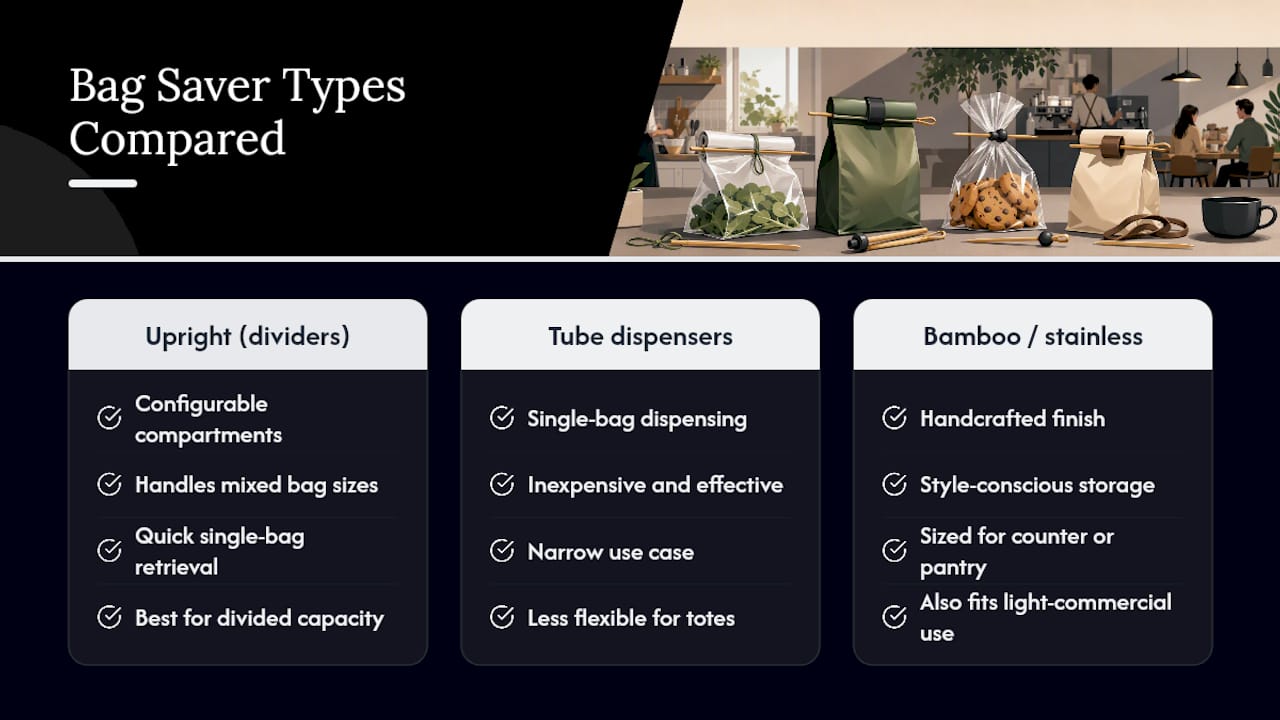
Adjustable upright organizers with dividers, the style popularized by products like the StoraBag reusable bag organizer, are built around configurable compartments that separate small produce bags from larger totes. That’s the right call if you mix bag sizes and want quick single-bag retrieval without digging.
Simple tube dispensers, the category IKEA’s VARIERA represents, are built for a single job: dispensing plastic grocery bags one at a time from a wall or cabinet mount. They’re inexpensive and effective for that narrow use case but don’t flex well for reusable canvas totes or oversized bags.
Handcrafted bamboo and stainless options, the kind The Spruce highlights for style-conscious storage, target buyers who care how the piece looks sitting out on a counter or open shelf. Cozee-bay’s bamboo dispensers fall into this category, built with the same natural-material approach used across its paper towel dispensers and organizers, and sized to work equally well tucked into a home pantry or mounted in a light-commercial kitchen.
The right pick depends on your priority: maximum divided capacity, minimal footprint, or a finish that matches the rest of your room.
A bag saver is a small purchase, but the warranty terms still tell you a lot about build confidence. Look for a clear return or money-back window rather than vague “satisfaction guaranteed” language with no timeframe attached.
Most reputable sellers offer some combination of a money-back guarantee, straightforward exchange process for defective hardware, and accessible customer support if a mounting bracket or divider arrives damaged. Read the fine print on adhesive-mounted products specifically. Some warranties cover the unit itself but exclude wall damage from adhesive residue, which matters if you’re in a rental.
Some sellers back their bamboo dispensers and organizers with a money-back guarantee, giving you room to test fit and mounting in your own kitchen before committing. That kind of policy matters most on bamboo and stainless pieces, where you’re paying a premium for finish and durability and want assurance the piece will hold up.
Star ratings and written reviews on bag saver products cluster around a few recurring themes worth watching for before you buy.
Buyers consistently flag capacity accuracy as the top complaint category. A product advertised as “holds 20+ bags” that actually jams at 12 generates the most one and two-star reviews across marketplaces. Mounting durability is the second most common thread, especially for adhesive-based units in humid kitchens where reviewers report the bond failing within weeks.
On the positive side, reviewers reward one-handed dispensing and visible, contained storage most often, echoing the same behavioral pattern noted earlier: a bag saver you can see and use quickly gets used more, while one that requires two hands or a search gets ignored. Products with adjustable dividers also earn praise for flexibility, since they adapt to whatever mix of bag sizes a household actually generates rather than assuming one size fits all.
Before buying, skim recent reviews specifically for capacity complaints and mounting failures. Those two issues account for the bulk of negative feedback across the category, far more than material preference or color.
Most buyers fixate on brand names when the real predictors of long-term success are form factor and where you put the thing. A dispenser that perfectly matches your cabinet depth and sits at eye level will outperform a fancier product mounted somewhere you forget about.
Some bamboo products prove out in demanding settings, from restaurants and coffee shops to senior living centers and schools, which says more about durability than any single review score could. Pair that track record with a clear money-back guarantee and detailed product resources on space-saving storage, and the case for material quality over brand chasing gets stronger.
Pick the form factor that fits your habits first. Then choose a finish, bamboo, stainless, plastic, or fabric, that matches both your room and your values.
— Cozee
Some sellers offer practical alternatives to generic plastic dispensers for anyone who wants a bag saver that looks intentional, not just functional. Where a basic polypropylene tube gets hidden inside a cabinet, a bamboo dispenser is built to sit out on open shelving or mount visibly near your pantry or recycling bin without looking out of place.

The Cozee-bay bamboo paper towel dispenser line shares the same natural-material design used in its broader bag and food storage organizers, sized to work equally well as a kitchen countertop piece, mounted inside a cabinet door, or set up in a light-commercial space like a café counter or office break room. Many product pages list dimensions and customer reviews, and some are backed by a money-back guarantee and free shipping across the contiguous US.
If you’re outfitting a pantry wall near your recycling station, mounting a dispenser at eye level there keeps grocery bags visible and easy to grab on your way out. Check the current bamboo dispenser lineup and pick the size that matches your cabinet or counter space.
Capacity varies widely, from small 10 to 15 bag tube dispensers to adjustable upright organizers holding 20 or more bags with divided compartments.
Yes. Adhesive-backed dispensers, tension rod sleeves, and freestanding fabric holders all work without screws, making them a better fit for rental kitchens.
Bamboo and stainless steel hold up better to daily handling and moisture than plastic or fabric, though all four materials work fine with regular cleaning.
Not usually. High-traffic commercial spots like cafés or offices need a durable, purpose-built dispenser rather than a repurposed tissue box, which wears out quickly under daily public use.
Yes, Cozee-bay backs its bamboo dispensers and organizers with a money-back guarantee, along with free shipping within the contiguous US.
Comments will be approved before showing up.