Your Cart is Empty


TL;DR:
- Bamboo is a highly renewable and resource-efficient material, especially when processed mechanically. Proper sourcing, certifications, and low-VOC adhesives are essential for sustainable bamboo products. Not all bamboo items are eco-friendly, so buyers should prioritize transparency and third-party certifications.
You might assume that anything labeled bamboo is automatically a green choice. Grab a bamboo cutting board, a set of bamboo shelves, or a bamboo paper towel dispenser, and you’re doing your part for the planet, right? Not always. Sustainability depends heavily on processing methods, and without knowing the difference, even well-meaning eco-shoppers can end up with products that undercut the very values they’re shopping for. This article cuts through the noise, walks you through what truly makes bamboo renewable, and gives you the practical knowledge to shop with real confidence.
| Point | Details |
|---|---|
| Processing matters | Bamboo must be mechanically processed to maximize renewability. |
| Certification is essential | Look for FSC and low-VOC labels to avoid greenwashed products. |
| Eco-impact varies | Bamboo can be carbon-negative or harmful depending on manufacturing methods. |
| Smart shopping tips | Prioritize certified, mechanically processed products and avoid generic bamboo textiles. |
Let’s start by understanding what makes bamboo attractive as a renewable material for stylish, sustainable home goods.
Bamboo is not a tree. It’s a grass, and that distinction matters enormously. Some species grow up to three feet per day, reaching harvest maturity in three to five years compared to the decades hardwoods like oak or maple require. It also regenerates from its root system after cutting, meaning no replanting is needed. That alone sets it apart from nearly every conventional building or home goods material on the market.
Beyond speed, bamboo requires very little. It typically needs no pesticides, minimal irrigation, and fixes carbon in the soil as it grows. When you compare that to the resource demands of hardwood logging, steel manufacturing, or plastic production, bamboo starts looking like a genuinely smart material choice for eco-friendly spaces.
The carbon story is compelling, too. Engineered bamboo products can be carbon-negative versus hardwood or concrete, meaning they store more carbon than is emitted during their production. That’s a rare claim in the world of home goods materials.
Here’s a quick comparison of bamboo against common home goods materials:
| Material | Harvest time | Carbon footprint | Renewability |
|---|---|---|---|
| Bamboo | 3 to 5 years | Low to negative | Very high |
| Oak hardwood | 60 to 80 years | Moderate | Low |
| Concrete | N/A | Very high | None |
| Plastic | N/A | High | None |
Bamboo also brings genuine versatility to the table. You’ll find it in:
“Bamboo’s rapid growth cycle and low input requirements make it one of the most resource-efficient materials available for home goods manufacturing.”
For homeowners and small business owners who want style without sacrificing sustainability, bamboo home products offer a rare combination: beautiful grain patterns, natural warmth, and a genuinely lower environmental footprint when processed correctly.
While bamboo is promising, how it’s processed determines true sustainability.
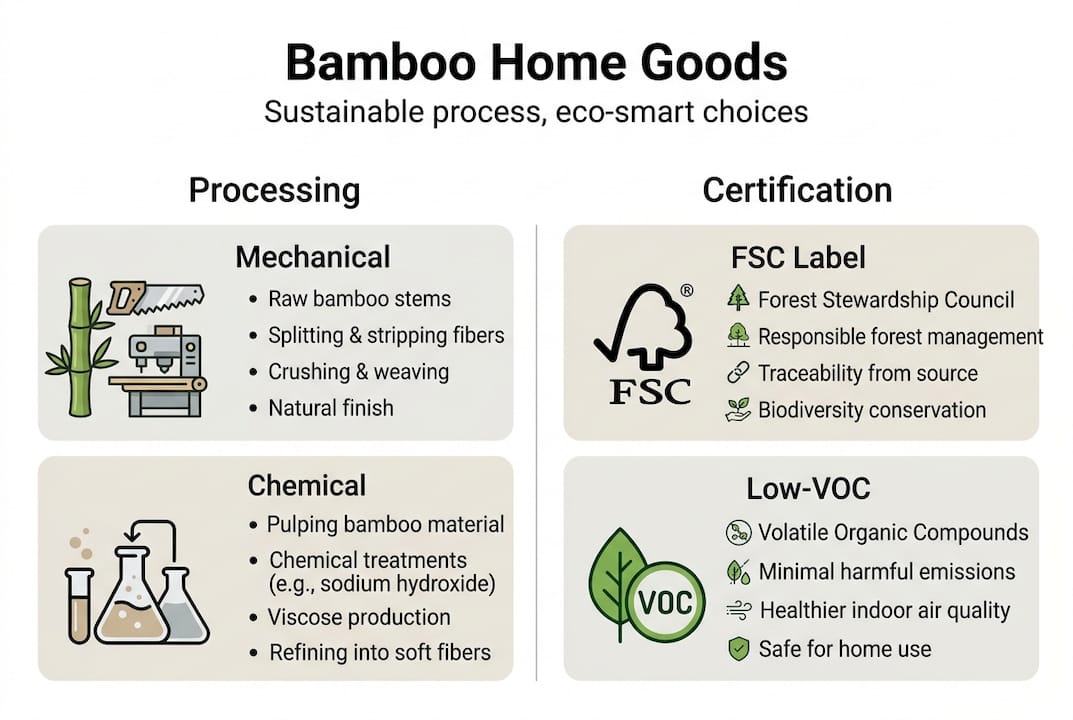
Here’s something most eco-product marketing won’t tell you: not all bamboo processing is created equal. The method used to turn raw bamboo into a finished product can either preserve its renewability or largely cancel it out.
There are two primary processing paths:
For home goods like furniture, flooring, kitchenware, and organizers, mechanical processing is the standard and the better choice. The concern with chemical processing is most relevant when you’re shopping for bamboo textiles like sheets, towels, or clothing.
Here’s a side-by-side look:
| Processing type | Used for | Chemical use | Eco impact |
|---|---|---|---|
| Mechanical | Flooring, furniture, kitchenware | Minimal | Low to positive |
| Chemical (viscose) | Textiles, soft goods | High | Can be negative |
When shopping for ethically sourced bamboo products, certifications are your best friend. Look specifically for:
Understanding what FSC certified bamboo actually means helps you filter out greenwashing quickly. FSC certification verifies responsible forest management, fair labor practices, and environmental accountability across the supply chain.
Pro Tip: If a product is labeled simply as “bamboo” with no processing details or certifications listed, that’s a red flag. Legitimate eco-brands are transparent about how their bamboo is sourced and processed.
Greenwashing in the bamboo space is real. Phrases like “natural,” “plant-based,” or “eco-friendly” on packaging mean nothing without third-party verification. Train yourself to look past the marketing language and straight to the certifications.
Understanding these processes, let’s look at how bamboo finds its way into everyday items and what to watch for as a smart buyer.
Mechanically processed bamboo shows up in a wide range of practical home goods. Cutting boards, utensil trays, paper towel dispensers, drawer organizers, shelving, and flooring are all common examples. These products retain bamboo’s natural durability and low environmental footprint. Chemically processed bamboo, on the other hand, is mostly confined to textiles.

One issue worth knowing about is VOCs, or volatile organic compounds. Bamboo flooring and furniture can emit VOCs from the adhesives used in manufacturing, unless low-emission or formaldehyde-free glues are specified. This matters both for indoor air quality and for the product’s overall eco credentials.
Here’s what to look for when evaluating specific product categories:
On the durability side, bamboo holds up impressively well when processed correctly. Strand-woven bamboo achieves flexural strength above 200 MPa, making it harder than many traditional hardwoods. That’s excellent news for high-use items like flooring, countertops, and organizers.
That said, untreated bamboo does have a weakness: moisture. In consistently humid environments like bathrooms or outdoor spaces, untreated bamboo can warp or crack over time. For those areas, look for moisture-resistant bamboo products that have been specifically treated or finished for humidity exposure.
Pro Tip: Ask brands directly whether their bamboo products use formaldehyde-free adhesives. Brands that care about sustainability will answer this question without hesitation.
For a broader look at how bamboo performs across product types, exploring sustainable bamboo products for your home gives you a solid starting point. And if durability is your top concern, durable bamboo home products can help you identify which items are built to last.
With these categories in mind, here’s how you can make confident, green choices as you shop.
Shopping for bamboo sustainably is not complicated, but it does require a little more attention than just reaching for the product with a leaf on the label. Follow these steps and you’ll avoid the most common pitfalls:
As eco-homeowners should prioritize mechanically processed bamboo with FSC or low-VOC certifications, and steer clear of products labeled only as bamboo viscose or rayon, applying this filter alone will eliminate a large portion of misleading products.
Here are a few quick care tips to extend the life of your bamboo goods:
For style inspiration that aligns with sustainability, bamboo interior design ideas can show you how to incorporate these materials beautifully. And if you want practical room-by-room guidance, bamboo interior decoration walks you through seven smart ways to use bamboo with sustainability in mind.
Pro Tip: When in doubt, buy less and buy better. One well-made, certified bamboo product will outlast and outperform three cheap, uncertified ones, and it will do far less environmental damage over its lifetime.
Now, let’s cut through the hype about bamboo with a fresh, experience-based perspective.
Here’s the uncomfortable truth: bamboo’s renewable nature does not automatically make every bamboo product eco-friendly. The raw material is extraordinary. But the moment it enters a factory that uses heavy chemical processing, uncertified adhesives, or opaque sourcing practices, that renewability advantage starts to shrink.
We’ve seen this pattern play out repeatedly. A product gets a bamboo label, earns a spot on an eco-friendly gift guide, and sells well because buyers trust the plant’s reputation. But without third-party certification, that trust is misplaced.
The real sustainability work happens in the supply chain, not on the shelf. Choosing ethically sourced bamboo means asking harder questions: Who certified this? What adhesives were used? Where was it processed? These aren’t unreasonable questions. They’re the ones that separate genuine eco-choices from clever marketing.
True sustainability is not a one-time purchase decision. It’s an ongoing practice of paying attention, asking questions, and rewarding brands that are transparent.
For those ready to upgrade, here’s where to start your journey.
At Cozee Bay, every bamboo product is selected with real sustainability in mind, not just the appearance of it. From handcrafted paper towel dispensers to drawer organizers, food bag organizers, and wrap and foil dispensers, each item is designed to be functional, stylish, and responsibly made.
We believe your home or business space deserves products that look great and align with your values. That means being transparent about materials, offering pieces built to last, and making it easy to shop with confidence. Explore our full collection and read about our commitment to ethically sourced bamboo choices to see exactly how we approach sustainability. Free shipping within the contiguous U.S. and a money-back guarantee make it easy to get started.
No. Only mechanically processed bamboo with responsible certifications is truly sustainable, while chemically processed textiles or uncertified products can undermine eco benefits.
Look for FSC certification and low-VOC or non-toxic adhesives to confirm that a bamboo product meets genuine sustainability standards.
Most bamboo textiles involve toxic chemical solvents during processing and are not fully eco-friendly. Choose mechanically processed bamboo hard goods instead when sustainability is your priority.
Bamboo home goods typically carry a much lower or even carbon-negative lifecycle footprint compared to hardwood or concrete, especially when mechanically processed and responsibly certified.
Comments will be approved before showing up.