Your Cart is Empty


TL;DR:
- Organizing a spice drawer involves purging unused jars, measuring drawer dimensions, and labeling jars for quick identification.
- Sorting spices by usage rather than alphabet and creating designated zones significantly improves accessibility and efficiency.
You open the drawer to grab cumin, and five other jars tumble over. You find the smoked paprika you needed three minutes ago, right after you already substituted something else. If this sounds familiar, you already know how a chaotic spice drawer can throw off your entire cooking rhythm. Knowing how to organize spices in a drawer is less about aesthetics and more about protecting your time and sanity at the stove. This guide walks you through every step, from purging and measuring to labeling and long-term maintenance, so your spice drawer actually works for you.
| Point | Details |
|---|---|
| Purge before you organize | Remove spices unused in the last 1 to 3 months before setting up any system. |
| Measure your drawer first | Check drawer depth at the back to avoid jar fit issues before buying organizers. |
| Organize by usage, not alphabet | Grouping spices by cooking frequency keeps your most-used jars within easy reach. |
| Label jar tops clearly | Top-facing labels let you read every jar at a glance without lifting anything. |
| Date your spices | Writing purchase dates on jar bottoms prevents you from cooking with stale spices. |
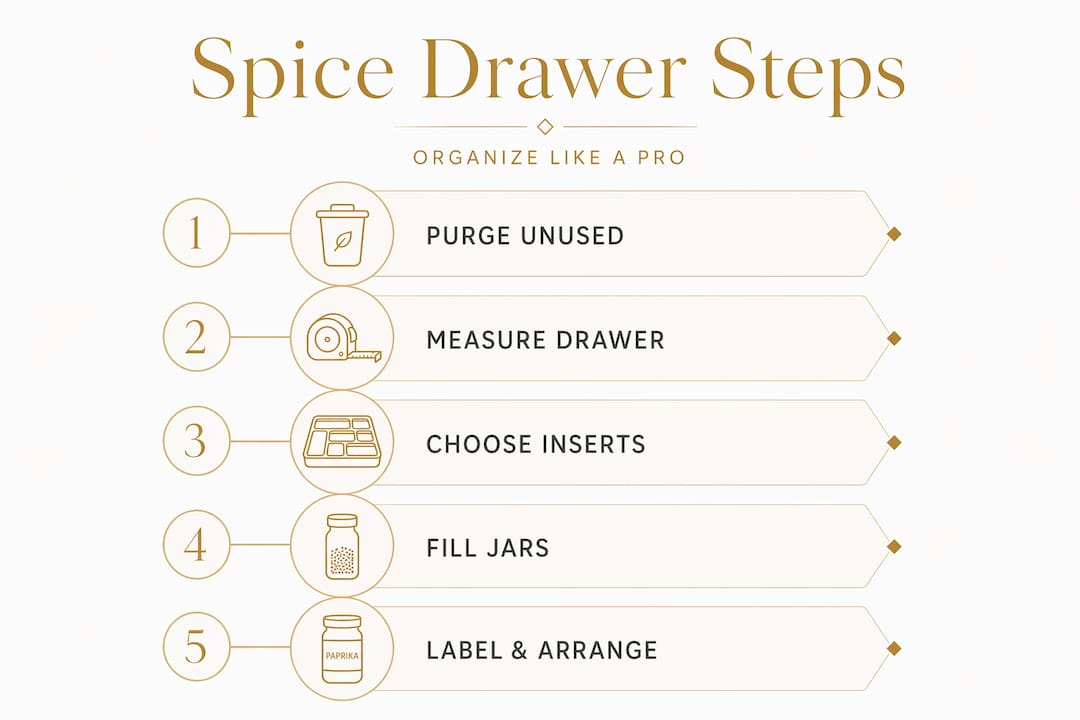
You cannot build an organized spice drawer on a foundation of clutter. Before you buy a single insert or print a single label, you need to spend some time sorting through what you actually have.
Purge first, organize second. Professionals recommend purging any spice you have not used in the last one to three months. That ancient bottle of allspice from a 2019 holiday recipe? Let it go. Stale spices take up space and actually hurt your cooking. Once you pull everything out, you will likely find duplicates, mystery powders with no labels, and jars that are nearly empty. Toss them all.
Next, measure your drawer carefully. This step trips up more people than any other.
Once you have your measurements, you can shop for organizers or plan a DIY solution with actual confidence. Here is a quick comparison of what each option typically costs and what you get:
| Option | Approximate cost | Best for |
|---|---|---|
| Bamboo or wood drawer insert | $20 to $45 | Eco-conscious cooks wanting a polished look |
| Plastic tiered tray insert | $12 to $25 | Budget shoppers with standard drawer sizes |
| DIY foam sheet dividers | Under $10 | Custom drawer shapes or very shallow drawers |
| Tension rod dividers | $5 to $15 | Temporary setups or renters |
Pro Tip: Before purchasing any organizer, cut a piece of cardboard to your exact drawer dimensions and test it inside the drawer. This gives you a physical template to compare against product listings, saving you from the hassle of returns.
Finally, gather your supplies. You will need uniform spice jars if possible, a fine-tip permanent marker or printed label sheets, and your chosen insert or divider system. Uniform jars make a dramatic difference in how clean and scannable the drawer looks.
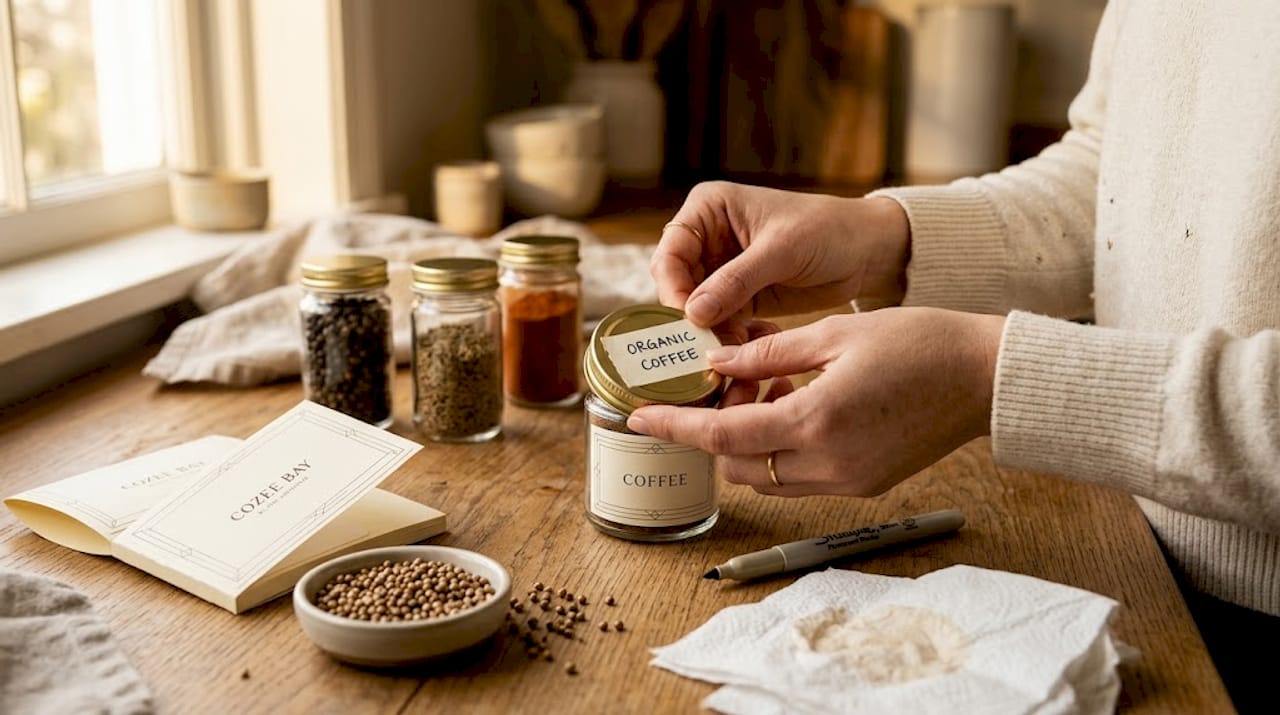
With your drawer emptied and measured, this is where the real work happens. A well-set-up spice drawer can reduce spice search time from over five minutes to under twenty seconds, which adds up fast when you cook regularly.
Follow these steps to build a drawer layout that genuinely works:
Choose your orientation. Decide whether jars will lie flat in an angled tray or stand upright. Angled inserts let you read labels from above without moving anything. Upright jars work well in deeper drawers with enough height clearance. Test jar height against drawer clearance before committing.
Transfer spices into uniform jars. If you are still working with a mismatched collection of store-bought bottles in different heights and widths, consider transferring everything into matching small glass jars. Uniform containers pack more efficiently and look far cleaner.
Label every jar on the top lid. Whether you use a fine-tip marker directly on the lid or printed round labels, top-facing labels are the whole point of a drawer system. You should be able to scan every single jar without touching one.
Create zones based on how you cook. This is where spice drawer organization tips get practical. Rather than organizing alphabetically, group spices by dish type or cooking frequency. Place your daily drivers closest to the front, your occasional baking spices in the middle zone, and specialty or rarely used spices at the back.
Designate a “daily” row at the front. Salt, black pepper, garlic powder, onion powder, cumin, and whatever else you reach for almost every night go right in that front row. You will grab them without thinking.
Test the drawer closure. Push the drawer closed slowly before calling the setup done. If it catches or fails to close fully, a jar is too tall or an insert is too thick. Better to catch it now than to stress the drawer mechanism over time.
Here is a quick comparison of the two most popular spice organization ideas to help you decide which approach fits your kitchen:
| Method | Pros | Cons |
|---|---|---|
| Angled tray inserts | All labels visible at once; nothing needs lifting | Requires specific insert dimensions |
| Upright jars in flat inserts | Fits more jars per row; works in deeper drawers | Need sufficient drawer height clearance |
Pro Tip: Write the spice name on both the lid and the side of the jar. Lids for drawer visibility, sides for when jars end up on a counter or in a cabinet during cooking.
Getting organized is the fun part. Staying organized is where most people fall off. The good news is that maintenance does not take much effort once you build a few simple habits.
The biggest mistake people make after organizing a spice drawer is immediately overfilling it. Leaving empty space in your drawer is actually a feature, not a flaw. That breathing room makes it easy to add a new spice, pull jars out quickly, and avoid the cascade effect where touching one jar sends three others sideways.
Here are the habits that keep a spice drawer organized long-term:
The best way to store spices has less to do with the container you choose and more to do with consistency. A beautiful system you use haphazardly will degrade faster than a simple one you follow every single time.
Pro Tip: If a jar lid gets stuck or jams, the culprit is usually dried spice residue around the rim. A quick wipe with a damp cloth after each use takes five seconds and prevents a sticky mess later.
Not every kitchen has an ideal deep drawer ready to become a spice showcase. Sometimes you are working with a shallow pull-out, a narrow strip of space, or a drawer that is already full of other things. Here are efficient spice storage solutions for those trickier situations:
| Drawer challenge | Recommended fix | Approximate cost |
|---|---|---|
| Too shallow for upright jars | Angled insert or side-lying jars | $12 to $30 |
| Mixed jar heights creating chaos | Tiered riser inside drawer | $8 to $20 |
| No dedicated drawer available | Cabinet door rack or lazy Susan | $10 to $35 |
| Odd-shaped or tapered drawer | DIY foam insert cut to fit | Under $10 |
Pro Tip: Tension rods placed vertically inside a drawer create instant divider compartments with no cutting or gluing required. They are adjustable and removable, which makes them perfect if you rent or like to reconfigure your kitchen setup seasonally.
For more ideas on making the most of awkward or deep storage spaces, the guide on organizing deep kitchen drawers at Cozee-bay covers layout strategies that apply directly to spice storage challenges.
I have seen a lot of beautifully photographed spice drawers online, all uniform jars lined up in alphabetical order, looking like they belong in a catalog. And I get it. It looks satisfying. But in my experience, alphabetical organization is one of the least practical systems for an active cook.
When I reach for spices in the middle of making a weeknight stir-fry, I am not thinking “C for cumin.” I am thinking “stir-fry spices.” Treating spice drawer organization as a workflow improvement rather than mere storage is what actually changes how you cook. Organizing by usage frequency and cooking zones prevents repeated reaching for the wrong jar, and it shaves real time off busy meal prep.
I am also a firm believer in keeping the collection small. The research backs this up too. Limiting your collection to 7 to 10 essential spices of genuinely high quality outperforms a drawer stuffed with thirty mediocre, half-stale jars every single time. Less to search through. Less waste. More flavor.
The other thing I would tell any home cook: do not wait until the drawer is perfect to start using it. Get the jars labeled and in approximate zones, and let the system evolve from real use. You will quickly learn which jars need to move forward because you reach for them constantly, and which ones belong at the back.
— Cozee
If reading this has you ready to finally tackle that chaotic spice situation, you are in the right place. Cozee-bay carries a thoughtfully selected range of drawer organizers built for kitchens just like yours, including inserts sized for spice jars, dividers that fit standard and deep drawers, and eco-conscious options crafted from sustainable materials.

Whether you are starting from scratch or just upgrading a system that is not quite working, the kitchen drawer organizers at Cozee-bay make it easy to find something that fits your space and your budget. Free shipping is included on all orders within the contiguous U.S., and every product comes backed by a money-back guarantee. Why not spare a weekend afternoon to ditch the spice drawer chaos for good?
Group jars by height within the drawer and use a tiered riser or angled insert to keep shorter jars visible behind taller ones. Transferring all spices into uniform jars is the most efficient long-term fix.
Write or print labels on the top lid of every jar so you can read each one at a glance without lifting anything. Using a fine-tip permanent marker directly on the lid works well and costs almost nothing.
A quick review every three months keeps the system working well. Toss expired jars, consolidate duplicates, and check that every jar is back in its correct zone.
Yes. Use an angled tray insert so jars lie at a readable angle, or remove spices from the drawer entirely and use a cabinet door rack or magnetic strip to free up the shallow space for other items.
Store spices in airtight glass or stainless steel containers, keep the drawer away from heat and moisture, and write purchase dates on jar bottoms so you always know how old each spice is.
Comments will be approved before showing up.