Your Cart is Empty


TL;DR:
- Most paper is naturally biodegradable because its cellulose fibers decompose under the right microbial conditions. However, coatings like plastics or synthetics can significantly hinder or prevent complete biodegradation, especially in landfills with limited oxygen. Proper disposal methods, such as composting, accelerate breakdown, while landfilling causes slow decomposition and methane emissions, emphasizing the importance of mindful waste management.
You toss a paper bag in the trash and assume it’ll break down harmlessly. Most people do. But whether paper is biodegradable in any meaningful sense depends on factors most of us never think about — the coatings on the surface, the disposal method, the conditions surrounding the material as it sits and waits to decompose. The answer to “is paper biodegradable” is yes, mostly, but the details matter a lot. This guide breaks down exactly what affects paper’s ability to biodegrade and what that means for your everyday choices.
| Point | Details |
|---|---|
| Paper is naturally biodegradable | Cellulose fibers from wood pulp break down under the right microbial conditions. |
| Coatings are the real problem | Plastic or synthetic coatings on paper products can block or slow complete biodegradation significantly. |
| Disposal method changes everything | Composting produces far lower emissions than landfilling, where anaerobic conditions slow breakdown. |
| Recycled paper is a greener choice | Recycled paper uses fewer resources and chemical treatments, making it more eco-friendly than virgin fiber. |
| Composting beats landfilling | Shredding paper and adding moisture accelerates home composting and reduces greenhouse gas output. |
Paper’s biodegradability starts with what it is made of. Most paper comes from wood pulp, which is rich in cellulose. Cellulose is an organic polymer that microorganisms readily break down under aerobic conditions, meaning they need oxygen to do the job. This is why a plain sheet of office paper or a cardboard box will decompose within weeks when composted properly. The natural fiber is the reason paper earned its reputation as an eco-friendly material.
However, not all paper is created from the same starting point. There are two main categories worth understanding: virgin fiber paper and recycled fiber paper.
The core material, plain cellulose fiber, is absolutely biodegradable. But coatings and additives are what separate a product that decomposes in weeks from one that lingers for years.
Pro Tip: Before composting any paper product, run your thumb across the surface. If it feels slick or waxy, there is likely a coating present that will hinder proper decomposition in your bin.
Understanding the conditions around paper decomposition helps you make smarter disposal decisions. The speed and completeness of biodegradation is not fixed. It shifts depending on where and how you dispose of paper products.
This is the single biggest variable in real-world paper biodegradation. Research confirms that plastic coatings block microbial uptake of cellulose fibers, meaning even a thin synthetic layer can prevent full breakdown. A pizza box with a grease-resistant lining, a coffee cup with a polyethylene interior, or a glossy mailer with a laminated finish are all examples where the base paper is biodegradable but the product as a whole is not.

The disposal environment makes a dramatic difference. Here is how the two main pathways compare:
| Condition | Composting (aerobic) | Landfill (anaerobic) |
|---|---|---|
| Oxygen availability | High | Very low |
| Microbial activity | Active and efficient | Slow and limited |
| Decomposition speed | Weeks to months | Months to years |
| Greenhouse gas output | Low CO2 | Methane (high climate impact) |
| Paper breakdown outcome | Near-complete | Partial and slow |
In a home or industrial composting environment, paper biodegrades over weeks to months when moisture, oxygen, temperature, and microbial activity are all present. Landfills, by contrast, are densely packed with limited oxygen, which creates anaerobic conditions where paper breaks down slowly and releases methane instead of CO2.
These three factors work together. Dry conditions dramatically slow microbial digestion of cellulose. Low temperatures reduce enzyme activity in the microbes that drive decomposition. And without a diverse microbial population present in the composting medium, even wet, warm paper will sit there without breaking down efficiently.
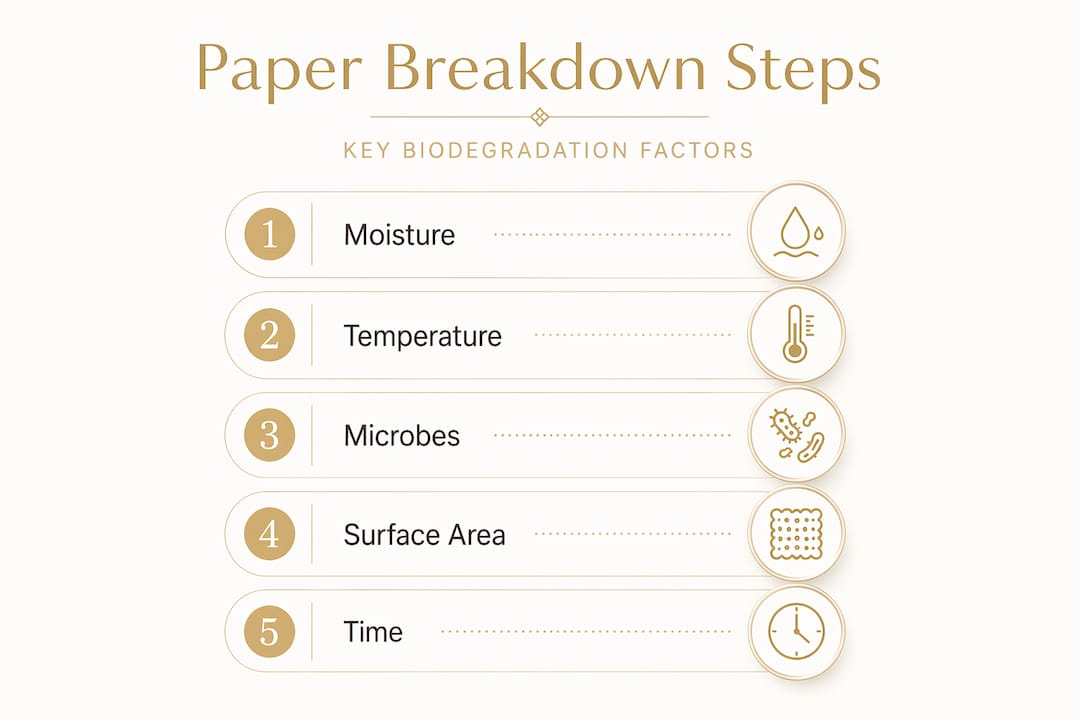
Pro Tip: Shredding paper before adding it to your compost bin increases the surface area exposed to microbes. Shredded paper and moisture can produce visible decomposition in as little as two weeks under good conditions.
These two terms appear on packaging constantly, and most consumers assume they mean the same thing. They do not, and the distinction has real consequences for how you dispose of paper products.
Biodegradable simply means a material can be broken down by microorganisms at some point under some conditions. There is no time limit attached to the claim, and no specification about what environment is required. A plastic-coated paper bag that takes 10 years to partially decompose in a landfill technically qualifies as biodegradable by some definitions.
Compostable is a more specific and demanding standard. A compostable paper product must break down completely within a defined timeframe and produce no toxic residue. Here is where consumers need to read carefully:
Industrial composting conditions are what many biopolymer-based packaging materials actually require to fully break down, which means dropping them in your home compost bin often leads to disappointment. Checking for recognized certifications like BPI (Biodegradable Products Institute) or TÜV Austria’s OK compost HOME label gives you a far more reliable guide to actual disposal behavior.
Composting is the most reliable recovery route for biodegradable materials precisely because it creates optimal microbial, moisture, and temperature conditions that few natural environments or landfills can match. When in doubt, find out whether your local area has a composting facility that accepts food-contact paper. That single step makes a bigger difference than the label on the product.
Here is where paper biodegradability stops being just a science question and starts being a sustainability conversation. Where paper ends up when you are done with it shapes its entire environmental footprint.
The numbers on landfill paper decomposition are worth sitting with. Paper in landfills undergoes slow anaerobic breakdown, and that process generates methane, a greenhouse gas roughly 80 times more potent than CO2 over a 20-year timeframe. Landfill emissions from paper waste range widely, from under 200 to around 800 kg CO2-equivalent per ton, depending on how well the landfill captures and manages the gas produced. That is a significant variable, and most consumers have no way of knowing which end of the spectrum their local landfill falls on.
What you can control is where your paper waste goes. Here are the most impactful steps, ranked from highest to lowest environmental benefit:
The environmental benefit of biodegradability depends critically on the waste management pathway chosen. A paper product that composts in three weeks under aerobic conditions still generates methane for years if it ends up in a landfill instead.
I have spent a lot of time thinking about how consumers interact with sustainability claims, and one pattern stands out clearly: people tend to give paper a free pass that other materials do not get.
The assumption runs something like this: paper comes from trees, trees are natural, and natural things break down. That logic works for a plain piece of notebook paper sitting in a garden bed. It completely falls apart for a disposable coffee cup, a fast-food bag, or a receipt with a thermal coating. In my experience, the biggest mistake eco-conscious shoppers make is trusting the material rather than inspecting the product.
What I have found actually works is treating paper the same way you would treat any packaging material: flip it over, feel it, and ask whether it has anything on it besides paper. If it does, it probably needs industrial composting or recycling, not your backyard bin. That quick habit check prevents a lot of well-intentioned composting from being undermined by a wax lining you did not notice.
I am also a firm believer that consumers hold more purchasing power than they realize. When you consistently choose uncoated biodegradable paper products over laminated alternatives, you send a signal that manufacturers and retailers respond to. That shift does not happen overnight, but it does happen. And honestly, understanding the compostable versus biodegradable distinction, which you can explore further through Cozee-bay’s breakdown of compostable vs biodegradable materials, is the single clearest step toward making disposal decisions you can feel confident about.
— Cozee
At Cozee-bay, we built our product line around one core belief: the materials you use at home and in your business should not create a disposal problem you cannot solve.

Our bamboo-based products are designed to work alongside paper products that genuinely decompose, not just claim to. Whether you are managing a restaurant kitchen, a school break room, or your own home, choosing the right dispensers and organizers helps you use less paper overall and dispose of what you do use responsibly. You can explore our full range at Cozee-bay’s home page, or read our guide on reducing paper towel waste to find practical strategies that lower your paper footprint without any compromise on function. We offer free shipping within the contiguous U.S. and back every product with a money-back guarantee, because sustainable living should come with confidence, not risk.
Paper can biodegrade in a landfill, but very slowly due to anaerobic conditions and limited microbial activity. The process also generates methane, which has a much higher climate impact than CO2.
Plain uncoated paper can show visible decomposition within two weeks in a well-managed compost environment. In a landfill, the same paper may take months to years to partially break down.
Most plain paper bags are biodegradable and can be composted at home. However, paper bags with plastic coatings, wax linings, or lamination require industrial composting or recycling instead.
Yes. Recycled paper undergoes fewer chemical treatments during production, making it generally more biodegradable and a lower-impact choice for environmentally conscious consumers.
Biodegradable paper will break down eventually under some conditions, while compostable paper meets specific standards for complete breakdown within a set time, often requiring industrial composting facilities to achieve that outcome.
Comments will be approved before showing up.