Your Cart is Empty


The fastest way to stop hunting for tools is to give every utensil one home based on how often you use it. Audit what you own, sort it by the Three Reach Rule, keep 5 to 7 daily tools in a weighted crock, and store the rest in measured drawer zones or on a wall rail. Start now: pull open your busiest drawer and set aside the handful of tools you touched today. That pile is your daily crew, and it’s the first piece of the whole system.
TL;DR:
- Daily-use tools should be kept within arm’s reach in a crock or top drawer, while weekly and occasional tools can be stored further away to reduce clutter.
- Measuring drawer dimensions accurately before buying organizers ensures a proper fit and prevents rattling or wasted space.
- Using bamboo or stainless steel organizers, instead of plastic, enhances durability and maintains the system’s appearance over time.
- Vertically mounted wall storage, such as pegboards or magnetic strips, works best for larger tools and adds accessible, space-saving options.
- A quick weekly reset and a demotion rule for unused tools help maintain long-term organization and prevent clutter accumulation.
Buying trays and crocks before you know what you own is how drawers end up messier than before you started. The smarter move, and the one professional organizers push hardest, is a full audit first. Savvy & Sorted makes the case plainly: matching storage to your actual collection prevents overspending on organizers that don’t fit and cuts down on duplicate tools you didn’t realize you had.
Here’s the process, step by step:
This step doesn’t just tidy up. It’s diagnostic. A kitchen where the audit reveals 20 daily tools needs a different setup than one where it reveals six. Skipping this step and jumping straight to Pinterest-worthy drawer trays is exactly how organizing projects stall out halfway through, according to Savvy & Sorted’s breakdown of common utensil-organizing mistakes.
Most kitchens need all three, working together rather than competing. The trick is matching each storage type to the right category of tool instead of defaulting to whatever’s most visible.
Drawers work best when each one has a single job. A drawer that holds spatulas, measuring cups, and rubber bands at the same time will always look chaotic, no matter how nice the tray is. Give one drawer to cooking utensils, another to baking tools, and a third to gadgets you use less often. Adjustable trays let you resize compartments as your collection changes, and diagonal inserts solve a problem flat trays can’t: long tools like spatulas, tongs, and wooden spoons that won’t lie straight in a standard rectangular slot. The Kitchn calls out diagonal drawer storage as one of the highest-return, lowest-cost fixes in kitchen organizing, and it’s a detail most people never think to look for when shopping.
Countertop crocks should hold only your most-used tools, and not one more.
A crock stuffed with 20 tools stops being a convenience and starts being visual clutter you have to dig through anyway.
Vertical storage earns its keep when drawer space runs short. Pegboards mounted on an open wall let you hang pots, strainers, and larger tools where you can see them at a glance. Rails with S-hooks work well above a prep counter for frequently used spoons and spatulas. Magnetic strips are a smart pick for metal tools like knives or shears, since they keep sharp edges visible and off the counter. Cabinet-door hooks make use of dead space most kitchens waste entirely, tucking measuring cups or oven mitts inside a door that would otherwise just swing open on empty air.
Renters shouldn’t assume vertical storage is off the table. IKEA’s organizing guidance points to suction-mounted rails for tile or glass backsplashes and Command-style hooks that come down clean, so you get the wall storage without a single drilled hole.
Buying a tray without measuring first is the single most common reason organizers end up rattling around loose or, worse, not fitting at all. Kitchen drawer interiors almost always run smaller than the drawer face suggests, since the front panel and slide hardware eat into usable space.
Before you shop, grab a tape measure and record three numbers:
Write these down on your phone before you leave the house. It sounds obvious, but showing up to a store or scrolling a product page from memory is how most mismatched trays get bought.
Once you have measurements, match them to an organizer type:
For a deeper walkthrough on matching organizer style to drawer shape, our guide to organizing kitchen drawers covers sizing scenarios in more detail, and the same logic applies if you’re setting up a cutlery drawer for flatware.
Pro Tip: Measure twice, once with the drawer empty and once with anything you’re keeping in it (like a stray charger cord or spare batteries). A tray that fits the empty drawer perfectly can still get blocked by something you forgot was living in the back corner.
Every utensil should live in a spot that matches how often your hand reaches for it. That’s the entire logic behind the Three Reach Rule, a simple frequency-based system for placement that keeps your busiest tools close and everything else out of the way without being out of reach.
Mapping this to your actual kitchen layout matters more than the categories themselves. Tools used at the stove (spatulas, tongs, ladles) belong near the stove. Prep tools (peelers, measuring cups, mixing spoons) belong near your cutting board. Cleanup tools (dish brushes, scrapers) belong near the sink. When a recipe calls for sautéing vegetables, whisking a sauce, and plating the finished dish, a well-mapped kitchen means your hand never has to cross the room between steps, since each tool is already waiting at the station where you need it.
Even a perfectly built system falls apart without small habits to protect it. The good news is those habits take minutes, not hours.
A single deep clean feels satisfying, but it’s the weekly five-minute reset that actually keeps a kitchen organized months later.
Not all organizer materials age the same way, and the material you choose affects how long your system holds up. Plastic trays are cheap but tend to warp, stain, or crack within a couple of years, especially in a drawer near the dishwasher’s heat vent. Metal organizers resist warping but can scratch wooden utensil handles and feel cold and clinical against natural wood tools.
Bamboo sits in a different category. It’s dense enough to hold its shape under the daily weight of a fully loaded drawer, and it resists moisture better than most people expect from a wood product, which matters given how often kitchen drawers deal with damp tools going back in before they’ve fully dried. Savvy & Sorted specifically recommends bamboo or stainless steel over plastic for exactly this reason: durability and stability over time, rather than a tray that needs replacing every organizing season.
For more on pairing sustainable materials with drawer layouts, our post on eco-friendly ways to organize cooking utensils walks through maintenance in more depth, and Cozee-bay’s drawer organizer collection gives you a starting point for browsing bamboo tray options sized for standard kitchen drawers.
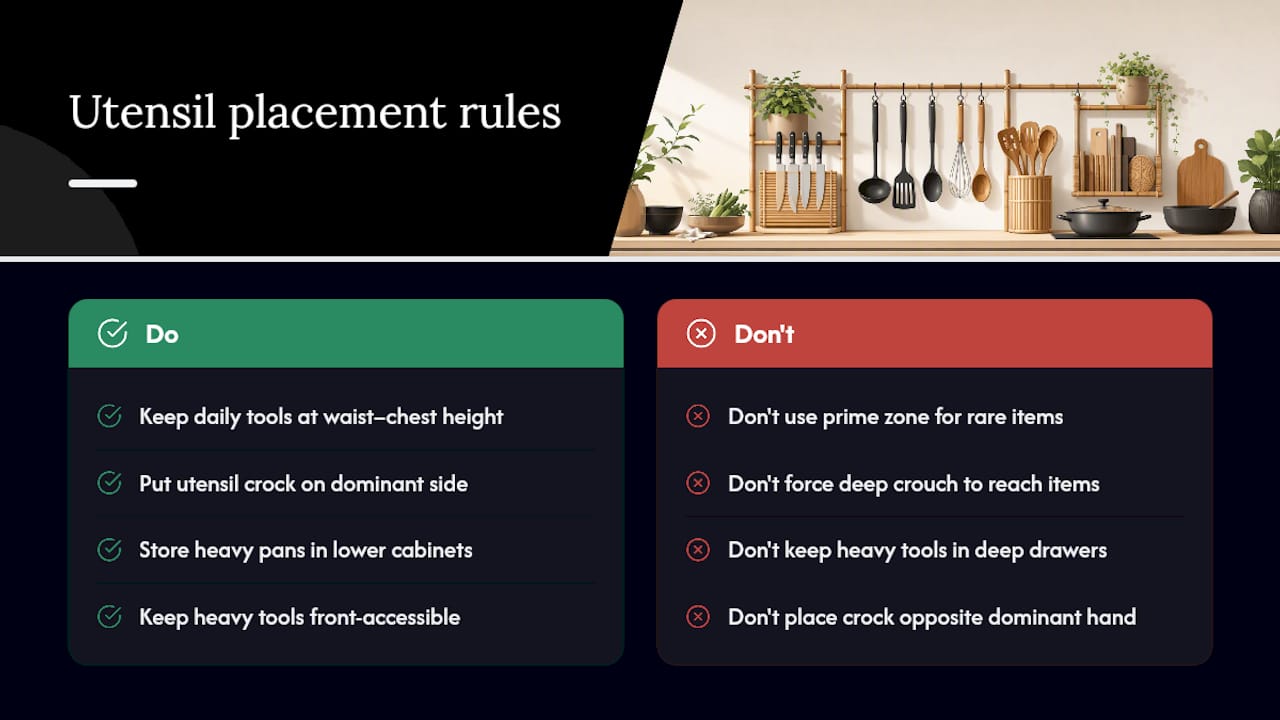
Ergonomic kitchen organizing comes down to one question: how far does your body have to travel to grab a tool mid-task? The farther the reach, the more strain builds up over a week of daily cooking, and the more likely you are to drop something or knock over a container while stretching for it.
Start at waist to chest height, the zone your arms reach without bending or stretching. That’s prime real estate, and it should hold your daily crock and top drawer tools, not decorative items or rarely used gadgets. Anything stored below the waist should require a squat, not a deep crouch, which means heavier or bulkier tools like stockpots or roasting pans belong in lower cabinets while lightweight daily utensils stay up top.
Pay attention to twisting motions too. If your utensil crock sits on the far side of the stove from your dominant hand, you’re twisting your torso every single time you reach for a spoon while stirring. Moving the crock to your dominant side, even by a foot, removes that repeated twist from your cooking routine entirely.
Heavier tools deserve open, easy-access spots rather than the back of a deep drawer, since pulling a heavy item from a cluttered back corner is a common source of minor kitchen strain. A cast-iron skillet or a stand mixer attachment should live where you can lift it out in one clean motion, not one you have to dig for and yank free.
The goal isn’t a showroom kitchen. It’s a layout where your hands know where things are without your brain having to think about it, and where your body isn’t paying a small physical price every time you cook dinner.
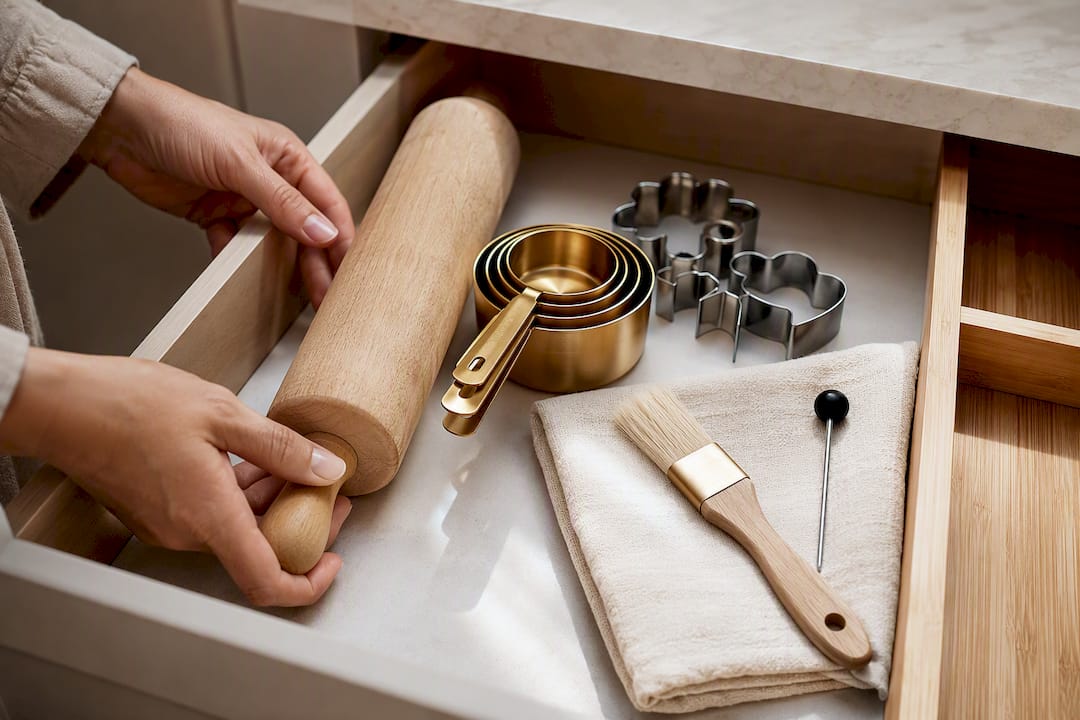
Specialty tools break the frequency model a little, since a rolling pin might get used weekly during a baking phase and then sit untouched for two months. The fix is grouping by activity rather than by individual frequency.
Baking tools work best consolidated into one drawer or a dedicated bin: measuring cups, a rolling pin, cookie cutters, a pastry brush, and cake testers. Keep this group together even if some pieces are used more often than others, since the whole point is grabbing everything you need for a baking session in one motion instead of hunting through three different drawers.
Grilling tools tend to be long, which makes them a poor fit for standard drawers. A long-handled grill brush, extended tongs, and a meat thermometer often work better hung on a rail near the back door or stored in a tall, narrow bin near wherever your grill gear lives. If your kitchen doesn’t connect directly to an outdoor grilling space, a dedicated bin in a coat closet or garage shelf keeps these tools out of your kitchen drawers entirely.
Specialty single-use tools, like a melon baller, a cherry pitter, or a fondue set, belong in the occasional zone from the Three Reach Rule. Group them by category (fruit prep, dessert tools, entertaining gear) rather than scattering them across multiple drawers based on size.
The organizing principle that ties all of this together: sort by task, not just by how often an individual tool gets used. A cookie cutter used twice a year still belongs with the other baking tools, not off in a random junk drawer where you’ll forget it exists by the time the holidays roll around.
Holiday cookie cutters, a turkey baster you touch once a year, and a specialty ice cream scoop for summer are all real parts of most kitchens, and they all create the same problem: prime drawer space getting eaten up by tools that see a few weeks of use a year.
The fix is a rotating storage tier. Keep a labeled bin, either in a top cabinet, a pantry shelf, or even a closet outside the kitchen, for anything tied to a specific season or holiday. Swap it into an accessible drawer only during the weeks it’s actually in use, then rotate it back out once the season passes.
This approach keeps your daily and weekly drawers lean year round, since seasonal tools only occupy prime real estate during the actual weeks you need them. A meal-prep routine built around batch cooking, like the seasonal workflow ideas in Wild Foodz’s holiday meal prep guide, tends to surface exactly which seasonal tools are worth keeping accessible versus which ones can stay boxed up most of the year.
Labels aren’t just for pantry jars. In a drawer with multiple compartments or a cabinet holding several bins, a label is the difference between finding a tool in two seconds and pulling out three trays to locate it.
For drawer organizers, a simple approach works best: label by category rather than by individual tool. “Baking,” “Daily cooking,” and “Occasional” cover most kitchens without needing a label for every single spoon and spatula. If you share a kitchen with a partner, roommate, or kids old enough to help with cooking, category labels also mean everyone puts things back in the same place, which does more for long-term tidiness than any tray ever could.
For vertical storage, color coding often works better than text labels. A red hook strip for grilling tools, a blue one for baking, and a neutral one for daily cooking tools gives a visual sort that’s faster to scan than reading text while your hands are busy mid-recipe.
Categorization methods to consider:
Whichever method you pick, consistency matters more than cleverness. A system that changes categorization logic drawer by drawer is harder to maintain than one simple rule applied everywhere.
You don’t need a weekend-long overhaul to see results. Habit research consistently shows small, repeated actions stick better than one big push that burns you out by Sunday afternoon. Pick one drawer. Audit it, measure it, add one bamboo tray or a single wall rail. See how it feels for a week before touching anything else. Momentum from one working drawer carries you into the next far better than a to-do list of twelve projects you’ll abandon by Wednesday.
— Cozee
Handcrafted bamboo organizers can support a system where each drawer has one purpose, with a stable daily crock and tools that stay put instead of sliding around every time you open a door.

Once you’ve measured your drawers, the Drawer Organizers collection gives you bamboo trays sized for real kitchens, not showroom photos. If your counter space is doing double duty as a crock and a napkin holder, a countertop paper towel dispenser frees up room without adding another plastic gadget to the mix. And if your “occasional” pile includes plastic bags, wraps, or foil that never quite has a home, the Bag Organizer with Wrap Dispenser tucks that whole category into one bamboo unit instead of three separate boxes rattling around a cabinet. Every piece is handmade from natural bamboo and backed by a money-back guarantee, so start with the drawer you already pulled apart and see how it fits.
Pull everything out of your drawers, sort into keep, occasional, and donate piles, then apply the Three Reach Rule to place daily tools within arm’s reach. Measure your drawer interiors before buying any trays or organizers.
Limit your countertop crock to 5 to 7 of your most-used daily tools. Everything else belongs in a measured drawer zone or on vertical wall storage to keep counters clear.
Bamboo and stainless steel hold up better than plastic over time, resisting warping and staining through years of daily use, according to Savvy & Sorted’s organizing research. Cozee-bay’s handcrafted bamboo drawer organizers are built specifically for this kind of long-term daily use.
Keep utensil crocks at least 12 inches from cooktop burners to limit heat exposure and reduce fire risk, especially for wooden-handled tools. This distance also protects plastic and silicone handles from warping over time.
A five-minute weekly reset, putting stray tools back where they belong and wiping down trays, does more for long-term tidiness than one big overhaul. Reassess seasonal and occasional items once or twice a year to catch anything that’s quietly become clutter.
Comments will be approved before showing up.