Your Cart is Empty


TL;DR:
- Most kitchen drawers in standard 24-inch cabinets have an interior depth of 21 to 22 inches due to hardware and construction.
- Choosing the correct slide length and measuring the cabinet interior precisely ensures proper fit and function.
Most kitchen drawers in a standard base cabinet run 21–22 inches deep inside the box, even though the cabinet itself is listed at 24 inches. That gap is not a mistake. The back panel, nailer strip, and slide hardware all consume space before a single fork goes in. If you are planning a remodel or ordering replacement drawer boxes, standard kitchen drawer measurements confirm that usable interior depth typically lands between 21 and 22 inches depending on cabinet construction and the slide system you choose.
A few quick numbers to orient you:
The 24-inch figure you see on cabinet spec sheets is the exterior depth, measured from the face frame to the back wall. Once you account for the back panel (usually 3/4"), a nailer strip at the rear, and the slide hardware itself, the usable interior shrinks noticeably. Most homeowners are surprised to find they have only about 21–22 inches of workable space.
| Cabinet exterior depth | Typical drawer box depth range |
|---|---|
| 24" (standard base) | about 21–22" |
| 30" (deeper base/island) | typically deeper drawers |
Island cabinets are the exception worth knowing, as explored in Beyond the Wall: A Chic Kitchen Island Makeover. Their extra depth allows deeper island drawer options that handle plates, large pots, and bakeware without stacking.
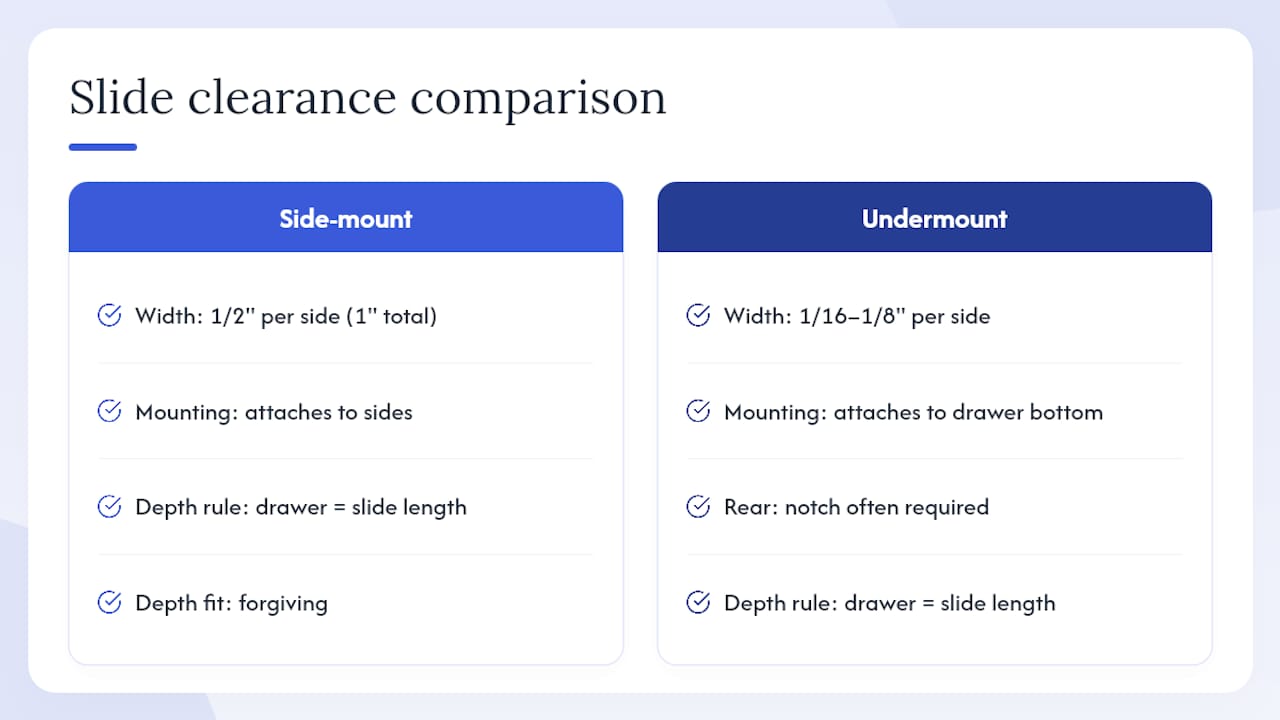
Here is the rule every cabinetmaker uses: drawer box depth equals slide length. If you install a 22-inch slide, you build a 22-inch drawer box. The drawer depth = slide length principle also means your cabinet interior must be slightly longer than the slide, typically by at least 1/2 inch, to allow the slide to seat and the drawer to clear the back wall.
Side-mount slides (the traditional ball-bearing type) require a side clearance of 1/2 inch per side, so 1 inch total off the opening width. They are forgiving on depth math but need that width deduction.
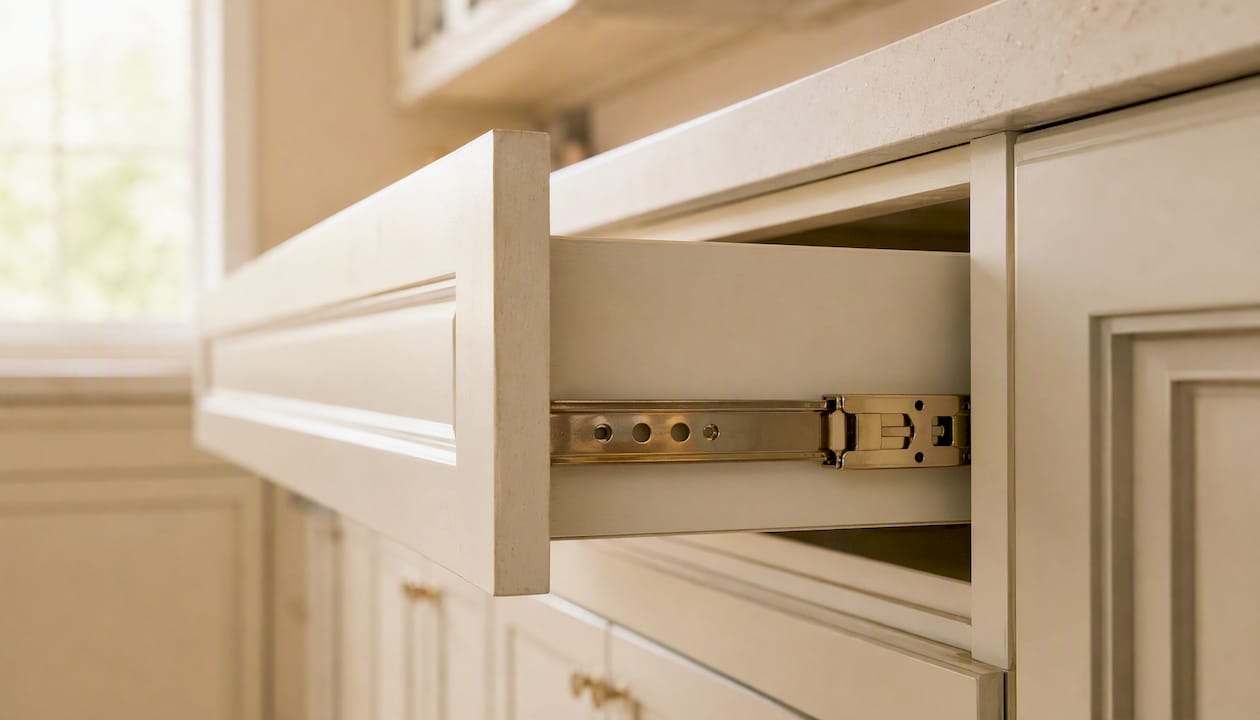
Undermount slides (Blum Tandem, Salice, KV) attach to the drawer bottom and require less side clearance, usually 1/16–1/8 inch per side. The trade-off: some undermount systems require a notch cut into the rear of the drawer box, and their installation clearances are model-specific. Vertical clearance (top and bottom of the opening) also varies by slide model, typically 1/4–1/2 inch top and bottom.
Pro Tip: Pick the longest standard slide length that fits inside your cabinet interior while still leaving at least 1/4 inch of rear clearance. When in doubt, drop to the next shorter standard length rather than squeeze the fit.
Getting this right the first time saves you a return shipment. Follow these steps in order.
Worked example: Your cabinet opening measures 17-1/2" wide × 7" tall × 23-1/4" deep. You choose a 22" side-mount slide (leaving 1-1/4" rear clearance). Drawer box width = 17-1/2" minus 1" = 16-1/2". Drawer box height = 7" minus 1/2" = 6-1/2". Drawer box depth = 22". The CabinetNow measuring guide walks through this same overlay/inset logic with additional examples.
Quick measurement checklist to bring on-site:
Manufacturer compatibility charts publish exact deduction values per slide model — use them, not generic rules.
Drawer depth and height work together. A shallow, wide drawer at counter height is perfect for cutlery; a tall, deep bottom drawer is where your cast-iron lives. Here is how the common use cases break down.
Cutlery and flatware: A drawer box 14–18 inches deep with a height of 3–4 inches keeps utensils visible and reachable. Going deeper here just means forks sliding to the back. For arranging a cutlery drawer efficiently, shallower is almost always better.
Spice and small items: Similar depth range, 14–18 inches. A taller box (5–6 inches) lets you stand spice jars upright so labels face you.
Pots, pans, and bakeware: This is where full depth pays off. A bottom drawer running the full 21–22 inches of a standard base cabinet, with a box height of 10–12 inches, handles a 12-inch skillet laid flat. Organizing pots and pans in drawers gets much easier when the drawer is deep enough to stack lids separately.
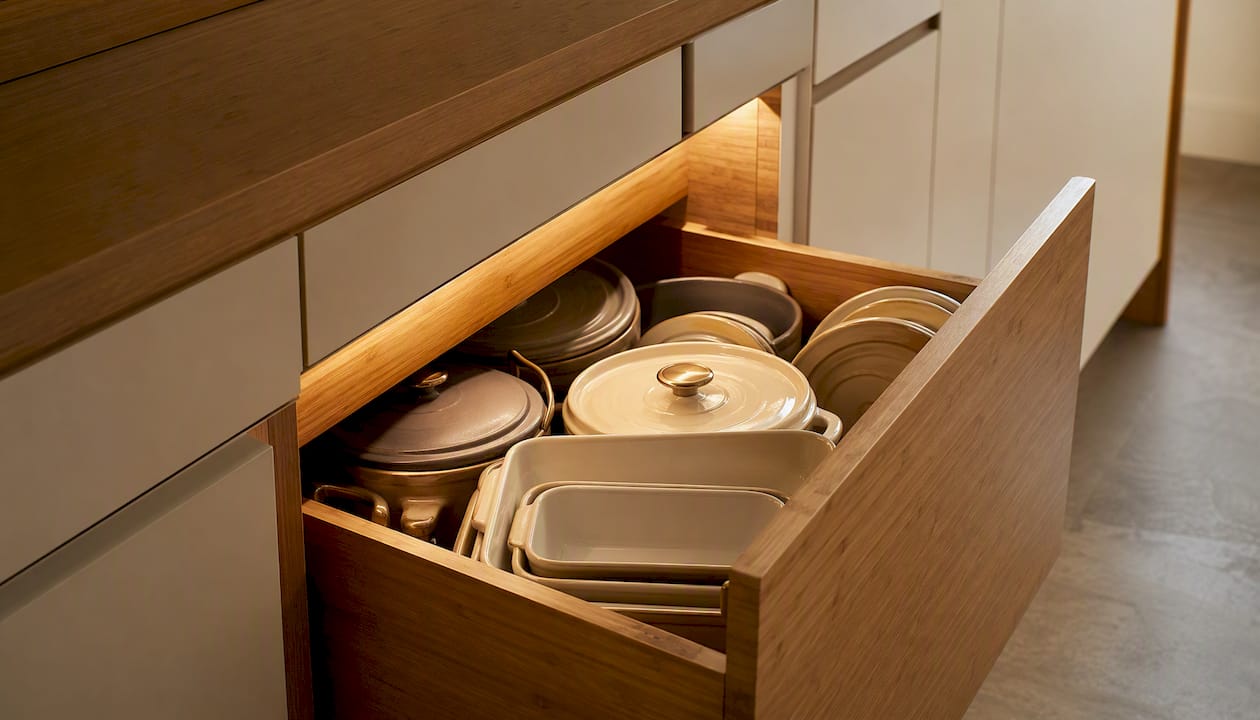
Pantry-style and island drawers: Island cabinets allow deeper drawer options reaching 26–30 inches. These suit dry goods, large serving pieces, and anything you do not need daily. The ergonomic caveat: drawers deeper than about 24 inches cause “back drift,” where small items migrate to the rear and become hard to retrieve. Use dividers or bins to keep things front-accessible.
Pro Tip: For frequently used items, prefer a drawer depth of 14–18 inches. Reserve the full 20–22 inch depth for cookware and items you pull out by hand rather than by feel.
Generic rules get you close. Manufacturer specs get you there. Design professionals consistently note that optimal depths in 24-inch base cabinets land at 20–22 inches, but that range assumes you have already checked the clearance numbers for your specific slide model. Blum, Salice, and KV each publish different side, vertical, and rear clearance requirements, and those numbers change between product lines within the same brand.
Hardware checklist before ordering:
Pro Tip: Wood expands in humid climates. Leave approximately 1/8 inch of extra tolerance rather than sizing to the absolute maximum interior depth. A drawer that binds in July is a problem you could have avoided in January.
Standard kitchen drawers in a 24-inch base cabinet typically yield a usable drawer box depth of 21–22 inches once slide clearances and cabinet construction are accounted for.
| Point | Details |
|---|---|
| Standard usable depth | A 24" base cabinet produces a 21–22" drawer box after back panel and slide clearances. |
| Slide length rule | Set drawer box depth equal to your chosen slide length; cabinet interior must be at least 1/2" deeper than the slide. |
| Side-mount vs. undermount | Side-mount slides deduct 1" total from width; undermount slides need model-specific clearances and may require a rear notch. |
| Deep drawers by use case | Use 14–18" depth for cutlery and spices; reserve 20–22" for pots, pans, and bakeware. |
| Cozee-bay organizers | Measure your interior drawer depth before buying inserts; Cozee-bay’s drawer organizer guide helps you match organizer size to actual box dimensions. |
The single most common mistake is assuming the interior depth matches the cabinet’s listed exterior depth. It never does. You pull out a tape measure, read 23-1/4 inches to the back wall, and order a 22-inch slide thinking you have plenty of room. Then the slide arrives and the rear clearance is tighter than expected because the nailer strip sits 1/2 inch proud of the back wall. Suddenly your drawer box is binding.
The fix is straightforward: always measure to the most restrictive point inside the cabinet, whether that is the nailer strip, a pipe chase, or an electrical box. Then choose the next standard slide length below that measurement, not the one that just barely fits.
A second gotcha is the undermount notch. Some Blum and Salice undermount systems require a rectangular notch cut into the bottom rear of the drawer box. If you order pre-built drawer boxes without specifying the notch, you will be cutting them yourself on-site, which is doable but annoying. Order a single test drawer box before committing to a full kitchen run. One sample drawer costs far less than eight wrong ones.
Consulting the manufacturer’s spec sheet before you finalize dimensions is not optional. It is the step that separates a smooth install from a frustrating one.
Once you know your interior drawer depth, the next step is filling that space well. A 22-inch drawer with no organization system is just a deeper version of the same chaos. Cozee-bay’s bamboo drawer organizers are sized to fit standard kitchen drawer boxes, and the deep kitchen drawer organization guide walks you through exactly how to lay out compartments based on your measured interior depth.

Before you buy any insert, write down your interior drawer depth (not the cabinet exterior spec). That single number determines whether a bamboo divider tray fits flush or rattles around. Cozee-bay ships free within the contiguous U.S. and backs every product with a money-back guarantee, so you can order with confidence once your measurements are in hand. Browse the full collection at cozee-bay.com and find an organizer that fits your actual drawer, not just the average one.
These are the pages worth bookmarking before you finalize any drawer box order.
Comments will be approved before showing up.