Your Cart is Empty


A hands-free soap dispenser releases a measured dose of soap when a sensor detects your hand, so nothing needs to be pressed, pumped or touched. It solves half of a clean handwashing routine. The other half is what happens after the rinse: the drying step is where touch-free setups usually fall apart, with a wet hand reaching for a shared towel roll or a damp hand towel. The best setup pairs the soap dispenser with a dry, easy-to-reach towel dispenser, and that is the pairing we build our bamboo paper towel dispensers for, in kitchens, bathrooms and commercial restrooms alike.
Below you will find how these dispensers work, which type suits a home or a business, how to avoid clogs, and how to build a complete station that looks as good as it works.
The mechanics are simpler than the product pages make them sound. Most models use an infrared sensor: an LED sends out an infrared signal, your hand reflects it back to a receiving diode, and the circuit then triggers the pump. UNICEF’s technical guide for handwashing facilities describes this sensor-based approach and notes that it provides true contactless operation.
Inside the housing, a small motor drives either a roller pump that squeezes a flexible tube or a piston-style pump. The motor runs just long enough to move one dose, then stops. That is why the dose is consistent, and why these dispensers tend to use less soap than someone pumping by hand.
Two practical consequences follow:
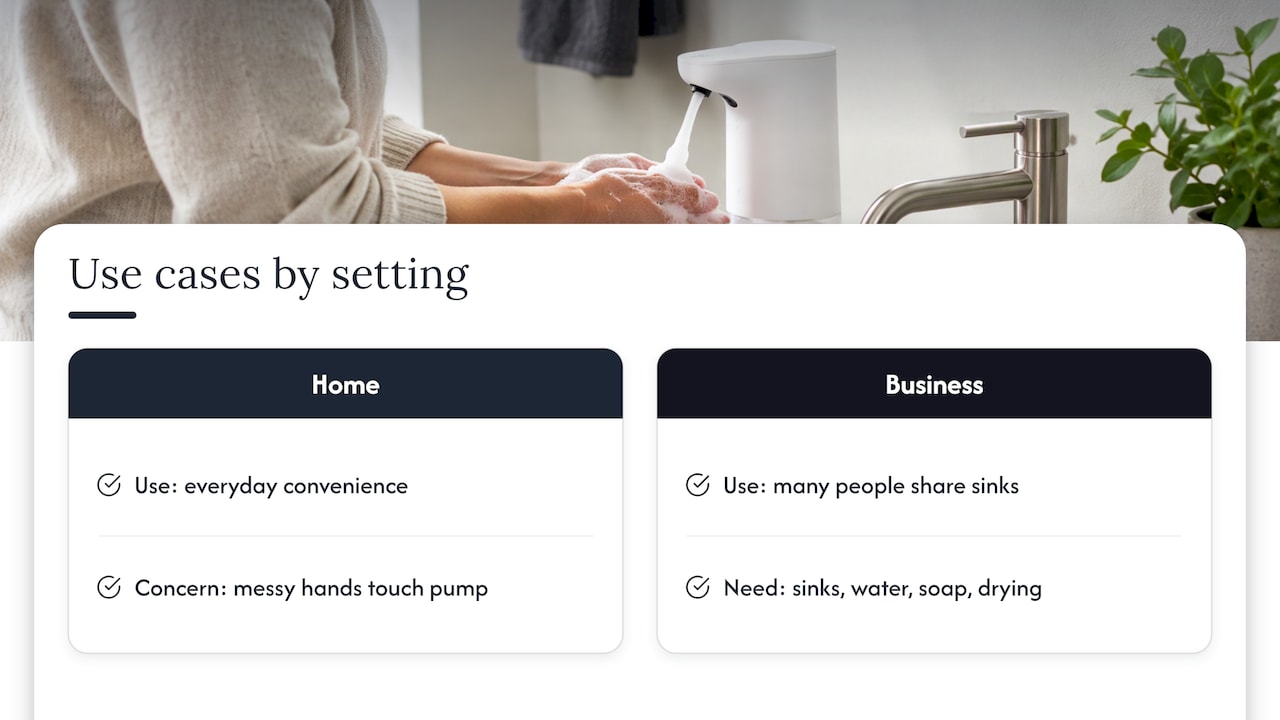
At home, the case is everyday convenience. Raw chicken, sticky dough or a toddler with muddy hands all make a pump bottle unpleasant to handle. A touch-free dispenser keeps the soap area clean because contaminated hands never touch it.
In a business, the case is shared use. Restaurants, schools, churches, coffee shops and senior living centers all have many people using the same sink. The CDC’s guidance on hand hygiene lists the basics a handwashing station needs: easily accessible sinks, clean running water, soap and a way to dry hands, such as paper towels or a hand dryer. Soap is one item in that list of four. A station is only as good as its weakest piece.
There are four main styles you will meet when shopping for a home or commercial space.
| Type | How it mounts | Best for | Things to know |
|---|---|---|---|
| Countertop sensor pump | Sits beside the sink | Kitchens and home bathrooms | Easy to place and refill; keep the sensor away from splashes |
| Wall-mounted sensor dispenser | Screws to the wall | Commercial restrooms, schools, churches | Frees counter space; a fixed location suits busy traffic |
| Under-counter or deck-mounted system | Pump head on the counter, reservoir below | Kitchens where a large soap supply is wanted | Needs a hole in the counter and room underneath |
| Foaming sensor dispenser | Countertop or wall | Households with kids, high-use sinks | Uses diluted soap, which goes further |
If you are planning a kitchen, our guide to under-counter soap dispenser options walks through what actually fits beneath a sink.
Liquid dispensers work with a wider range of soaps. Foam dispensers mix soap with air and are built for thinner, foaming formulas. Foam looks like a generous amount while using less product per wash, and many families find kids use it more willingly. The trade-off is that you must match the soap to the mechanism, which brings us to the most common frustration.
The soap goes through a narrow tube and a small pump, so thickness matters. Thick, creamy soaps, soaps with scrub beads and many dish soaps can slow the pump or stop it altogether. Foaming models need soap made for foaming, or regular liquid soap diluted with water. Follow the dispenser’s manual for the ratio, because each mechanism is different.
If a dispenser clogs, America’s Test Kitchen tested four motion-activated models and gave a simple clog-removal routine for one of them:
Check your own dispenser’s manual first, since materials differ between models. As a habit, keep the soap thin and clean, and never top up with a different soap while some old soap sits in the reservoir.
Use this list whether you are outfitting one kitchen or ten restrooms.
For several dispensers in a commercial space, our guide to setting up touchless dispensers for commercial spaces covers placement and flow so that people do not queue at a single sink.
Touch-free does not mean maintenance-free. The SHEA/IDSA/APIC 2022 hand hygiene update noted that touchless alcohol-based dispensers showed higher rates of mechanical defects than mechanical ones, pointing to the value of ongoing maintenance. A short routine keeps any sensor dispenser dependable:
The same logic applies to sanitizer stations. If you also stock a dispenser for hand rub, hand disinfectant products fit the same sensor-style dispensers, and the same nozzle care applies.
A sensor dispenser is a small appliance, so its footprint comes from three places: the soap, the power and the housing.
That last point is where we come in. Our guide to choosing eco-friendly dispensers explains what to look for when you want a sustainable look across the whole room.
Wash, rinse, dry. If the soap step is hands-free, the drying step should be easy and clean as well. In the CDC’s list of handwashing supplies, drying is named alongside soap and water. A shared cloth towel or an awkward roll sitting on the counter undoes some of the care you took at the soap pump.
A wall-mounted or countertop paper towel dispenser keeps the towels clean, dry and within reach of a wet hand. Think about how the station works in practice:
Our step by step restroom paper towel setup shows how to place a dispenser so the station flows from sink to exit.
Cozee Bay bamboo paper towel dispensers are handmade from premium, organic bamboo, with patented, user-friendly designs. They come as wall-mounted and countertop styles, are compatible with multiple towel fold types and brands, and are easy to install. They are already in use in restaurants, churches, schools, coffee shops and senior living centers. Every order ships free within the contiguous U.S. and is backed by a money-back guarantee.

For a business, start with our commercial paper towel dispensers. For a home kitchen or bathroom, browse the countertop paper towel dispensers, or see the whole range on our collections page.
We think about handwashing as a small system: soap, water, a place to dry, and a counter that stays tidy. A hands-free soap dispenser is a smart upgrade to the first step, and we like that it spares shared surfaces from wet, soapy hands.
What we see as the natural next step is the drying station. Our bamboo paper towel dispensers are designed to be user-friendly and easy to install, and they work with multiple towel fold types and brands, so your station is not tied to one kind of towel. Handmade bamboo gives a kitchen, bathroom or restroom a warm, natural look, and it matches the care that people who choose touch-free soap already put into their space.
If you are setting up a commercial space, choose the soap dispenser for reliable output and easy refilling, then give the towel dispenser the same attention. Put them side by side, keep the route from sink to exit clear, and you get a station people use without thinking about it.
Cozee
Only if the dispenser is made for it or the soap is thin enough to pass through the pump. Thick dish soaps are a common cause of clogs, and foaming models need a foaming formula or a diluted soap. Check the manual for the right soap and dilution.
First check the batteries and make sure the sensor window is clean and clear. If the pump is dry, activate it several times so soap reaches the nozzle. If the nozzle is clogged, a flush with rubbing alcohol and then water, as described by America’s Test Kitchen for one tested model, often clears it. Follow your own model’s manual.
They remove the need to touch a pump with soiled hands, which is a real advantage in kitchens and shared restrooms. They still need regular cleaning of the nozzle and sensor, and they work best as part of a full handwashing routine that includes at least 20 seconds of scrubbing and a clean way to dry, as the CDC advises.
Put it on a flat, dry surface near the faucet, with the nozzle clear of sink spray and away from shiny surfaces that can reflect the sensor’s signal. In a commercial restroom, wall mounting beside the sink saves counter space and keeps the dispenser in a predictable spot.
A clean, easy-to-reach way to dry hands. A wall-mounted or countertop paper towel dispenser completes the station and keeps towels tidy and dry.
Comments will be approved before showing up.