Your Cart is Empty


A tidy office comes from three habits: clear out what you don’t use, give everything you keep a fixed home, and reset the space for a few minutes at the end of each day. Gadgets help, but the system comes first. The ideas below cover the desk, paper, cables, drawers and the shared spots people forget, like the break room and restroom. We build handcrafted bamboo organizers and paper towel dispensers for homes and commercial spaces, so we spend a lot of time thinking about where small, everyday items should live.
Buying bins before you purge is the most common mistake. You end up organizing things you didn’t need to keep. Sort first, then buy containers that fit what is left.
The KonMari team’s guide to organizing a workplace recommends starting with individual desks, sorting items by category, and then moving on to shared areas. Its advice on storage space is worth copying: leave at least a quarter of every drawer, desktop and bookcase free. Empty space makes it faster to find, put back and clean.
Here is a simple order that works for a home office or a small business office:
If your office is shared, schedule the project for a slower week and involve everyone. KonMari’s workplace advice is that leadership should back the effort and provide resources, and that the work is best done when it won’t disrupt deadlines.
A cluttered desk isn’t just ugly. Professional organizer Julie Morgenstern, quoted in WSJ Buy Side’s desk organization piece, observes that many people use the desk as a to-do list, with piles serving as visual reminders of unfinished work. Her fix is to move those tasks into your calendar so you don’t need the piles to remember them, then file, scan or discard the paper.
That shift is the real organizing idea. A desk should hold what you’re working on right now, not everything you might need someday.
Start by deciding what lives within reach of your chair. Architectural Digest’s desk guide puts it plainly: keep daily-use items close and hide the non-daily items in storage.
A three-tier approach makes that easy:
On a small desk, the monitor often takes the most room. Popular Science notes that a typical monitor stand footprint is about eight to ten inches deep. Moving to a smaller monitor, a wall-mounted or arm-mounted screen, or adding a shelf above can give that depth back. Lifting a desktop tower off the surface or swapping a base lamp for a clamp lamp does the same.
Wirecutter’s home office expert Melanie Pinola keeps small items like a flash drive and a microfiber cloth on a wall hook, within reach but off the desk, as described in Wirecutter’s desk organization picks. Wall hooks, a shelf or a pegboard (handy if you rent and can’t drill big holes) turn dead space into storage.
Paper clutter is usually the real source of an untidy office. Forbes Home quotes organizing expert Ashley Jones Hatcher saying that if you get paper under control, everything else falls into line. She suggests a pending system with three parts: to be filed, to be reviewed and to be shredded, and a habit of handling it at the start or end of each week.
Organizing coach Barbara Hemphill’s Clutter is Postponed Decisions material says the average worker spends 150 hours a year looking for misplaced information. Her answer is the F.A.T. decision: for every piece of paper, choose File, Act or Toss, and handle it once after it leaves the in-box. The same material suggests asking whether the paper needs action, exists elsewhere, is recent enough to be useful, has tax or legal implications, and what the worst case is if you don’t have it. “Just in case” usually isn’t a good enough reason.
Professional organizer Kacy Paide told NPR’s Life Kit to start with the paper within arm’s reach of your computer and make a rough split between what needs action and what doesn’t. Action items shouldn’t be filed away, because you’ll forget them. Keeping only those visible gives you one snapshot of what needs doing.
Consumer Reports recommends three categories: pending items in a desk folder, temporary storage for current paperwork (including seven years of tax returns), and permanent documents in a file drawer or fire-safe folder. It also suggests labeling folders the way you would search for them, and budgeting about an hour per file drawer’s worth of paper.
A few practical touches:
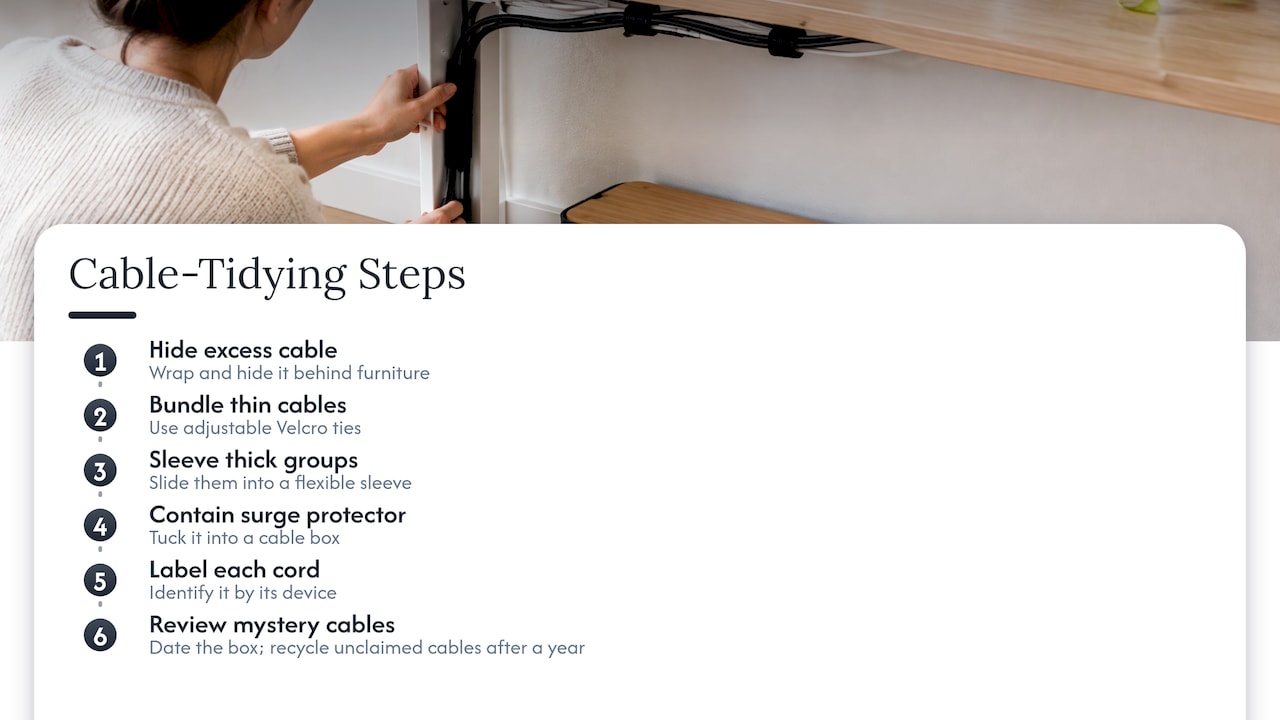
Cords make an otherwise neat desk look chaotic. Consumer Reports estimates cable tidying takes about 20 minutes: wrap and hide excess cable behind furniture, bundle thin cables with Velcro ties, slide thicker groups into a flexible sleeve, tuck a surge protector into a cable box, and label each cord with its device. Its organizer expert also suggests keeping unmatched cables in a dated “Mystery Cables” box and recycling whatever is still unclaimed after a year.
Wirecutter’s Pinola prefers thin hook-and-loop ties over zip ties because they are adjustable and reusable. That small choice matters if your desk setup changes often.
For spare chargers and cords you do want to keep, a drawer works better than a tangle in a bin. Our walkthrough on organizing cords in a drawer with clips or bamboo shows a 30-minute version.
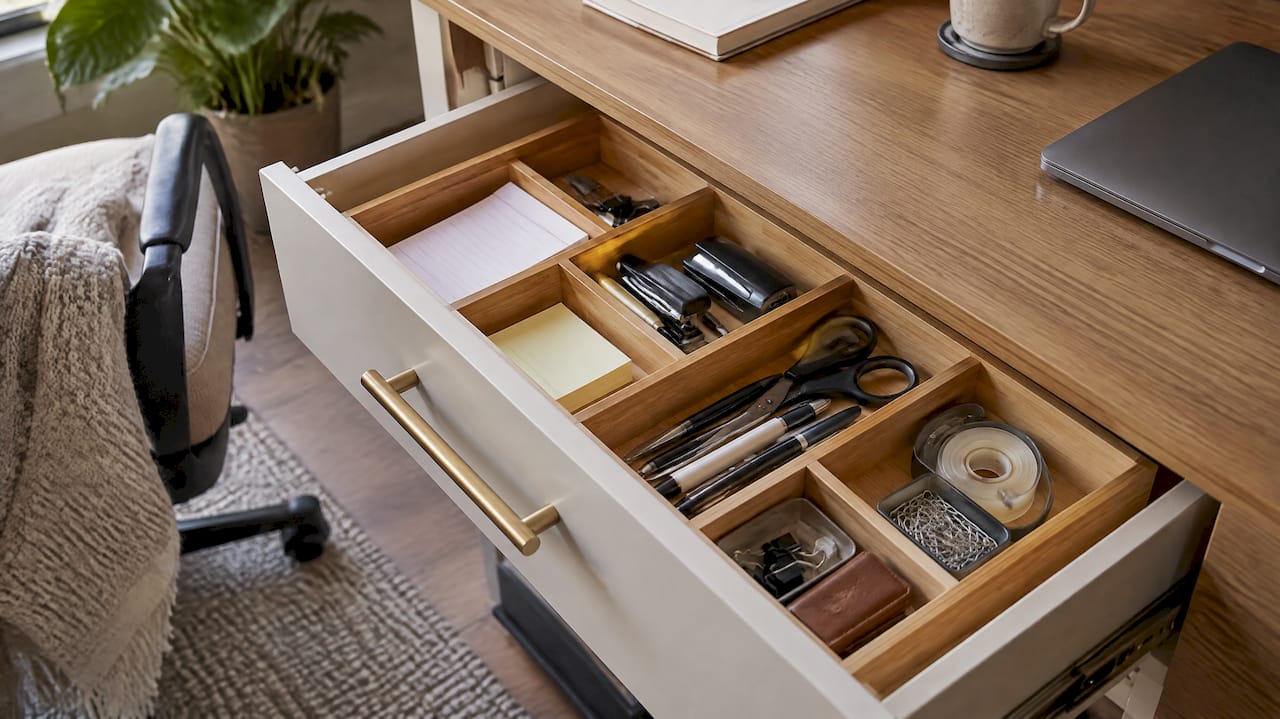
Once the clutter is gone, storage is about matching containers to habits. If you never put lids back on, use an open tray. If you reach for the same five items all day, they need a shallow drawer or a desktop holder, not a deep box.
A quick storage plan:
Forbes Home quotes professional organizer Caroline Roberts on planning before buying: list the kinds of storage you need, such as shallow or deep drawers, paper volume, samples and equipment, then use sorting, labels and color-coding so each item has a designated spot. She also cautions against over-organizing, so keep the system simple enough that you’ll actually maintain it.
Dividers are where bamboo earns its place. Natural bamboo looks warm on a desk and in a drawer, and it fits the look of a home office better than a stack of mismatched plastic trays. Our drawer organizers are made from natural bamboo, and our guide to eco-friendly storage organization ideas shows how to plan them around what you own.
In a business office, the places that look messiest are often the shared ones. A roll of paper towels on a counter, a stack of folded towels beside a sink or a box that is always empty when someone needs it all signal disorder to staff and visitors alike.
The fix is the same as at the desk: give the item one fixed home. Our bamboo paper towel dispensers come in wall-mounted and countertop versions and work with multiple towel fold types and brands, so you can pick the format that suits your break room, kitchenette or restroom. They are designed to be easy to install. Cozee Bay dispensers are already used in restaurants, churches, schools, coffee shops and senior living centers, and our commercial paper towel dispensers are built for that kind of daily traffic.
For a home office that shares a kitchen or a pantry, a countertop paper towel dispenser keeps the counter clear and a roll within reach. A wrap and foil dispenser or a bag organizer inside a nearby drawer does the same job for lunch supplies.
An organized office isn’t just a tidy desk. Forbes Home quotes interior designer Phillip Thomas recommending several spots for different purposes. A separate comfortable seat for reading paperwork gives you a break from sitting at the desk all day and can recharge your motivation. He also suggests breaking up storage to fit the activity in each zone.
A practical layout might look like this:
| Zone | What happens there | What to store nearby |
|---|---|---|
| Focus zone | Computer work, calls | Daily items only, notebook, pen cup |
| Paper zone | Reading, signing, reviewing | In-tray, pending folder, shredder or recycling |
| Supply zone | Restocking | Boxes of spare supplies, labeled |
| Break zone | Coffee, snacks, cleanup | Paper towel dispenser, trash bag organizer |
If you want the paper zone to feel calm rather than clinical, look at these zen home decor ideas for simple, soothing touches.
Organized doesn’t have to mean sterile. Natural materials such as bamboo and wood, a plant, one framed print and good lighting make a workspace somewhere you want to sit. Keep decor to the edges of the desk so it doesn’t compete with daily items, and apply the same one-in, one-out rule you use for supplies.
Our post on bamboo organizer design ideas shows how natural finishes blend into different rooms, which helps if you’re an interior designer or manager choosing a consistent look across several spaces.
Any system fails without maintenance. KonMari recommends making tidying a daily habit: at the end of each working day, spend a few minutes storing items, discarding what you don’t need and cleaning the surface. Add a weekly pass through your pending paper and you’ve covered most of what keeps offices from sliding back into clutter.
A reset checklist:
For more on building routines that last, read our best practices for home organization.
We think organizing works when it fits the way you already move through your day. Nobody keeps a system that needs a manual.
That’s why we design our bamboo products around one idea: a fixed, good-looking home for the small things that cause daily friction. A paper towel dispenser that mounts on the wall or sits on the counter. A drawer organizer that stops pens and chargers from migrating. A bag or wrap organizer that keeps the kitchen drawer under control.
We make them from natural bamboo, handcrafted, with patented, user-friendly designs, because the tools you see every day should be as pleasant as they are useful. They suit homes and commercial spaces alike, from a home office to a break room, and they are backed by a money-back guarantee and dedicated customer support.
Start with the clear-out, set your zones, and add storage that matches what’s left. The rest is a five-minute habit.
Cozee
If your break room, restroom or kitchenette is the last untidy corner, a bamboo dispenser is a quick fix. We offer wall-mounted and countertop paper towel dispensers compatible with multiple towel fold types and brands, plus bag organizers, wrap dispensers and drawer organizers for supply drawers. Free shipping applies within the contiguous U.S., and every order is covered by our money-back guarantee.

Browse the full Cozee Bay collection to match a dispenser or organizer to your space.
Clear out first, then group what’s left by category and give each group a home. Keep daily items on the desk, weekly items in a drawer and rarely used items on a shelf. Finish with a short end-of-day reset so the system holds.
Pick one small zone, such as the top of your desk, and empty it completely. Sort into keep, relocate and discard, wipe the surface, and put back only what you use daily. Then move to the next drawer or shelf rather than tackling everything at once.
Reclaim depth first. A typical monitor stand takes about eight to ten inches of desk depth, so an arm mount or shelf frees room. Then use wall hooks, a pegboard, under-desk storage and drawers so only daily items stay on the surface.
Use a file, act or toss decision for each piece, keep action items in one visible tray, and file the rest into three groups: pending, current and permanent. Label folders the way you would search for them, and scan what you can.
Comments will be approved before showing up.