Your Cart is Empty


TL;DR:
- Commercial restroom accessories are essential fixtures that ensure hygiene, ADA compliance, and positive visitor experiences. Proper selection based on traffic volume, sustainability, and maintenance requirements optimizes operational efficiency and reduces costs. Integrating compliance verification, eco-friendly features, and smart monitoring creates a reliable and sustainable restroom system.
Commercial restroom accessories are the functional fixtures and dispensing systems that maintain hygiene, meet ADA standards, and shape how visitors perceive your facility. Whether you manage a busy restaurant, a corporate office, or a senior living center, the wrong accessories create runouts, compliance violations, and frustrated users. Poor restroom experiences deter repeat visits from 73% of users, which means every dispenser, grab bar, and waste receptacle you choose directly affects your bottom line. This guide covers the top 10 commercial restroom accessories, with practical guidance on ADA compliance, sustainability, and matching products to your traffic volume.
Commercial washroom accessories are typically grouped into functional categories that align with buildout needs, making procurement and specification far more manageable. Knowing these categories upfront saves you from costly retrofits and compliance headaches later.
The core categories every facility manager should plan for include:
Each category carries its own compliance requirements, maintenance demands, and sustainability considerations. Treating them as a system rather than individual purchases leads to better outcomes.
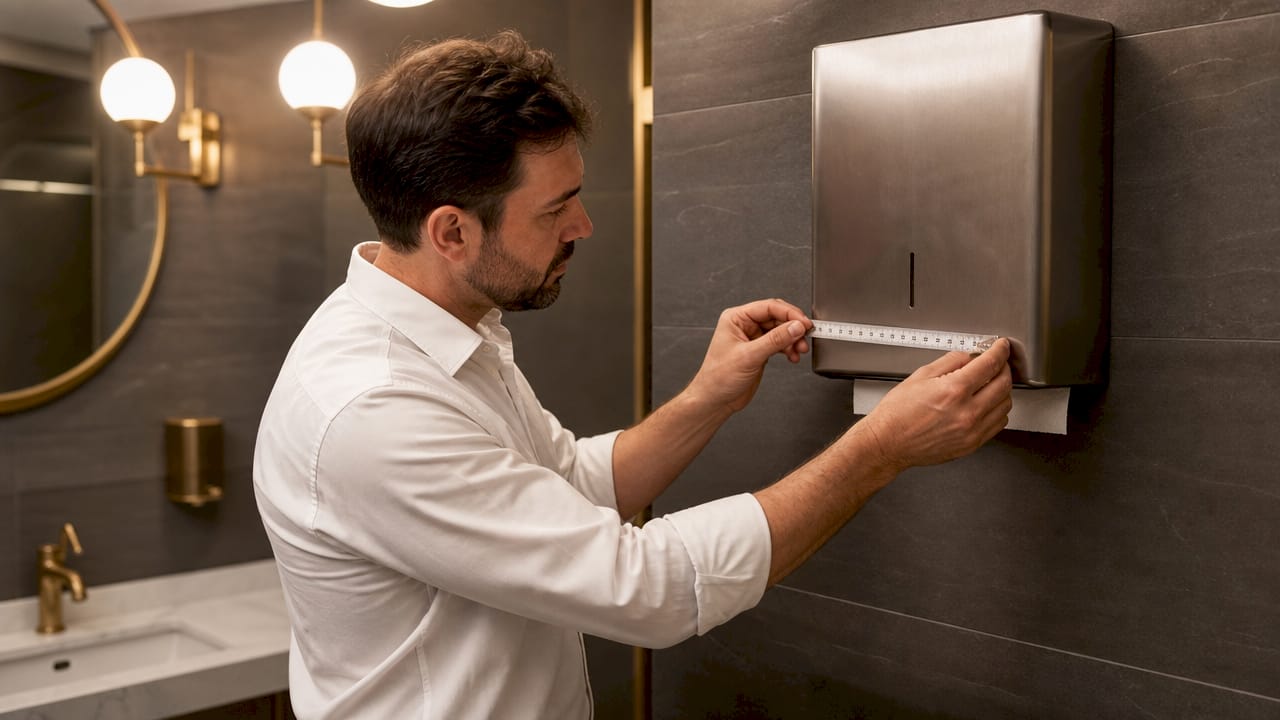
ADA compliance is not a one-time checkbox. It is an ongoing obligation with specific dimensional requirements that auditors check during inspections. Common ADA compliance failures in accessory installation include incorrect mounting heights, outlets positioned behind grab bars, and dispensers placed above reach limits. These violations are persistent and expensive to correct after occupancy.
The table below summarizes the most critical ADA dimensions for common restroom accessories:
| Accessory | ADA Requirement |
|---|---|
| Toilet paper dispenser | 15–48 inches above floor, 7–9 inches in front of toilet centerline |
| Mirror (reflective surface) | Bottom edge no higher than 40 inches above finished floor |
| Grab bar (side wall) | 33–36 inches above finished floor |
| Soap and paper towel dispensers | Forward reach max 48 inches; side reach max 54 inches |
| Baby changing station (lowered) | Operable parts within 15–48 inch reach range |
The ADA toilet paper dispenser must be mounted 15 to 48 inches above the finished floor and 7 to 9 inches in front of the toilet centerline. Getting this wrong is one of the most cited violations in post-occupancy audits.
Pro Tip: Request dimensional submittals and reach diagrams from your accessory supplier before installation. On-site verification of operability, including testing with one hand closed, catches compliance gaps that drawings alone miss.
Thorough ADA verification requires submission and on-site testing of detailed installation plans with absolute dimensions. Skipping this step turns a $200 dispenser into a $5,000 retrofit.
Sustainability in commercial restrooms goes well beyond product ingredients. It covers packaging, refill logistics, and the full lifecycle of every accessory you install. Facilities that focus only on “green” soap formulas while ignoring dispenser design miss the bigger opportunity.
The highest-impact changes you can make include:
“Coreless toilet paper systems’ waste reduction is one of the highest-impact sustainability measures facilities can take, cutting landfill contributions and operational labor tangibly.” — S.P. Richards Sustainability Report
Pairing eco-friendly accessory choices with a managed restocking program compounds the benefit. You reduce waste at the product level and reduce unnecessary service trips at the operational level.
Traffic volume is the single most important variable in accessory selection, yet many facilities default to one product tier across all restrooms. That approach creates runouts in busy areas and unnecessary cost in low-traffic spaces.
High-traffic restrooms (airports, stadiums, large retail centers, hospitals) need durability and capacity above all else. High-traffic commercial restrooms require jumbo roll tissue dispensers and automated towel dispensers to minimize restocking frequency and control consumption. Foam soap dispensers work well here because they stretch product volume further per pump.
Medium-traffic restrooms (offices, schools, coffee shops, restaurants) benefit from a balance of capacity and aesthetics. Standard roll dispensers with a reserve roll feature prevent runouts between scheduled service visits. Touchless liquid soap dispensers offer a clean look without the bulk of institutional-grade units.
Low-traffic restrooms (private offices, boutique hotels, senior living suites) are where you can prioritize comfort and style. Premium tissue, lotion soap, and decorative fixtures signal quality to guests without requiring heavy-duty capacity.
Pro Tip: Facilities with refill frequencies exceeding once daily benefit most from high-capacity dispensers. Multi-feed systems can reduce refill events by 70 to 90%, extending service intervals from hours to days.
Even the best accessories fail if your maintenance program cannot keep up with demand. The goal is to reduce the number of times staff must enter a restroom to refill, restock, or repair, while keeping every unit fully operational between visits.
Centralized multi-feed dispenser designs consolidate refill points and reduce maintenance calls compared to multiple single-cartridge units. A central reservoir approach creates fewer touchpoints, less disruption, and smoother restroom operations overall. In large facilities like convention centers or university buildings, this design shift alone can cut maintenance labor hours noticeably each week.
Managed supply programs take this further. UniFirst’s Essential Series provides restocking, maintenance, and predictable billing to prevent dispenser runouts in high-use environments. Route service monitoring and a customer portal give facility managers real-time visibility into supply levels without requiring manual checks.
Smart sensor technology is the next step. Dispensers equipped with occupancy sensors and fill-level alerts notify maintenance staff only when a refill is actually needed, replacing fixed-schedule service with demand-driven response. This reduces both unnecessary labor and the risk of an empty dispenser during peak hours.
Pro Tip: When evaluating managed programs, ask suppliers for uptime data and average response times for runout incidents. A program that looks affordable on paper but allows frequent runouts costs more in customer experience than it saves in labor.
The combination of high-capacity hardware, centralized refill architecture, and data-driven scheduling is the most reliable path to a restroom that runs itself between scheduled deep cleans.
Selecting the right commercial restroom accessories requires matching ADA-compliant, high-capacity, and sustainable products to your specific traffic volume and facility type.
| Point | Details |
|---|---|
| ADA compliance is non-negotiable | Verify mounting heights and reach ranges with dimensional submittals before installation. |
| Sustainability starts with dispensers | Coreless systems and touchless dispensers deliver the highest waste and labor savings. |
| Traffic volume drives product tier | High-traffic spaces need jumbo-roll and multi-feed systems; low-traffic spaces can prioritize aesthetics. |
| Centralized refill design cuts labor | Multi-feed and reservoir dispensers reduce maintenance touchpoints by up to 90%. |
| Managed programs prevent runouts | Services like UniFirst Essential Series add monitoring and predictable billing for busy facilities. |
I have seen facility managers spend serious money on stylish fixtures and then watch them fail within six months because nobody accounted for refill capacity or ADA reach ranges. The most common mistake is treating restroom accessories as a one-time purchase decision rather than an ongoing operational system.
The sustainability conversation has shifted, too. A few years ago, “eco-friendly” meant buying recycled paper. Now it means evaluating the full lifecycle of every product you specify, from packaging volume to refill logistics to end-of-life disposal. Facilities that understand commercial restroom hygiene as a system rather than a checklist consistently outperform those that do not.
ADA compliance is the area where I see the most expensive mistakes. Auditors do not just check whether a grab bar exists. They check whether it is at the right height, whether the dispenser next to it blocks reach, and whether the operable parts require more than one hand to use. Getting this right before installation costs almost nothing. Fixing it afterward costs a lot.
The facilities that get this right share one habit: they specify accessories, compliance requirements, and maintenance programs together, before a single fixture goes on the wall. That upfront discipline pays off every day the restroom is open.
— Cozee

If you are ready to move beyond generic fixtures and build a restroom that reflects your commitment to quality and sustainability, Cozee-bay has options worth exploring. Cozee-bay’s bamboo paper towel dispensers bring handcrafted style and eco-conscious materials to commercial spaces, from coffee shops and restaurants to schools and senior living centers. Every product is built with functional design in mind, and Cozee-bay offers free shipping within the contiguous U.S. along with a money-back guarantee. For facilities that want accessories that look good, hold up under daily use, and align with sustainability goals, Cozee-bay’s full catalog is a practical starting point. Browse the collection and find the right fit for your space today.
Commercial restroom accessories are the functional fixtures installed in public and business washrooms, including dispensers, grab bars, mirrors, waste receptacles, and baby changing stations. They serve hygiene, accessibility, and user experience functions in facilities ranging from offices to healthcare buildings.
The ADA requires toilet paper dispensers to be mounted 15 to 48 inches above the finished floor and 7 to 9 inches in front of the toilet centerline. Soap and paper towel dispensers must fall within a forward reach of 48 inches maximum.
Jumbo roll tissue dispensers and automated paper towel dispensers are the best choice for high-traffic restrooms because they minimize refill frequency and control consumption. Multi-feed systems can reduce refill events by 70 to 90% compared to standard single-roll units.
Coreless systems like Tork’s OptiServe eliminate cardboard cores and outer wraps, cutting packaging waste by 89% compared to conventional rolls. This reduces both landfill contributions and the storage space needed for backup inventory.
A managed restroom supply program, such as UniFirst’s Essential Series, provides scheduled restocking, maintenance, and real-time monitoring to prevent dispenser runouts. These programs use route service tracking and customer portals to give facility managers predictable supply costs and uptime assurance.
Comments will be approved before showing up.