Your Cart is Empty


TL;DR:
- A truly sustainable product considers environmental, social, and economic impacts across its entire lifecycle.
- Verification through lifecycle assessment, responsible sourcing, and third-party certifications helps identify genuine sustainability efforts.
A sustainable product is designed, manufactured, and managed to minimize environmental and social harm while remaining economically viable across its entire life cycle. Think of it as the Triple Bottom Line in product form: environmental responsibility, social fairness, and economic sense, all three working together. Quick checklist: (1) materials sourced responsibly, (2) lifecycle impact assessed via LCA, (3) social practices verified.
TL;DR:
Most people use “eco-friendly” and “sustainable” interchangeably, but they describe different things. Eco-friendly typically means a product causes less harm at one point in its life, usually during use. Sustainable means the product holds up across all three dimensions of the Triple Bottom Line: environmental impact, social equity, and economic viability, from raw material extraction through final disposal.
The Triple Bottom Line framework matters because a product made from recycled materials in a factory with unsafe labor conditions is not truly sustainable. Social factors — fair wages, safe working conditions, community impact — carry equal weight alongside carbon footprint and resource use.
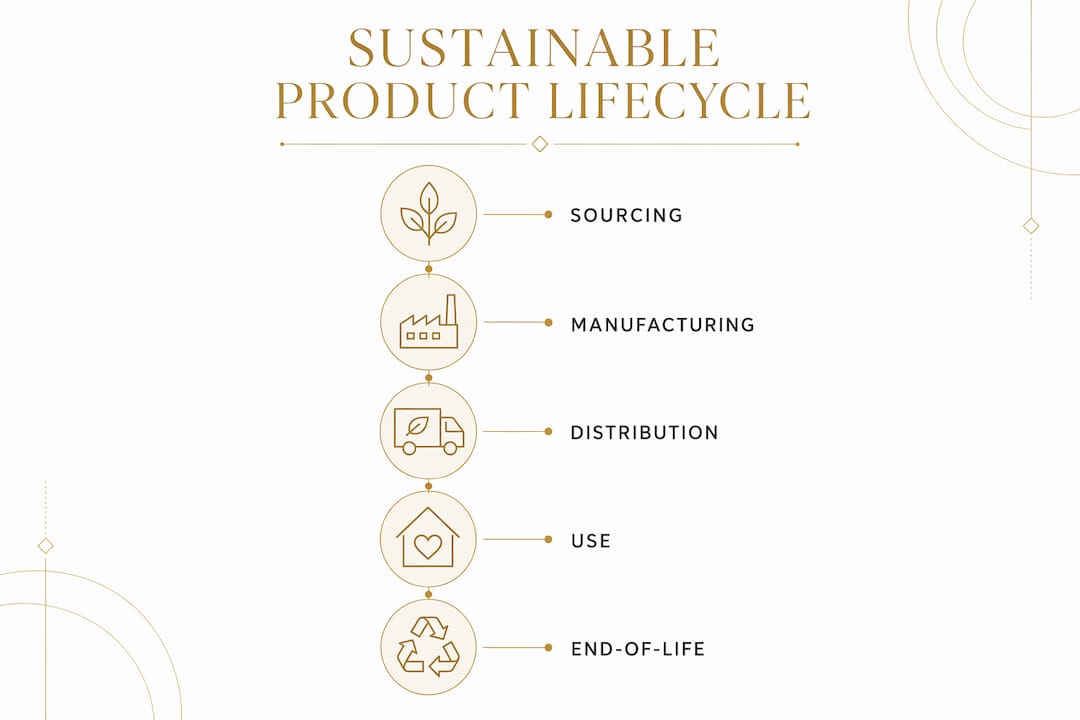
Life-cycle orientation is the practical engine behind this definition. Instead of judging a product by what it is made of, you judge it by what it does at every stage: where materials come from, how it is manufactured, how far it travels, how long it lasts, and what happens when it wears out. That full-picture view is what separates genuinely sustainable products from clever marketing.
Every product moves through five core stages, and each one carries its own sustainability risks. The EPA notes that manufacturing, use, and disposal are common “hot spots” where environmental and health impacts concentrate — but the right questions differ by stage.
| Life-cycle stage | Key sustainability checks |
|---|---|
| Raw materials | Renewable or recycled? Responsibly sourced? Extraction impacts disclosed? |
| Manufacturing | Energy source (renewable vs. fossil)? Emissions, water use, chemical safety? |
| Transport | Distance from source to shelf? Packaging efficiency? Carbon offset claims verified? |
| Use phase | Energy or water consumption? Durability and repairability? Hazardous substances? |
| End of life | Recyclable, compostable, or biodegradable? Take-back or EPR program available? |
Practical questions to ask at each stage:
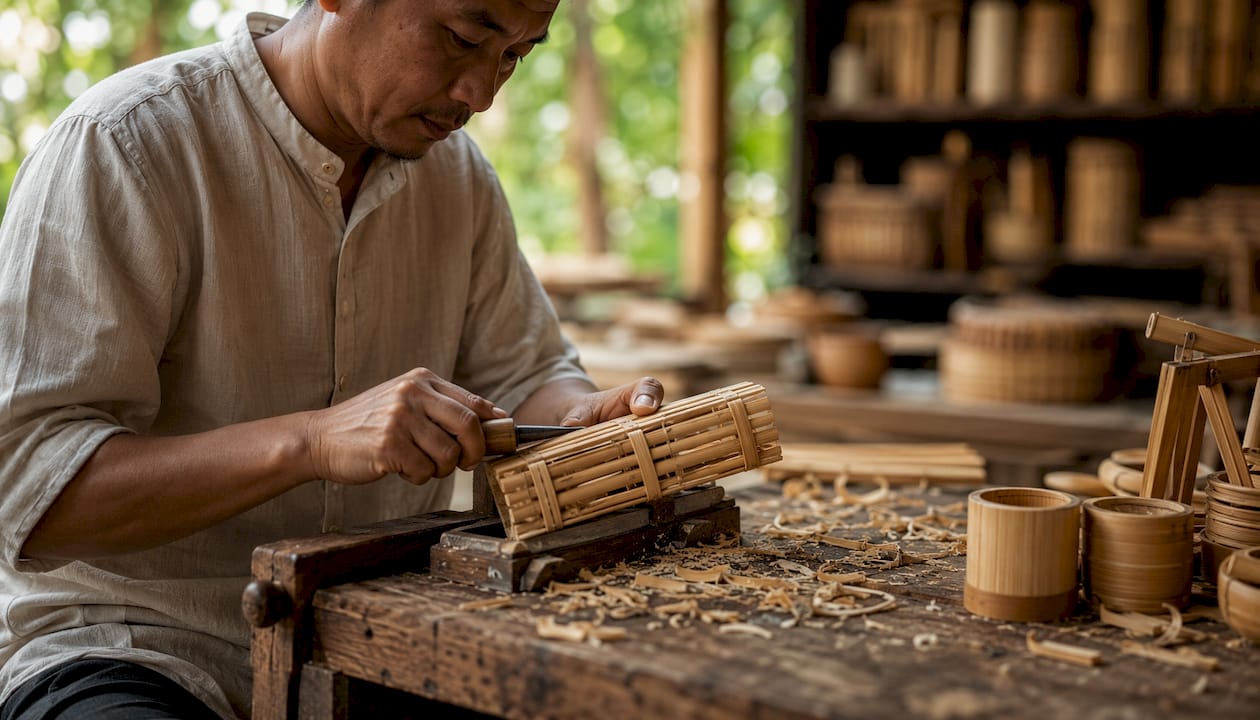
For bamboo products specifically, the lifecycle from growth to disposal includes sourcing location, processing chemicals, adhesives used, transport emissions, durability, and end-of-life compostability — all of which a credible brand should be able to address.
Sustainable design is not one feature — it is a cluster of attributes that work together. Here is what to look for:
Circularity ties these together. Practitioners consistently prioritize products designed for longevity and reparability, viewing recycled materials as a starting point, not a finish line. Reuse, repair, and end-of-life reclaim are what keep a product out of the landfill.
Certifications are useful shortcuts, but each one covers a specific slice of the sustainability picture. Understanding what a label actually measures — and where it stops — saves you from misplaced confidence.
| Certification / Standard | What it covers | Primary trust signal | Key limit |
|---|---|---|---|
| LCA / ISO 14040-series | Full lifecycle environmental impact assessment | Science-based, stage-specific data | Requires expert interpretation; scope varies by study |
| FSC (Forest Stewardship Council) | Responsible forest management and chain of custody | Third-party audited | Covers wood/paper sourcing only |
| Fair Trade | Fair wages, safe conditions, community premiums | Independent certification body | Scope varies by product category |
| USDA Organic | Organic agricultural inputs, no synthetic pesticides | Federal program via USDA AMS | Covers farming stage; not full lifecycle |
| Energy Star | Energy efficiency during product use phase | EPA-backed program | Use-phase only; no material or labor coverage |
| Cradle to Cradle | Material health, recyclability, renewable energy, water stewardship, social fairness | Multi-attribute, tiered certification | Self-reported elements at lower tiers |
| GRI (Global Reporting Initiative) | Corporate sustainability reporting framework | Standardized disclosure | Reporting framework, not a product certification |
Life Cycle Assessment (LCA), governed by the ISO 14040-series, is the analytical backbone behind most credible sustainability claims. An LCA maps inputs and outputs at every stage and quantifies impacts like carbon emissions, water use, and toxicity. Certification schemes are private standards that specify sustainability metrics for products and supply chains — they signal compliance, but their scope limits mean no single label tells the whole story.
Pro Tip: When a brand cites a certification, ask which product components it covers. An FSC label on a wooden product does not automatically mean the adhesives, finishes, or packaging meet the same standard.
Greenwashing is common enough that a healthy skepticism is a practical skill, not cynicism. Follow this checklist when evaluating any product’s sustainability claims.
Common greenwashing red flags:
For verification, the EPA’s Safer Choice program evaluates chemical ingredients in cleaning and household products. The EPA’s greener products guidance and the GRI reporting framework are reliable starting points for deeper research.
Sustainable products deliver genuine value across all three pillars, but they come with real trade-offs worth knowing upfront.
Benefits:
Trade-offs to be honest about:
Sustainability should be treated as continuous improvement rather than a fixed label. Brands that show measurable progress over time — reduced emissions year over year, expanded supplier audits, improved recyclability — are more credible than those claiming perfection from day one.
Sustainable choices exist in nearly every product category. Here is a quick-reference breakdown, with a note on where greenwashing tends to concentrate.
| Category | Sustainable examples | Greenwashing watch |
|---|---|---|
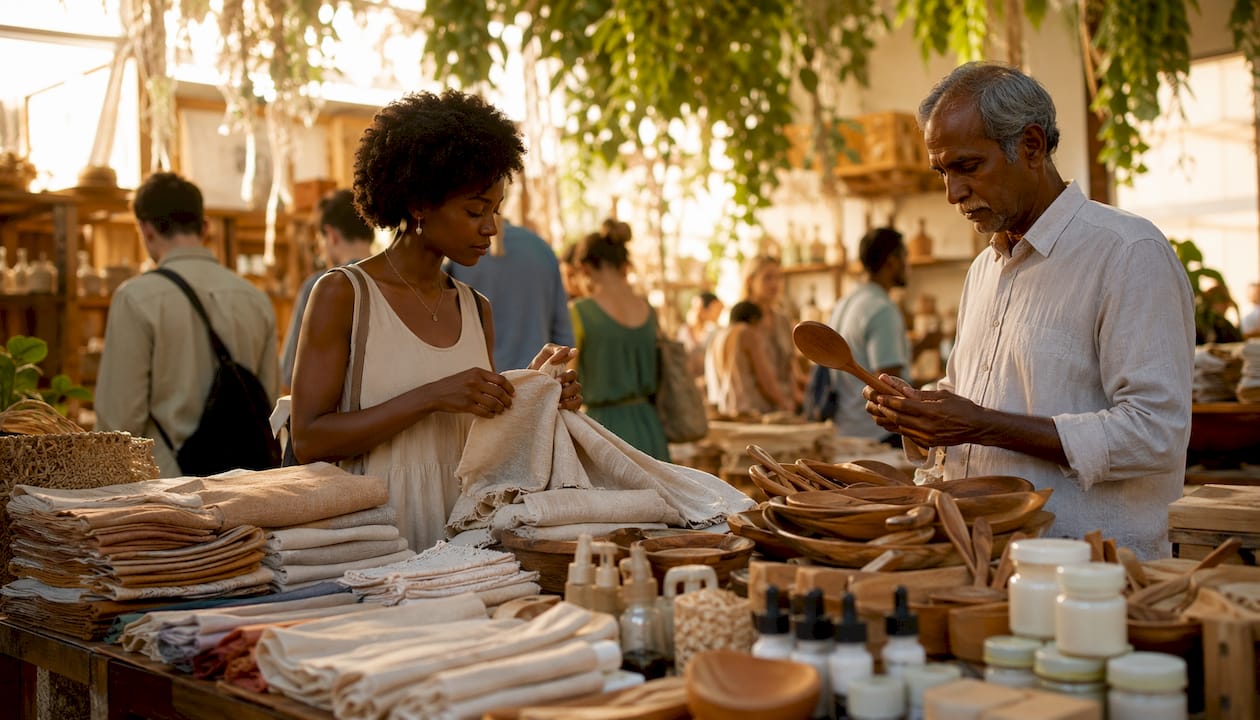
| Home goods | Bamboo paper towel dispensers, reclaimed wood shelving, recycled glass containers | Vague “natural” claims without sourcing data |
| Textiles | Organic cotton, TENCEL (lyocell), recycled polyester from post-consumer bottles | “Eco” fast fashion with no supply-chain disclosure |
| Cleaning products | EPA Safer Choice-certified cleaners, concentrated refillable formulas | “Biodegradable” with no timeframe or conditions stated |
| Electronics | Energy Star-rated appliances, modular smartphones designed for repair | E-waste programs that are marketing only, with no verified recycling |
| Building materials | FSC-certified lumber, recycled-content insulation, low-VOC paints | “Sustainable” wood with no chain-of-custody certification |
Textiles and personal care are the categories most prone to greenwashing, largely because supply chains are long and complex, and consumers rarely have access to upstream data. For sustainable building products, FSC certification and verified recycled content are the clearest signals available.
Sustainability at the product level starts in the design phase, long before a consumer sees the item on a shelf.
Design strategies:
Supply-chain practices:
Sourcing specialty materials with verified supply chains — whether for textiles, wood, or natural fibers — is one of the most concrete steps a brand can take to back up its sustainability claims with evidence. Transparency is the mechanism: brands that publish supplier lists, audit results, and lifecycle data give buyers the tools to verify rather than simply trust.
Bamboo is one of the more credible sustainable materials available, but the material alone does not make a product sustainable. What matters is how the full lifecycle holds up against the checklist.
Cozee-bay’s handcrafted bamboo products illustrate this mapping well. Bamboo’s fast growth rate and biodegradability address the raw materials stage. Durable construction — the kind built for restaurants, schools, and senior living centers, not just occasional home use — addresses the use phase by extending product life and reducing replacement frequency. The brand’s emphasis on craftsmanship and a money-back guarantee signals confidence in longevity, which is itself a sustainability claim: a product returned or discarded quickly is a lifecycle failure regardless of what it is made from.
For the end-of-life stage, bamboo’s natural biodegradability is an advantage over plastic alternatives, provided the product does not use synthetic adhesives or coatings that compromise compostability.
Pro Tip: When evaluating any bamboo product, ask the brand three questions: Where was the bamboo grown and harvested? What adhesives or finishes were used in processing? And what is the recommended end-of-life path — compost, recycle, or landfill? A brand that can answer all three is operating with genuine transparency.
A sustainable product addresses environmental, social, and economic impacts across its entire lifecycle — not just at the point of sale.
| Point | Details |
|---|---|
| Triple Bottom Line is the baseline | Sustainability covers environmental, social, and economic factors — not environmental impact alone. |
| Lifecycle thinking changes everything | Evaluate materials, manufacturing, transport, use, and end-of-life before trusting any sustainability claim. |
| Certifications have scope limits | FSC, Energy Star, and Fair Trade each cover specific stages — check what each label actually measures. |
| Durability beats single-use “green” | A long-lasting product avoids multiple replacement cycles and is often the more sustainable choice overall. |
| Cozee-bay bamboo products | Cozee-bay’s handcrafted bamboo homeware pairs renewable materials with durable construction across residential and commercial settings. |
The conversation around sustainable products tends to get stuck on materials. Bamboo good, plastic bad. Organic cotton good, polyester bad. That framing is not wrong, but it is incomplete in a way that costs consumers real money and gives brands an easy out.
The harder truth is that a durable, well-made product from a less-celebrated material often outperforms a fragile “eco” product made from the right stuff. A bamboo item that lasts a decade beats a recycled-plastic alternative that cracks in two years — not because bamboo is inherently superior, but because longevity is the most underrated sustainability variable in the entire lifecycle. Every replacement cycle is a new set of raw materials, manufacturing energy, and transport emissions.
Supply-chain transparency is the other piece most buyers skip. Certifications are useful, but they are snapshots of compliance at a specific point in a supply chain. The brands worth trusting are the ones that publish supplier information, share audit results, and treat sustainability as a process of continuous improvement rather than a badge earned once and displayed forever. That standard is harder to meet — and exactly why it is worth holding brands to it.
If you want to see what lifecycle-conscious product design looks like in a real retail context, Cozee-bay’s bamboo household collection is a practical place to start. The products are built for durability in demanding environments — restaurants, schools, coffee shops — which means they are designed to last, not to look good for one season and get tossed.
Cozee-bay ships free within the contiguous U.S. and backs every product with a money-back guarantee, so you can evaluate the craftsmanship and material quality firsthand without risk. Whether you are outfitting a home kitchen or sourcing for a commercial space, the bamboo paper towel dispensers, drawer organizers, and wrap and foil dispensers give you a concrete example of how renewable materials, durable construction, and thoughtful design come together in one product line. Browse the full collection at Cozee-bay and see the product details, customer reviews, and sourcing information for yourself.
Disclosure: This article is written from Cozee-bay’s brand perspective. The money-back guarantee referenced above applies per Cozee-bay’s current return policy — confirm details at checkout.
Comments will be approved before showing up.