Your Cart is Empty


Eco-friendly cleaning products are formulas that disclose their full ingredient list, skip high-VOC solvents and synthetic fragrance, break down safely in the environment, and often come in concentrated or refillable packaging. Three checks tell you fast whether a bottle earns that label: a trusted certification or transparent ingredient list, a low-VOC and fragrance-free formula, and a concentrate or refill option. A “natural” claim on the front label does not on its own prove safety or environmental benefit.
TL;DR:
- Always verify that eco-friendly cleaners have a trusted third-party certification and transparent ingredient lists rather than relying on vague marketing claims.
- Routine cleaning with eco formulas is usually as effective as conventional products if used at proper dilution and with sufficient contact time, especially with mechanical action.
- Use specific, labeled DIY recipes with basic ingredients like vinegar, baking soda, castile soap, and hydrogen peroxide, but avoid mixing bleach with acids or ammonia.
- Packaging choices, such as concentrates and refill systems, significantly reduce environmental footprint, but ensure labels specify recyclability or compostability.
- For business procurement, prioritize third-party certifications and full safety documentation, whereas home users should focus on ingredient transparency and low-VOC formulas.
Not every job calls for the same bottle, and that’s true whether you’re maintaining a kitchen counter or managing a 40-unit apartment building. Understanding the categories helps you avoid the common mistake of grabbing one all-purpose spray for every surface, which usually means using either too much product or the wrong chemistry entirely.
Here’s how the main categories break down and where eco-friendly formulations diverge from conventional ones:
An eco-friendly specialty product beats a generic all-purpose one whenever the surface itself is the risk, not just the mess. Natural stone, unsealed wood, and some laminates react badly to the wrong pH, and no amount of “green” marketing on an all-purpose bottle changes that chemistry. Cozee-bay’s own product checklist for eco-friendly homes walks through which categories matter most room by room.
Every cleaning formula is built from a handful of functional ingredient classes, and knowing what each one does turns a label from a wall of chemical names into something you can actually judge. Surfactants lift dirt and grease off surfaces. Builders soften water so surfactants work better. Solvents dissolve oily residue. Preservatives keep the formula from growing mold in the bottle. Fragrances mask chemical odors. Quats (quaternary ammonium compounds) kill germs in disinfectant formulas.
The eco-friendly question isn’t whether these ingredient classes exist. It’s which specific compounds fill each role.
Two edge cases trip up even careful shoppers. First, plant-based doesn’t automatically mean safe. Some plant-derived ingredients concentrate limonene and other terpenes that raise indoor VOC levels and sensitization risk just as much as synthetic ones do, since the whole formulation matters more than any single ingredient’s origin. Second, homemade doesn’t mean risk-free either. Essential oils used in DIY recipes can sensitize skin and airways at the same concentrations that make them smell “natural.”
One rule with zero exceptions: never mix bleach with ammonia, vinegar, or any acidic cleaner. The reaction produces toxic gas, full stop.
Pro Tip: If an ingredient list uses the word “fragrance” without naming the compounds behind it, treat that single word as a placeholder for dozens of undisclosed chemicals, some of which are exactly the phthalates you’re trying to avoid.
A certification on the label means someone outside the manufacturer checked the formula against a fixed standard. That’s the entire value of an ecolabel, and it’s why it beats any marketing phrase a company writes for itself.
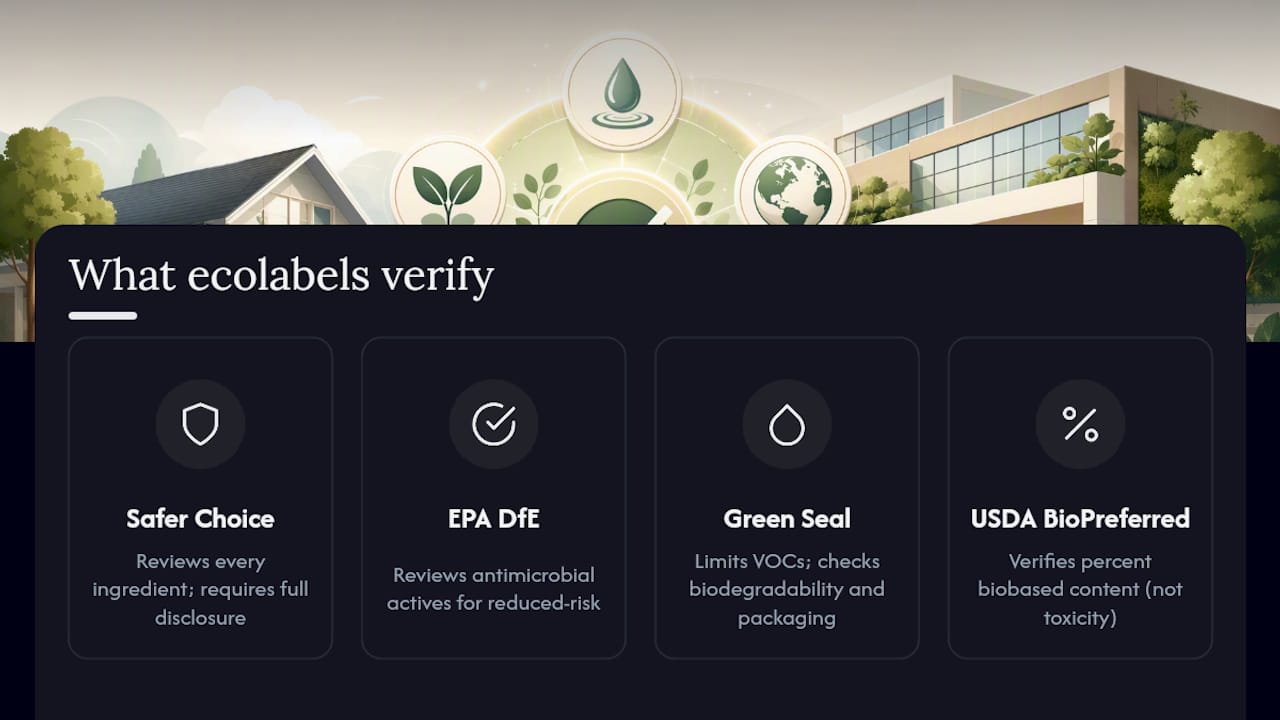
EPA Safer Choice evaluates every single ingredient in a certified product, not just the ones the manufacturer chooses to highlight, and it requires full ingredient disclosure as a condition of certification. EPA Design for the Environment (DfE) applies a similar review specifically to antimicrobial and disinfectant products, checking that active ingredients meet reduced-risk criteria. Green Seal certifies against published standards covering VOC limits, biodegradability, and packaging. USDA BioPreferred verifies the percentage of biobased content in a formula, though it doesn’t evaluate toxicity the way Safer Choice does. The EWG Guide to Healthy Cleaning isn’t a certification at all. It’s a searchable database with toxicology-based hazard ratings, useful for cross-checking a product before you buy it.
Here’s what these labels do not guarantee: performance. A Safer Choice certification tells you the formula passed a health and environmental review; it says nothing about whether the product will cut through baked-on grease as fast as a conventional degreaser. Certification and performance are separate questions, and the smartest shoppers check both.
To verify a product is genuinely certified rather than just displaying a logo it isn’t licensed to use, search the brand and product name directly in the certifying body’s own database rather than trusting the packaging.
A four-step check takes less than a minute once you know what you’re looking for, and it works the same way whether you’re standing in a store aisle or scrolling a product page on your phone.
Red flags worth memorizing: “proprietary blend,” “naturally derived” with no ingredient names attached, and a fragrance description like “fresh citrus scent” standing in for an actual list of what produces that scent.
Pro Tip: When you’re shopping on a phone and don’t have time for all four steps, do this one: search the brand name plus “Safer Choice” or “EWG rating” before you add anything to your cart. It takes fifteen seconds and catches most greenwashing on the spot.
For routine cleaning, eco-friendly products perform comparably to conventional cleaners in most everyday scenarios. Routine cleaning removes visible dirt, dust, and some germs through physical action and surfactant chemistry. Disinfection is a different standard entirely: it requires killing a specified percentage of a specific pathogen within a specific contact time, and that’s a regulated efficacy claim, not a marketing one.
This distinction matters most in kitchens after handling raw meat, bathrooms in a household with an active illness, and any high-touch commercial surface in a healthcare or food-service setting. In those cases, you need a registered disinfectant, eco-friendly or not, and the label needs to state its kill claims and required contact time explicitly.
For everyday cleaning, though, eco-friendly formulas close the performance gap easily when you use them correctly:
Four ingredients cover most household cleaning tasks: white vinegar, baking soda, castile soap, and hydrogen peroxide, with a few drops of essential oil added mainly for scent rather than cleaning power. Extension service guidance and tested DIY recipe collections both point to the same short ingredient list, which is a good sign that the basics are well established rather than trend-driven.
Label every DIY bottle clearly and use them within a short timeframe, since homemade formulas lack preservatives found in commercial products. Store them out of reach of children just as you would with any cleaning product, DIY or purchased.
The rule that matters most: never combine bleach with ammonia or vinegar, and understand that DIY cleaners are not registered disinfectants. They clean effectively. They do not carry the tested kill claims that a genuine disinfectant needs for situations involving illness or raw meat.
Pro Tip: Test any DIY essential oil blend on a small skin patch before regular use. “Natural” doesn’t mean hypoallergenic, and concentrated essential oils cause more skin reactions than most synthetic fragrances.
The bottle matters almost as much as what’s inside it. A concentrate that makes 32 ounces of ready-to-use cleaner from a 4-ounce pouch cuts plastic use and shipping weight dramatically compared to buying that same 32 ounces pre-diluted, which is why government procurement guidance increasingly favors concentrates and refill systems for exactly this reason.
For disposal, concentrated cleaning residues, especially anything with quats or strong acids, shouldn’t go down a storm drain. Check your local household hazardous waste program before pouring out anything you wouldn’t want in a lake.
Home buyers and facility managers are solving different problems even when they’re shopping the same product category. A homeowner cares about safety and simplicity. A facilities manager cares about consistency across dozens of units and defensible documentation for every product on site.
For home purchases, prioritize full ingredient disclosure, a low-VOC or fragrance-free formula, and a concentrate you can dilute yourself. Keep the safety data sheet (SDS) on hand for anything you’d want to reference in an emergency, and lean toward products that carry an actual certification rather than a marketing claim. Cozee-bay’s guide to selecting eco-friendly products breaks this down further for home shoppers weighing multiple brands.
For business and facility purchases, the math changes. Cost-per-diluted-liter matters more than sticker price on the bottle, since facilities often use automated dilution systems that make concentrate economics very different from retail comparisons. Third-party certifications simplify procurement specs and cut down the time spent validating vendor safety data sheets one by one.
| Buyer Type | Top Priority | Second Priority | Documentation Needed |
|---|---|---|---|
| Home | Ingredient disclosure | Low VOC / fragrance-free | SDS for reference |
| Business / facility | Cost per diluted liter | Third-party certification | SDS plus staff training records |
A simple line for procurement documents: “Supplier must provide products certified under EPA Safer Choice or equivalent third-party ecolabel, with full SDS documentation available upon request.” That single sentence does most of the filtering work for a facilities manager sourcing at scale.
A maker of bamboo paper towel dispensers and household organizers focuses on sustainable materials and durable design in their product line. That real-world use across high-traffic commercial sites shapes a practical bias: refillable systems and reusable materials consistently outperform disposable ones once you factor in restocking frequency and long-term cost. It’s the same logic that applies to concentrated cleaners over pre-diluted ones. Every product on the site carries a money-back guarantee, reflecting a straightforward approach to standing behind sustainable design.
Check the EPA’s greener products guidance for federal recommendations, the EWG cleaning database for ingredient ratings, and your local health department’s site for regional disposal rules. Use official certification search tools directly, never a brand’s own claim about its status.
The conventional advice on eco-friendly cleaning spends too much time on ingredient lists and not enough on verification habits. Knowing that phosphates cause algae blooms doesn’t help you at 9 p.m. in a store aisle if you don’t also know to flip the bottle over and check for an actual certification logo instead of a green leaf someone’s marketing team drew.
What the research here actually supports is a shift in priority: transparency and third-party verification matter more than any single ingredient decision. A formula with a slightly less ideal surfactant but full disclosure and a real Safer Choice certification beats a mystery “plant-powered” blend with a vague fragrance line every time. That’s especially true for businesses, where certification does double duty as both a safety filter and a procurement shortcut that saves real staff hours.
If you take one thing from this guide, make it the habit, not the ingredient list. Check for disclosure and certification first. Everything else, VOC levels, packaging, dilution ratios, is easier to evaluate once you’ve filtered out the products hiding behind marketing language in the first place.
— Cozee
Comments will be approved before showing up.