Your Cart is Empty


In this guide, “eco-friendly fabrics” means solid bamboo wood products, not textiles. We’re talking about the paper towel dispensers, food bag organizers, and drawer organizers sitting on your kitchen counter or restaurant break room shelf. Bamboo wood earns its eco-friendly reputation from rapid renewability and a lower carbon footprint than most hardwoods, but that reputation only holds up if the finish is right and the safety testing checks out.
TL;DR:
- Choose finishes that provide moisture resistance, such as film-forming coatings, for products in humid or high-traffic environments to maximize lifespan.
- Ask sellers for specific details on finish type, reapplication frequency, and safety testing results to verify the product’s durability and safety claims.
- Consider natural oil finishes like tung or linseed oil for lower chemical impact, especially if biodegradability and end-of-life disposal are priority concerns.
- Match dispenser size, refill accessibility, and mounting method to the intended setting to prevent early wear or operational issues.
- Verify food-contact safety through independent migration testing reports rather than relying on vague “food-safe” labels.
Bamboo is a grass, not a tree, and that distinction changes everything about its environmental math. A stand of bamboo reaches harvestable maturity in three to five years. Oak or maple takes decades. That short growth cycle means bamboo pulls carbon out of the air and locks it into usable material at a pace no traditional hardwood can match, which is why bamboo wood products carry a lower embodied carbon footprint per unit than most cabinet-grade lumber.
The material also happens to work well for the job, with a durability that compares favorably to many textiles as covered in this discussion on bamboo fabric durability. Bamboo fiber runs in a strength-to-weight ratio that rivals steel in some engineering comparisons, and it machines cleanly into the tight tolerances a dispenser throat or drawer track needs. That combination, fast-growing and mechanically sound, is exactly why bamboo shows up in organizers and dispensers rather than just decorative trim.
One clarification worth making early: this article covers bamboo wood and bamboo-made household items, not bamboo viscose or bamboo-derived textile fabrics used in clothing. Different supply chain, different performance questions, different article.
Here’s where most buying guides stop, and where the real evaluation should start. Raw bamboo is porous. Without a finish, it absorbs moisture, stains, and eventually warps or cracks under repeated wiping and humidity exposure. The finish is not a cosmetic afterthought. It’s the difference between a dispenser that lasts a decade and one that delaminates in eighteen months.
Two finish categories dominate the bamboo organizer market: film-forming finishes (polyurethane, lacquer, hardwax oil blends) that sit on top of the wood and create a moisture barrier, and penetrating oils (tung oil, linseed oil) that soak into the grain and harden from within. Film finishes resist moisture and stains better out of the gate. Penetrating oils feel more natural and are easier to spot-repair, but they need more frequent reapplication in wet environments.
Peer-reviewed research backs up why this distinction matters. A 2025 MDPI Coatings study on bamboo coatings found that surface coatings measurably reduce moisture ingress into bamboo, which directly extends service life under everyday indoor conditions. Separate lab work on tung oil formulations enhanced with chitosan and gum arabic microcapsules showed improved gloss retention and even some self-healing behavior when the microcapsule content was optimized. That’s a meaningfully more advanced coating than a plain oil wipe, and it’s worth asking a seller whether their finish uses anything close to it.
Before buying, ask the seller these questions:
A seller who can answer all five without hedging is a seller who actually knows their supply chain.
Finish choice controls two things at once: how long the product lasts and how much wiping abuse it can take before you see wear. A film-forming polyurethane finish on a paper towel dispenser in a busy restaurant kitchen might hold up for two to three years before it needs a refresh. The same dispenser finished only with penetrating oil in that same kitchen could need reoiling every six to twelve months because of constant hand contact and steam exposure.
Low-traffic residential use flips the math. A drawer organizer or countertop dispenser in a home kitchen sees a fraction of the wipe cycles a commercial unit does, so even a lighter oil finish can go two or more years between touch-ups.
Pro Tip: Treat the finish and its maintenance schedule as part of the purchase price, not an afterthought. A cheaper dispenser with a weak finish that needs replacing in two years often costs more over time, and generates more waste, than a slightly pricier one built to last a decade.
Buyers who skip this math tend to under-budget for upkeep, then blame the material when a product wears out early. The wood usually isn’t the problem. The finish and how it was maintained usually is.
Commercial buyers and homeowners are solving different problems, even when they’re looking at the same shelf of products.
Vandal-resistant latching matters for public restrooms and schools. It rarely matters in a home kitchen. Matching the checklist to the actual use case saves money and frustration on both ends.
Any bamboo product that touches food or food packaging, including organizers near a kitchen counter or dispensers in a restaurant, should be backed by real migration testing, not just a “food-safe” label on the box. China’s GB 4806.12-2022 standard for food-contact bamboo and wood materials defines migration limits and the test conditions manufacturers should follow, including which food simulants (often water, acetic acid, or ethanol solutions) get used to check whether anything leaches out of the coating or adhesive.
When a seller claims eco-friendly or food-contact safe, ask for:
Request a scanned excerpt of the actual report page. Marketing copy that says “tested for food safety” without a lab name or a date is not proof of anything.
Search around and you’ll find “eco-friendly fabrics” used to describe organic cotton, hemp, linen, recycled polyester, and Tencel, textile materials grown or processed with lower environmental impact than conventional cotton or virgin polyester. That’s a legitimate category, but it’s a different supply chain from bamboo wood organizers, and it’s not what this guide covers.
Where bamboo wood and those textile fibers overlap is in the underlying logic: renewable inputs, lower processing impact, and a push toward materials that biodegrade or recycle more easily than petroleum-based alternatives. Bamboo wood delivers on that logic through its growth cycle and mechanical strength rather than through fiber spinning or dyeing processes. If you’re specifically researching bamboo’s textile applications, that’s a separate conversation from the organizers and dispensers covered here, and one worth researching through dedicated fabric resources rather than a wood products guide.
Plastic organizers and dispensers dominate the budget end of the market, and they carry a real environmental cost that bamboo avoids. Plastic manufacturing depends on petroleum feedstock, and most plastic household goods aren’t recycled in practice even when the resin technically allows it.
Conventional hardwoods like oak or walnut avoid the petroleum problem but bring a different one: slow regrowth. A harvested oak tree takes 40 years or more to reach comparable maturity, which puts far more pressure on forest stock per unit of usable wood than bamboo’s three to five year cycle.
Bamboo wood organizers land in a favorable middle ground. They skip the petroleum input of plastic, regrow far faster than hardwood alternatives, and, when finished properly, hold up to the kind of daily handling a paper towel dispenser or trash bag organizer needs. The tradeoff is that bamboo’s environmental advantage depends heavily on how it’s processed, finished, and shipped, so a bamboo product finished with heavy synthetic lacquer and shipped across multiple continents narrows that gap considerably compared to one processed and finished more simply.
The eco-friendly label on a bamboo product depends on decisions made well before it reaches a store shelf. Harvesting mature bamboo stalks rather than clear-cutting entire groves preserves the root system that lets bamboo regenerate without replanting. That’s one of bamboo’s structural advantages over tree farming.
Adhesive choice matters just as much. Laminated bamboo, where thin strips are glued and pressed into boards, can use either low-formaldehyde or conventional adhesives, and the difference shows up both in indoor air quality and in how the product performs on food-contact migration tests referenced under standards like GB 4806.12-2022. A manufacturer disclosing adhesive type is giving you real information; one that stays vague is giving you a marketing claim.
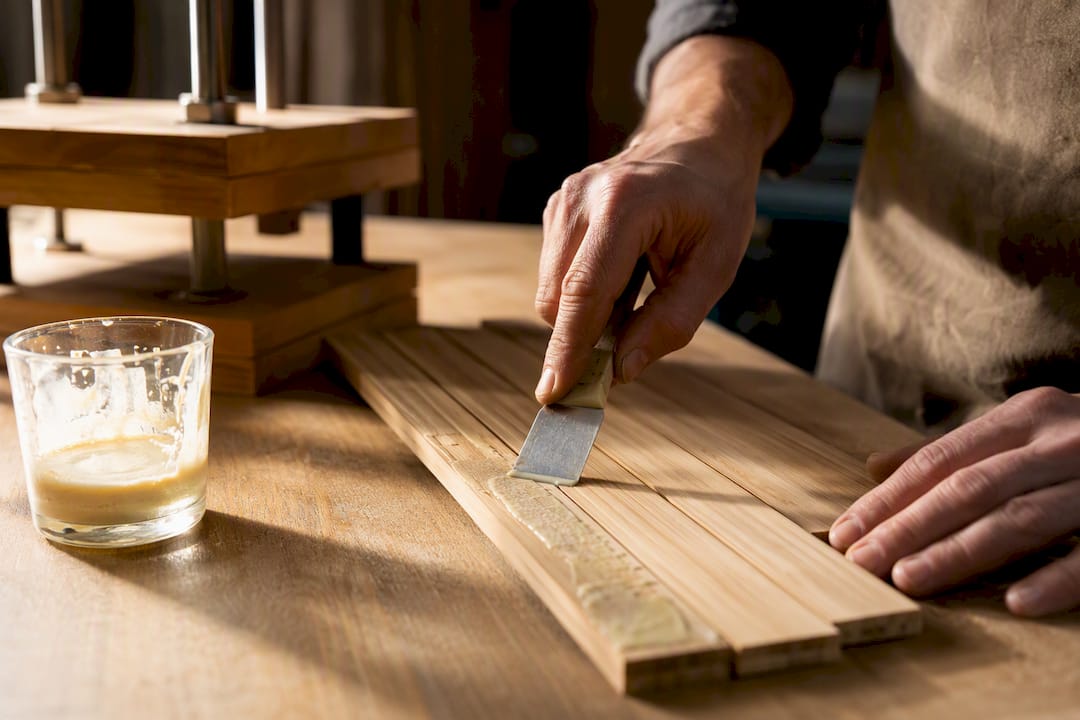
Finish application is the last production step that determines the eco profile. Water-based finishes and natural oils generally carry a lighter chemical footprint than solvent-heavy lacquers, though they may trade off some durability, which loops back to the maintenance conversation covered earlier. A manufacturer who’s thought this through will tell you what’s in the finish, not just that the finish exists.
Textile shoppers researching organic cotton or hemp often lean on certifications like GOTS, OEKO-TEX, or Bluesign to verify eco and safety claims. Those specific certifications apply to fiber and dye processing, not to solid bamboo wood products, so they won’t appear on a legitimate bamboo dispenser or organizer listing.
What does apply to bamboo wood is food-contact and material-safety documentation, most notably testing aligned with standards like GB 4806.12-2022 for items that touch food or food packaging. Beyond that, look for straightforward disclosure: species or grade of bamboo used, adhesive type in laminated pieces, and finish composition. A seller who documents these details in product listings or on request is operating with more transparency than one leaning on the word “eco-friendly” alone with nothing behind it.
Untreated bamboo wood biodegrades far faster than most conventional hardwoods and dramatically faster than any plastic organizer, since bamboo is a fast-growing grass fiber that breaks down under normal composting conditions once it’s no longer coated.
The finish changes that equation. A heavy polyurethane or synthetic lacquer coating slows biodegradation because the coating itself doesn’t break down the same way the bamboo underneath does. Natural oil finishes like tung oil or linseed oil interfere far less with the wood’s ability to decompose, since they’re derived from plant sources rather than synthetic polymers.
For recycling, bamboo wood generally isn’t accepted in curbside recycling programs the way paper or certain plastics are, because most municipal systems aren’t set up to process wood waste through the same stream. Composting, donation, or repurposing (a worn dispenser body reused as a planter, for instance) tends to be the more realistic end-of-life path than formal recycling. That’s worth factoring into a purchase decision if a fully closed-loop lifecycle matters to your household or business.
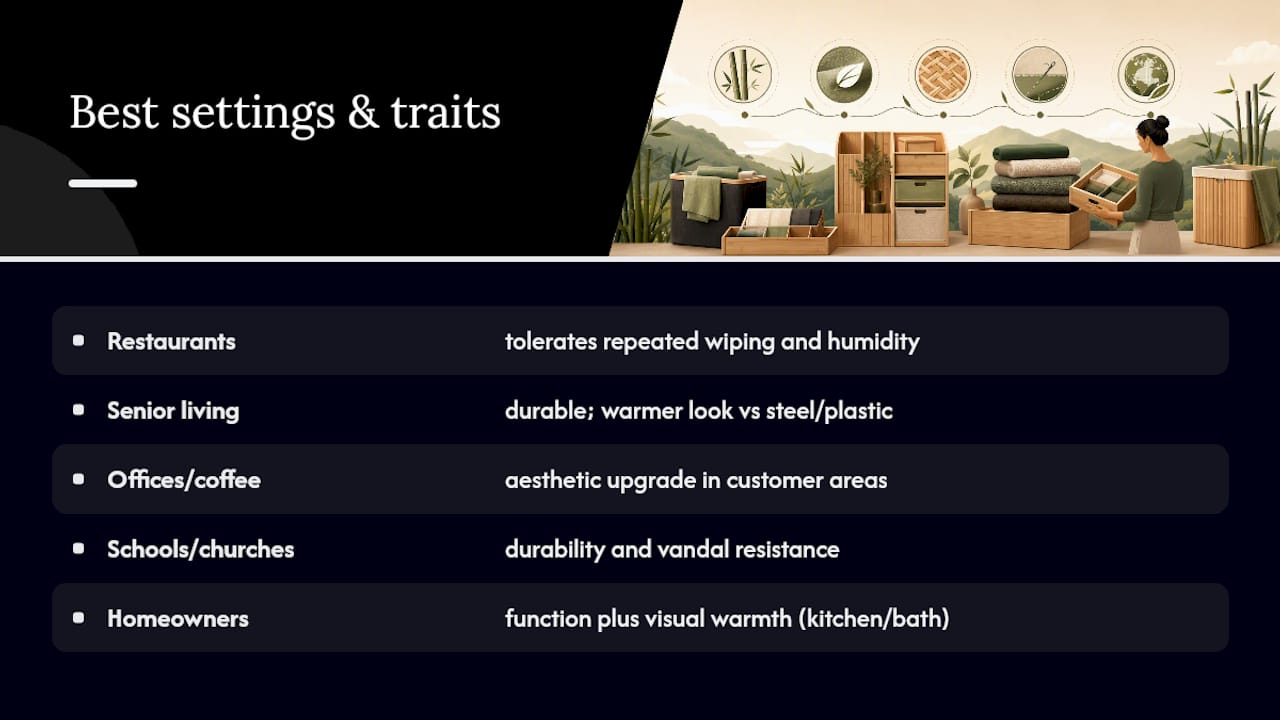
Bamboo wood products show up across a wider range of settings than people expect once you look past the kitchen counter. Restaurants use bamboo paper towel dispensers on prep stations because the material tolerates repeated wiping and humidity better than untreated softwoods. Senior living centers favor bamboo organizers in shared bathrooms and dining areas for the same reason, plus the warmer, less clinical look compared to stainless steel or plastic fixtures.
Offices and coffee shops lean on bamboo drawer organizers and wrap dispensers for the aesthetic upgrade over generic plastic bins, especially in customer-facing areas where appearance affects perceived quality. Schools and churches tend to prioritize durability and vandal resistance in public-facing bamboo dispensers, since those units see less supervised use than a home kitchen or private office.
Homeowners, meanwhile, get the most out of bamboo organizers in spaces where both function and visual warmth matter: kitchen drawers, bathroom counters, pantry shelving. The performance characteristics that matter shift by setting. A dispenser that succeeds in a low-traffic guest bathroom might fail fast in a high-volume commercial kitchen with the wrong finish, which is exactly why matching product to use case, not just picking the nicest-looking option, decides whether a bamboo purchase pays off.
Every guideline in this article comes down to one habit: ask for proof before you ask for the product. Durability, hygiene, and appearance all trace back to finish choice and documentation, not to the word “eco-friendly” printed on a listing. A bamboo dispenser with no disclosed finish type or test report isn’t automatically bad, but it’s an unknown, and unknowns are expensive when they fail in a busy restaurant kitchen or a senior living bathroom.
We’d rather a buyer walk away from a purchase with more questions asked than fewer. That’s not caution for its own sake. It’s the only way “eco” actually means something instead of just sounding good on a product page.
— Cozee
There are bamboo paper towel dispensers built for wall-mount and countertop use, plus food bag organizers, wrap and foil dispensers, trash bag organizers, and drawer organizers, all made from natural bamboo. The site shows product visuals, customer reviews, and details on materials and design for each item.
That transparency matters more than a catchy tagline. If you’ve read this far, you already know to ask about finish type, dispenser compatibility, and food-contact documentation before buying anything bamboo. Cozee Bay’s product pages and blog resources on selecting eco-friendly products are built to answer exactly those questions, whether you’re outfitting a restaurant break room or a home kitchen drawer. If you want to compare specific dispenser and organizer options against the checklist in this guide, browse the current Cozee Bay catalog and see which model fits your fold type, traffic level, and finish preference.
Comments will be approved before showing up.