Your Cart is Empty


TL;DR:
- Recycled-fiber paper towels with durable bamboo dispensers provide the best sustainability benefits for most U.S. households and businesses.
- Switching to 100% post-consumer recycled rolls and installing long-lasting dispensers significantly reduces environmental impact and waste.
The short answer: recycled-fiber paper towels paired with a durable bamboo dispenser beat bamboo-fiber rolls on most sustainability measures. If you want the fastest win, switch to 100% post-consumer recycled rolls today and replace your cheap plastic dispenser with something built to last years, not months.
TL;DR:
Two quick actions:
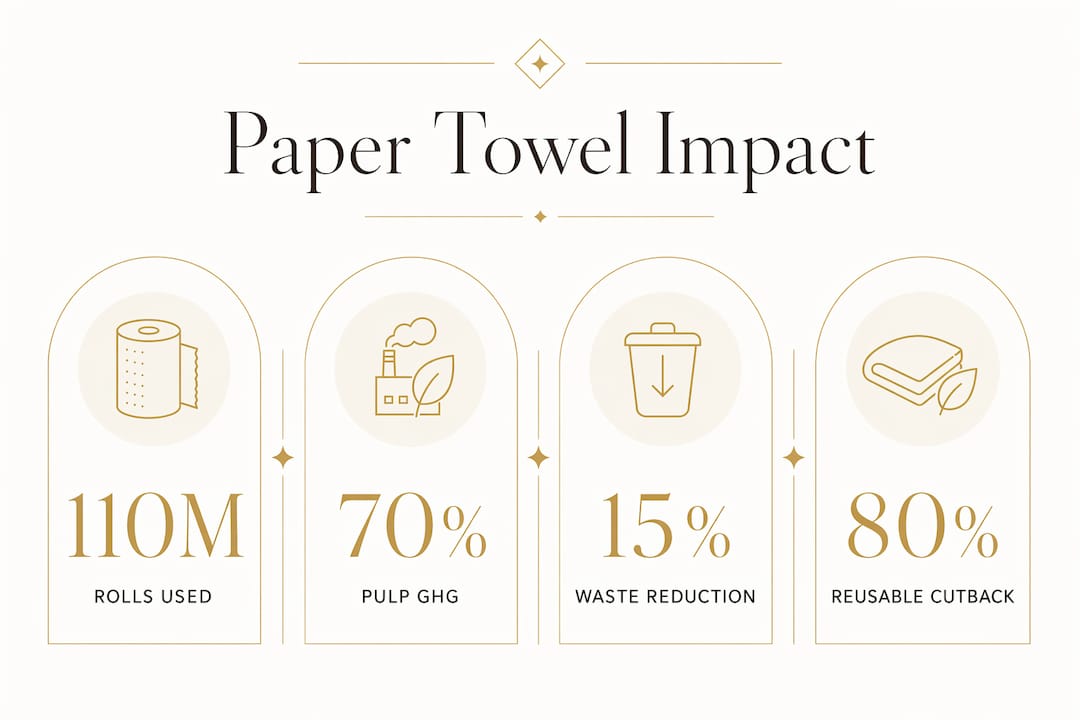
The numbers are hard to ignore. American demand for paper towels, tissues, and napkins burns through roughly 110 million trees and 130 billion gallons of water annually. Most of that waste ends up in landfill or incineration because used paper towels are not recyclable in U.S. municipal streams. Contamination and short fiber length after use rule them out of standard recycling.
Three life-cycle stages drive the bulk of the damage:
| Life-cycle stage | Primary impact | Key driver |
|---|---|---|
| Pulp/raw material production | Land use, GHG emissions | Tree harvesting, forest management |
| Mill electricity and fuels | Carbon footprint, fossil fuel depletion | Grid mix, combustion technology |
| End-of-life (landfill/incineration) | Methane, particulates | Non-recyclability of used towels |
A facility-level LCA of a major paper towel brand found that pulp contributes the largest share of greenhouse gases, with mill electricity and fuels close behind. Transport and retail distribution are comparatively minor. That means the two levers with the most impact are what the towel is made from and how the mill is powered.
Virgin pulp is the worst choice by nearly every measure. Beyond that, the comparison between recycled fiber and bamboo is more nuanced than most product labels suggest.
Certifications worth checking: Green Seal certification signals verified environmental performance for cleaning and paper products. FSC certification covers responsible forest management but does not guarantee low carbon intensity. For bamboo specifically, ask whether the fiber comes from dedicated bamboo plantations or converted forestland. A vague “sustainably sourced” claim with no third-party verification is a red flag.
Pro Tip: When reading a label, look for “100% post-consumer recycled content” as a specific claim, not just “recycled content.” A product with 30% recycled content still uses 70% virgin fiber. The percentage matters.
Explore the bamboo vs. recycled fiber comparison in more detail if you’re still weighing options for your space.
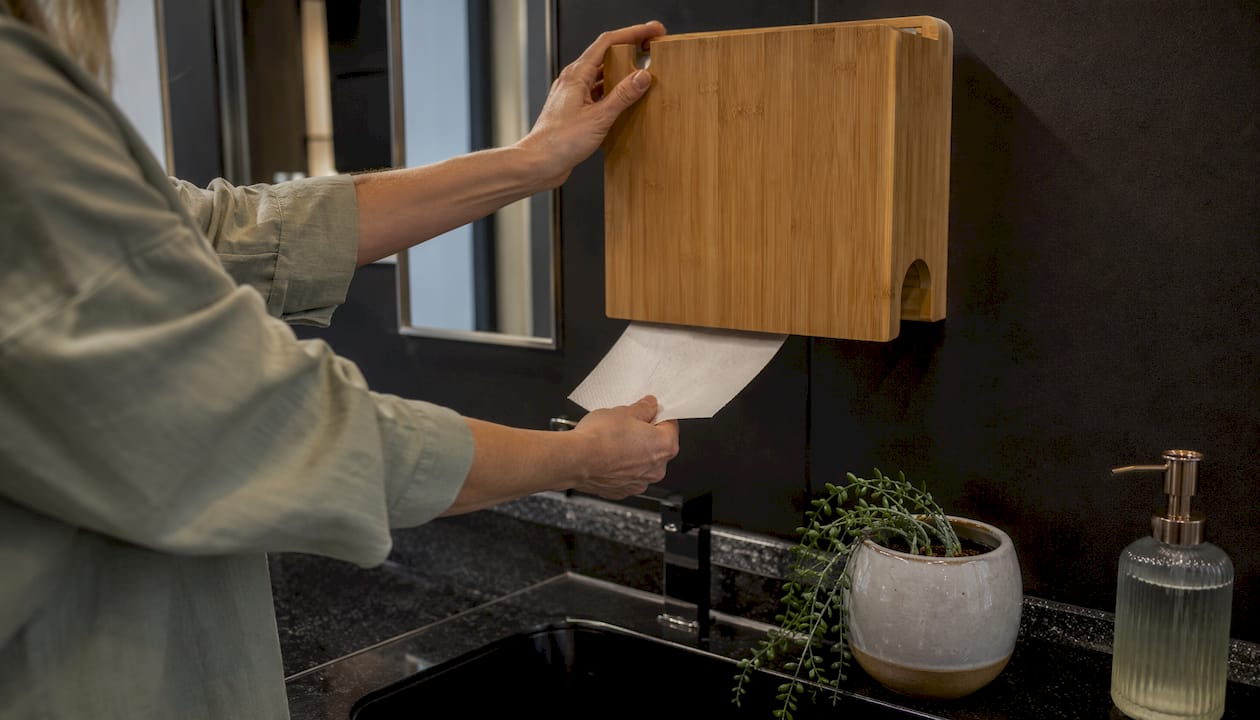
Yes, and more than most people expect. The dispenser is the mechanism that controls how much paper gets pulled per use. A loose, open roll in a holder encourages grabbing three sheets when one would do. A controlled single-sheet dispenser changes that behavior without requiring any willpower.
| Dispenser type | Waste reduction mechanism | Best fit |
|---|---|---|
| Single-sheet/controlled-feed | Dispenses one sheet at a time | Offices, schools, senior centers |
| Touchless/sensor | Eliminates over-pulling, reduces cross-contamination | Restaurants, healthcare, high-traffic restrooms |
| Refillable roll with tension control | Limits sheet length per pull | Commercial kitchens, coffee shops |
| Durable bamboo dispenser | Long service life spreads embodied impact over years | Homes, boutique retail, churches |
Durable hardware matters for a reason that rarely shows up in product marketing: a dispenser built to last five or ten years spreads its own manufacturing footprint across thousands of uses. A cheap plastic unit that cracks, jams, or gets replaced every year generates its own stream of waste. Sustainable paper towel dispensers built from bamboo or solid materials reduce that embodied-impact problem significantly.
Procurement decisions made quickly tend to cost more later, both financially and environmentally. Here’s a practical checklist to work through before signing any order.
Red flags to watch for: no supply-chain documentation, “eco-friendly” claims with no certification, refill systems that lock you into a single supplier, and performance figures with no LCA backing. For a deeper look at commercial dispenser options, Cozee-bay’s comparison guide covers the key variables.
You don’t need a full sustainability audit to make a real dent. A few targeted swaps get you most of the way there.
Washable cloths or microfiber towels can replace roughly 80% of household paper-towel uses, according to NRDC. Keep a small roll of 100% post-consumer recycled paper for genuinely messy jobs, raw meat handling, or anything you’d rather not wash. That’s the practical middle ground most households can actually stick with.
For store-bought rolls, look for 100% post-consumer recycled content, Green Seal certification, and a supplier that publishes its fiber sourcing. Avoid anything labeled just “recycled” without a percentage.
On disposal: used paper towels cannot go into your recycling bin. If they’re free of chemicals or grease, many municipal composting programs accept them. Check your local program before assuming. Greasy or chemically contaminated towels go to landfill.
Pro Tip: Try a one-week trial with a durable single-sheet dispenser and a reusable cloth set. Most households find they use 60–70% fewer disposable sheets within the first week, simply because the friction of reaching for a cloth is lower than expected.
A sustainable paper towel workflow can help you map out exactly where disposables are still necessary in your home or small business.
Switching from a traditional paper-towel setup to a bamboo or low-impact dispensing system doesn’t require a shutdown weekend. A realistic timeline for a small-to-medium business looks like this:
Week 1–2: Audit current usage. Count dispensers, note locations, and estimate monthly roll consumption. High-consumption sites like restaurants and coffee shops should prioritize first.
Week 3–4: Source dispensers and refills. Order a pilot quantity for one or two locations. Confirm refill compatibility before committing to a full order.
Month 2: Install and train staff. Controlled-feed and touchless dispensers require a brief orientation so staff don’t override the mechanism. Post a simple one-page guide near each unit.
Month 3 onward: Track consumption. Compare monthly roll usage before and after. Most businesses see measurable reductions within the first billing cycle.
The full transition for a multi-location business typically runs 60–90 days from audit to full deployment, assuming no supply delays.
The honest answer is that bamboo dispensers cost more upfront and less over time. Here’s how the math typically works out:
A standard plastic dispenser runs $10–$25 and lasts one to three years in a commercial setting before cracking or jamming. A quality bamboo dispenser runs $40–$80 and, with basic care, lasts five to ten years. Over a ten-year window, the bamboo unit is usually cheaper even before factoring in reduced maintenance calls.
Refill costs depend heavily on roll choice. Post-consumer recycled rolls are competitively priced with conventional rolls at most commercial suppliers. Bamboo rolls tend to run slightly higher per unit. Waste disposal fees drop when you reduce total roll consumption through controlled dispensing, which adds another line of savings that rarely appears in initial quotes.
For businesses in high-traffic settings like restaurants, the eco-friendly restaurant paper towel setup guide walks through real-world cost scenarios worth reviewing before you buy.
If you’ve worked through the checklist above and you’re ready to replace cheap plastic with something that actually lasts, Cozee-bay’s bamboo paper towel dispensers are worth a close look.

Cozee-bay specializes in handcrafted bamboo products built for both home and commercial use. Their dispensers have been installed in restaurants, schools, churches, coffee shops, and senior living centers across the U.S., which means the hardware is tested in exactly the high-traffic conditions where cheap plastic fails fastest. Each dispenser ships free within the contiguous U.S. and comes with a money-back guarantee, so you’re not taking a risk on a product you haven’t seen in person.
The bamboo construction spreads the dispenser’s embodied environmental impact across years of use, and the units are compatible with standard roll sizes, including 100% post-consumer recycled refills. That combination, durable hardware plus low-impact refills, is the practical setup this article has pointed toward from the start.
Browse Cozee-bay’s full bamboo paper towel dispenser collection and find the right fit for your space.
Recycled-fiber rolls paired with a durable bamboo dispenser deliver the best real-world sustainability outcome for most U.S. homes and businesses.
| Point | Details |
|---|---|
| Recycled fiber beats bamboo | NRDC ranks 100% post-consumer recycled fiber first; it uses ~15 gal/roll vs. ~25 gal/roll for bamboo. |
| Pulp and energy are the hotspots | LCA studies consistently show raw-material production and mill electricity drive the largest share of GHGs. |
| Carbon footprint varies widely | Tissue product carbon footprints range from ~1,392 to ~3,075 kg CO₂eq per metric ton based on mill and grid mix. |
| Behavior change cuts most waste | Switching to washable cloths can replace ~80% of household paper-towel uses, per NRDC guidance. |
| Cozee-bay for durable hardware | Cozee-bay’s handcrafted bamboo dispensers are built for commercial and home use, compatible with recycled refills, and backed by a money-back guarantee. |
Most sustainability conversations about paper towels focus entirely on the roll and skip the dispenser. That’s backwards. A controlled-feed bamboo dispenser changes behavior at the point of use, which is where the actual waste happens. You can buy the most responsibly sourced recycled roll on the market and still burn through twice as many sheets as you need if the dispenser lets you grab a fistful every time.
Cozee-bay’s approach, putting craftsmanship and durability into the hardware itself, reflects something the LCA data supports: the longer a dispenser lasts, the smaller its per-use environmental footprint. A bamboo unit that serves a restaurant for eight years has a very different lifecycle story than a plastic one replaced every eighteen months.
The bigger picture is this: the ecological footprint of paper towels is real and large, but it’s also genuinely reducible with choices that don’t require sacrifice. Better rolls, better dispensers, and a few reusable cloths for everyday spills get most households and businesses to a meaningfully lower impact without pulling out your hair over complicated procurement processes.
These are the authoritative references behind the figures and lifecycle claims in this article:
Comments will be approved before showing up.