Your Cart is Empty


TL;DR:
- Bamboo offers high strength and environmental benefits, making it a compelling building material for modern construction.
- Proper species selection, treatment, and adherence to international standards are essential for reliable, code-compliant bamboo structures.
Bamboo is defined as a high-performance structural material with a specific tensile strength three to four times greater than steel and the ability to absorb 35% more CO2 than an equivalent stand of trees. That combination of raw strength and environmental benefit makes bamboo one of the most compelling materials in modern construction. The Institution of Civil Engineers recognizes bamboo’s structural credentials, and products like MOSO Bamboo X-treme and HoRo-Bamboo have pushed performance into territory that rivals engineered timber. This guide to bamboo structural applications gives architects, builders, and engineers the species knowledge, treatment protocols, design standards, and implementation steps needed to put bamboo to work on real projects.
Species selection is the single most consequential decision in any bamboo structural project. Visual inspection alone is unreliable. You need tested data, not guesswork based on appearance or local availability.
Guadua angustifolia is the primary species for load-bearing members. It produces thick-walled culms with consistent mechanical properties, making it the preferred choice for columns, beams, and trusses in structural bamboo design. Engineers in Colombia, Ecuador, and increasingly the United States specify Guadua by name precisely because its strength data is well-documented.
Phyllostachys edulis, commonly called Moso bamboo, suits lighter structures and secondary framing. It is widely available in Asia and North America, which simplifies sourcing. Its wall thickness is thinner than Guadua, so it carries lower design loads. Bambusa species and other clumping varieties are not recommended for primary structural members. Their fiber density and wall geometry are inconsistent, and they lack the testing record that structural engineers need.
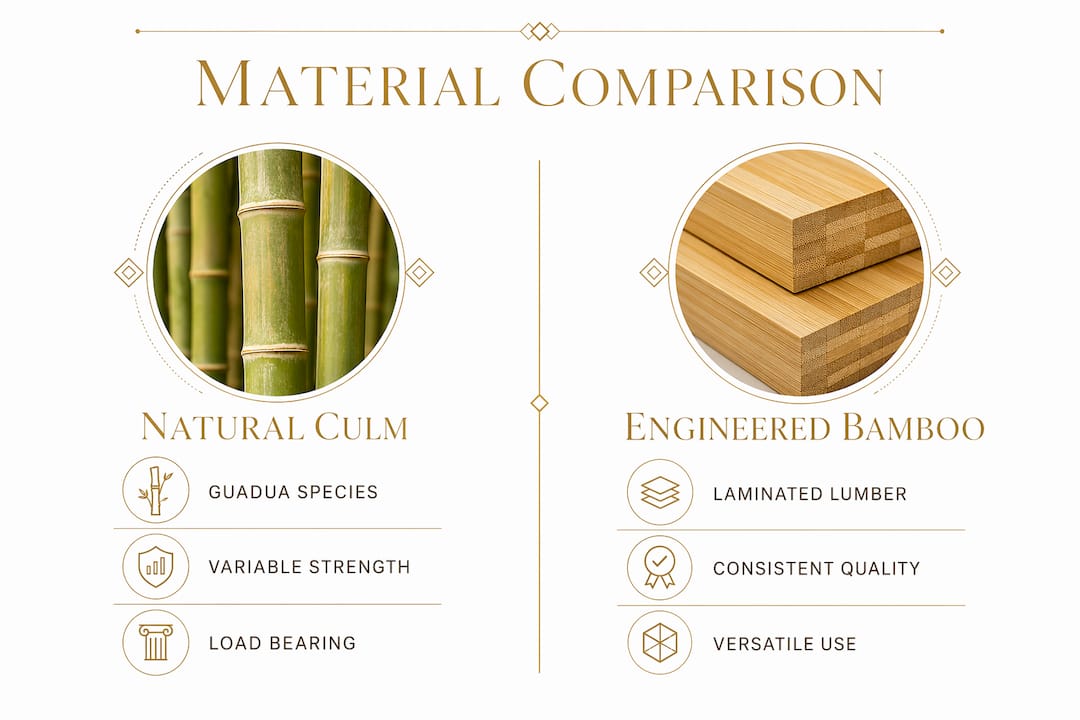
The more significant distinction for construction professionals is between natural culms and engineered bamboo products.
| Material Type | Species / Product | Tensile Strength | Best Use |
|---|---|---|---|
| Natural culm | Guadua angustifolia | High, well-documented | Columns, beams, trusses |
| Natural culm | Phyllostachys edulis (Moso) | Moderate | Light framing, secondary members |
| Engineered bamboo | Laminated Bamboo Lumber (LBL) | Consistent, predictable | Flooring, wall panels, beams |
| Engineered bamboo | HoRo-Bamboo | Over 630 MPa longitudinally | High-load structural members |
Engineered Bamboo Lumber addresses the core weakness of raw culms: variability. Laminated Bamboo Lumber and products like HoRo-Bamboo deliver dimensional stability and consistent mechanical properties that make code compliance achievable. HoRo-Bamboo carries a density of 0.83 g/cm³ and a carbon footprint of just 1.67 kg CO2 equivalent per kilogram produced. That is a genuinely low environmental cost for a material with structural performance at that level.
Proper treatment is non-negotiable. Untreated bamboo is vulnerable to fungal decay, insect attack, and moisture-driven degradation. A structure built on improperly treated culms will fail well before its design life.

The industry-standard method is borax-boric acid immersion. The solution penetrates the culm wall and creates a hostile environment for fungi and insects without introducing toxic compounds that compromise indoor air quality. The common recommendation of 5–7 days of immersion is not sufficient. Effective treatment requires at least 10 days of immersion, combined with random quality sampling to confirm penetration depth. Cutting corners on treatment duration is one of the most common and costly mistakes on bamboo projects.
Thermal treatment offers an alternative for outdoor applications. MOSO Bamboo X-treme uses a thermal modification process that has been installed across over 7 million m² of outdoor decking and cladding since 2008. It carries a 25-year warranty for certain outdoor components and achieves fire resistance without additional chemical retardants. That fire resistance performance matters for commercial projects where building codes require specific flame-spread ratings.
Key treatment and preparation steps for structural bamboo:
Pro Tip: Request a treatment certificate from your bamboo supplier and verify it against your own sampling results. Supplier-certified treatment and field-verified treatment are not always the same thing.
Bamboo structural engineering operates within a defined international framework. ISO 22156 is the governing standard for structural bamboo design. It covers characterization, design criteria, and connection requirements for full-culm bamboo. The challenge is that ISO 22156 does not automatically translate into local permit approval. Many local building codes, including the International Building Code, contain no bamboo provisions. That gap forces engineers into a “design by testing” pathway, which adds time and cost to project delivery.
Bamboo carries load well in tension and compression along its fiber direction. Tensile, compressive, and flexural properties all vary by species, culm diameter, and wall thickness. Engineers must use species-specific characteristic values rather than generic bamboo figures. For engineered bamboo products, manufacturers publish tested mechanical properties that align with timber engineering conventions, making structural calculations more straightforward.
Connections are the most failure-prone element in bamboo structures. Bolted connections through the culm wall create stress concentrations that can split the culm longitudinally. The preferred solutions include:
Bamboo’s natural flexibility is a structural asset in seismic zones. Buildings with bamboo benefit from the material’s ability to bend under seismic forces and return to its original shape. That behavior reduces brittle failure risk compared to concrete or unreinforced masonry. The Institution of Structural Engineers has cited this property as a key reason bamboo is gaining traction in earthquake-prone regions.
| Property | Raw Culm (Guadua) | Engineered Bamboo (LBL/HoRo) |
|---|---|---|
| Tensile strength | High, variable | High, consistent |
| Dimensional stability | Low | High |
| Connection complexity | High | Moderate |
| Code compliance pathway | Design by testing | Manufacturer data |
| Seismic flexibility | Excellent | Good |
| Fire resistance | Moderate | Good (product-dependent) |
Composite structural systems combine bamboo with concrete or steel to get the best of both materials. Bamboo-concrete composite slabs use bamboo as tensile reinforcement, similar in concept to rebar, while concrete handles compression. Bamboo shear walls in light-frame construction provide lateral resistance in low-rise buildings. Both systems are active areas of research and real-world application.
Successful bamboo construction projects follow a clear sequence. Skipping steps, especially early in the process, creates problems that are expensive to fix once framing is underway.
Confirm local code acceptance. Contact your building department before design begins. U.S. permitting for bamboo typically requires design testing due to absent code provisions. Budget time for pre-application meetings and plan for a third-party structural review.
Select species and material type for your load conditions. Use Guadua angustifolia for primary structural members. Specify engineered bamboo products where dimensional consistency is critical or where code compliance requires published mechanical data.
Source from verified suppliers. Bamboo supply chains are less mature than timber supply chains. Confirm that your supplier can provide species certification, treatment records, and moisture content data. Domestic sourcing is limited in the United States, so factor in shipping lead times.
Design connections first. Connection design drives culm sizing and spacing. Finalize your connection system before you finalize member sizes. Retrofitting connection details after framing is drawn is a common and avoidable waste of design hours.
Treat and verify before delivery. Specify treatment duration (minimum 10 days for borax-boric acid), and require sampling results before accepting a shipment on site.
Stage installation by moisture zone. Install bamboo members from the driest zones outward. Moisture gradients cause differential shrinkage that opens joints and cracks culms if installation sequence is not managed.
Plan for maintenance access. Bamboo structures require periodic inspection of connections and surface coatings. Design maintenance access into the building from the start.
“The projects that go smoothly are the ones where the engineer, the contractor, and the supplier are all aligned on species, treatment, and connection details before a single culm is cut.” This is the practical reality of bamboo construction in regulated markets.
Bamboo construction carries a 20–30% cost premium over conventional framing due to processing costs, specialist labor scarcity, and supply chain constraints. That premium is real, and clients need to understand it upfront. The long-term carbon and sustainability advantages are genuine, but they do not eliminate the need for honest budget conversations at project kickoff.
Pro Tip: Build a maintenance schedule into the project specifications and hand it to the owner at completion. Bamboo structures that receive regular inspection and recoating of exposed surfaces routinely outlast their design life. Structures that are ignored do not.
Bamboo is a structurally viable, low-carbon building material that requires species-specific selection, rigorous treatment, and ISO 22156-aligned design to perform reliably in regulated construction environments.
| Point | Details |
|---|---|
| Species selection is critical | Use Guadua angustifolia for load-bearing members; avoid Bambusa for primary structural use. |
| Treatment duration matters | Borax-boric acid immersion requires at least 10 days, not the commonly cited 5–7 days. |
| Engineered bamboo simplifies compliance | LBL and HoRo-Bamboo provide consistent mechanical data that supports code compliance pathways. |
| Connections drive design | Steel brackets and mortar-filled ends outperform bolted connections through culm walls. |
| Budget for the cost premium | Expect 20–30% higher costs than conventional framing due to labor and supply chain factors. |
Bamboo’s structural case is airtight on paper. The tensile strength data, the seismic flexibility, the carbon sequestration numbers — all of it points to a material that should be far more common in American construction than it currently is. The real barrier is not performance. It is the gap between what ISO 22156 says and what a local building official is prepared to approve on a Monday morning.
The professionals who succeed with bamboo are the ones who treat the permitting process as a design constraint, not an afterthought. They bring structural calculations, third-party test data, and a clear connection design to the pre-application meeting. They do not show up hoping the building department will figure it out with them.
The supply chain is improving. Bamboo product trends in 2025 show growing availability of engineered bamboo products in North American markets, and that trend is continuing into 2026. Engineered products like LBL and HoRo-Bamboo are closing the gap between bamboo’s theoretical potential and its practical deployability. My honest assessment is that the next five years will see bamboo move from specialty projects to a recognized option in the mainstream sustainable construction toolkit. But that shift requires professionals who know the material deeply, not just professionals who find it appealing in concept.
If you are exploring bamboo for a project, start with a small scope. A bamboo-framed pavilion or a composite bamboo-concrete slab in a low-risk application gives you and your team the hands-on experience that no amount of reading can replace. Build that knowledge base now, while the material is still niche enough that early movers have a real advantage.
— Cozee
Bamboo’s appeal extends well beyond structural framing. The same material properties that make it strong in a column make it durable and attractive in everyday commercial and residential products.

Cozee-bay curates a range of eco-friendly bamboo products designed for professionals and homeowners who want sustainable materials in every part of their space. From bamboo paper towel dispensers used in restaurants, schools, and senior living centers to drawer organizers and kitchen accessories, Cozee-bay brings the same commitment to quality craftsmanship that structural bamboo demands. Every product ships free within the contiguous U.S. and is backed by a money-back guarantee. If you are building with bamboo or simply want to extend that commitment to sustainable bamboo materials into the spaces you design and occupy, Cozee-bay is worth a look.
Guadua angustifolia is the strongest and most reliable species for structural applications. Its thick culm walls and well-documented mechanical properties make it the preferred choice for load-bearing columns, beams, and trusses.
ISO 22156 is the international standard governing bamboo structural design. However, many local codes including the International Building Code lack bamboo provisions, so projects often require a design-by-testing approval pathway.
Borax-boric acid immersion treatment requires a minimum of 10 days for effective pest and fungal resistance. The commonly cited 5–7 day duration is insufficient for thick-walled structural culms.
Yes. Bamboo’s natural flexibility allows structures to bend under seismic forces and return to their original shape, making it one of the better natural materials for earthquake-resistant construction.
Bamboo construction carries a 20–30% cost premium over conventional framing. That premium reflects processing costs, specialist labor scarcity, and supply chain limitations rather than the raw material cost of bamboo itself.
Comments will be approved before showing up.