Your Cart is Empty


TL;DR:
- Standard residential toilet paper rolls measure about 3.7 to 4.1 inches in width, 4 to 5 inches in diameter, and have a core diameter of 1.5 to 2 inches. Larger formats like mega and jumbo rolls vary in size and may not fit all home dispensers, especially older models. Since 1999, sheet sizes have decreased, so consumers should compare total square footage rather than sheet count for true value.
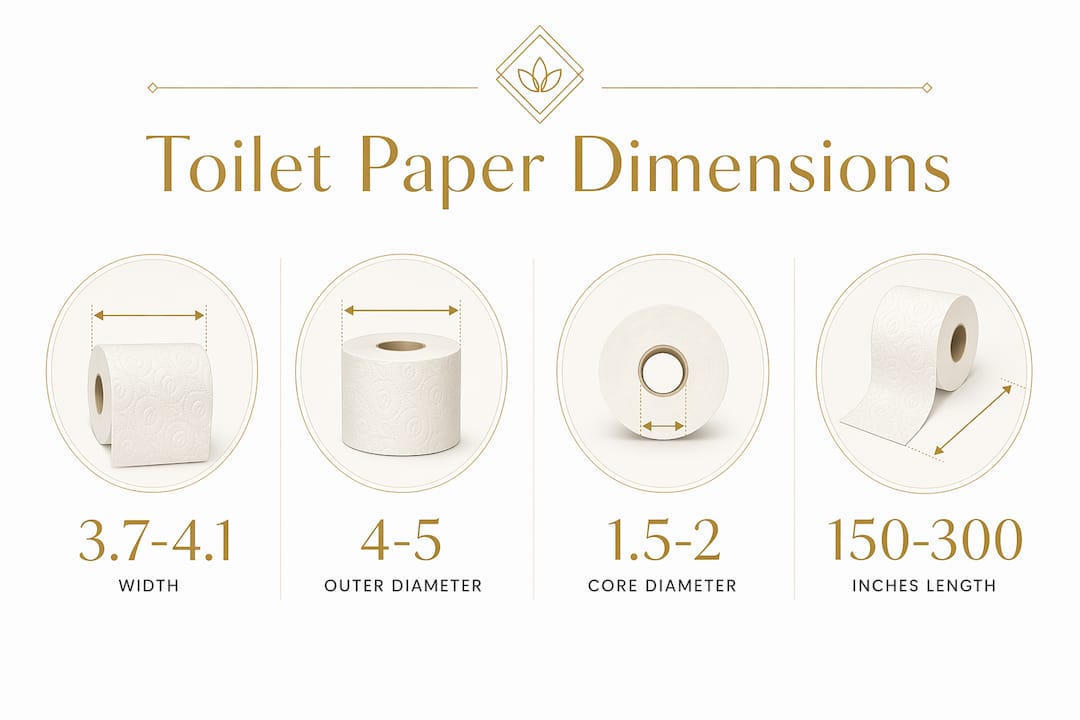
Toilet paper roll dimensions are defined by three physical measurements: width, outer diameter, and core diameter. A standard residential roll measures 3.7 to 4.1 inches wide, 4 to 5 inches in outer diameter, and carries a core diameter of 1.5 to 2 inches. These numbers matter far more than most homeowners realize. Get them wrong and your new mega roll won’t spin, your dispenser jams, or you end up paying more per square foot than you think. This guide gives you the exact specs, the history behind shrinking sheets, and the practical steps to match any roll to any holder without guesswork.
Standard household rolls follow a fairly consistent set of measurements, though no single government body enforces a universal size. The roll width typically ranges between 102 mm (4.0 inches) and 132 mm (5.2 inches) for standard to premium formats. That range reflects a balance between comfort, packaging efficiency, and dispenser fit. The core diameter measures 38–42 mm (about 1.5 to 1.65 inches) in US consumer rolls, sized to fit common spindles and adapters.

Beyond the standard format, roll sizes branch into several distinct categories. Each format carries different outer diameters and total paper lengths, which directly affects how long a roll lasts and whether it fits your holder.
| Roll Format | Outer Diameter | Width | Approx. Paper Length |
|---|---|---|---|
| Standard | 4–5 inches | 3.7–4.1 inches | 150–300 inches |
| Double | 4.5–5.5 inches | 3.7–4.1 inches | 300–500 inches |
| Mega | 5–6+ inches | 3.7–4.1 inches | 500–800 inches |
| Jumbo (commercial) | 8–12+ inches | 3.7–4.5 inches | Up to 2,000 inches |
Key differences to keep in mind:
The jumbo format can hold up to 2,000 inches of paper. That volume is useful in high-traffic commercial settings but creates real clearance problems in a standard wall-mounted home holder.
Sheet size is where the real story gets interesting. Traditional US sheets measured 4.5 x 4.5 inches, a square format that became the informal industry benchmark for decades. Since 1999, that standard has quietly eroded. Current sheets commonly measure 3.7 to 4.5 inches wide and 4.0 to 4.5 inches long. That is a meaningful reduction in surface area per sheet, even if the roll looks the same on the shelf.
Several forces drive this shrinkage:
Sheet size reductions since the 1990s, combined with the rise in ply and softness marketing, have changed how consumers perceive roll value. A roll that feels thick and plush may actually deliver less total surface area than a thinner roll from a decade ago.
Pro Tip: Before buying in bulk, check the sheet dimensions printed on the package, not just the sheet count. A roll with 300 sheets at 3.7 x 4.0 inches delivers noticeably less paper than one with 250 sheets at 4.5 x 4.5 inches.
The lack of a regulated standard means manufacturers use non-standardized marketing terms like “double” or “mega” without any legal definition behind them. Two brands can both call their product a “Mega Roll” while differing by an inch in diameter and 200 sheets in count. Checking the toilet paper roll sizes guide at Cozee-bay gives you a practical breakdown of what those labels actually mean in real measurements.
Dispenser fit is where toilet paper roll specifications stop being abstract and start costing you time and frustration. Mega and jumbo rolls often don’t fit older standard holders, causing jams or binding against the housing. The outer diameter is the measurement that matters most for clearance. The width matters for spindle fit. Both need to be checked before you buy.
Follow these steps to measure your dispenser correctly:
Measuring dispenser width, spindle core clearance, and feed alignment to ±2 mm is the standard that keeps rolls feeding reliably without jamming. That level of precision sounds fussy, but it takes about 90 seconds with a tape measure and saves you from a roll that won’t spin.
Pro Tip: If you love the value of mega rolls but your current holder is too tight, swap to an open-style or freestanding holder. Open holders have no side walls to restrict diameter, so they work with virtually any roll size.
Modern manufacturing tolerances run roughly ±1–2 mm for sheet width and perforation pitch. That small variance can compound across a roll, which is why two rolls labeled the same size can feel slightly different in the same holder. Checking your toilet tissue holder options before upgrading roll sizes is a smart first step.
Sheet count is the most common metric on packaging, and it is also the most misleading. Sheet count alone does not reflect true value because sheet dimensions vary widely across brands. A roll with 400 sheets sounds generous until you realize each sheet is 20% smaller than the competitor’s 300-sheet roll.
The better approach is to calculate total square footage or total linear inches per roll, then divide by price. Here is how:
| Roll Type | Sheet Size | Sheet Count | Total Sq. In. | Approx. Price | Cost per Sq. Ft. |
|---|---|---|---|---|---|
| Budget standard | 3.7 × 4.0 in | 200 | 2,960 | $1.00 | $0.49 |
| Mid-range standard | 4.0 × 4.5 in | 250 | 4,500 | $1.50 | $0.48 |
| Premium mega | 4.0 × 4.5 in | 400 | 7,200 | $2.50 | $0.50 |
| 2-ply standard | 4.0 × 4.5 in | 200 | 3,600 | $1.40 | $0.56 |
A few things this table reveals:
Converting sheet dimensions and sheet count into total square feet is the only reliable way to compare value across brands and avoid misleading marketing claims. The toilet paper buying guide at Cozee-bay walks through this calculation with real product examples if you want a deeper look.
Standard toilet paper roll dimensions, measured by width, outer diameter, and core diameter, determine both dispenser compatibility and real paper value more reliably than any marketing label.
| Point | Details |
|---|---|
| Standard roll dimensions | Width runs 3.7–4.1 inches, outer diameter 4–5 inches, core diameter 1.5–2 inches. |
| Format differences matter | Mega rolls add diameter, not width; jumbo rolls rarely fit residential holders. |
| Sheet sizes have shrunk | Sheets dropped from the traditional 4.5 × 4.5 inches to as small as 3.7 × 4.0 inches since 1999. |
| Measure before you buy | Check holder clearance diameter and spindle size to ±2 mm before switching roll formats. |
| Calculate real value | Use total square footage divided by price, not sheet count, to compare rolls accurately. |
The first time I bought a pack of “mega” rolls for a bathroom remodel, I was confident they would fit the new wall-mounted holder. They didn’t. The outer diameter was just large enough to press against the housing, and the roll wouldn’t spin freely. I had to return the holder and buy an open-style freestanding unit instead.
That experience taught me something the packaging never tells you: roll format labels describe paper quantity, not physical fit. A “mega” roll from one brand can be a full inch larger in diameter than a “mega” roll from another. Without measuring both the roll and the holder, you are making a guess.
My advice is to prioritize dispenser clearance over everything else when you are planning a bathroom update. Pick your holder first, measure its interior diameter and spindle size, then shop for rolls that fit those specs. Softness and ply are secondary choices. A plush 3-ply roll that jams every third day is not a comfort upgrade.
I also recommend checking the how long is a toilet paper roll guide at Cozee-bay if you are trying to match roll length to a high-traffic bathroom. Knowing total paper length per roll helps you plan restocking schedules, which matters more than most people expect once you have a busy household.
The bottom line is this: measure twice, buy once. The five minutes you spend with a tape measure before ordering saves you a return trip and a holder that collects dust in a closet.
— Cozee
If measuring your current holder revealed it is too tight for the roll sizes you prefer, a holder upgrade is the practical fix.

Cozee-bay’s bamboo paper towel dispenser is built with open-style clearance that accommodates standard and larger roll diameters without binding. The handcrafted bamboo construction fits naturally in both modern and traditional bathrooms, and installation takes minutes. Cozee-bay ships free within the contiguous US and backs every purchase with a money-back guarantee, so there is no risk in trying it out. If you are upgrading your bathroom setup, this is a practical place to start.
A standard residential roll measures 3.7 to 4.1 inches wide, 4 to 5 inches in outer diameter, and 1.5 to 2 inches in core diameter. These measurements fit most wall-mounted home dispensers without modification.
Total paper length varies by format. Standard rolls typically deliver 150–300 linear inches of paper, while mega rolls reach 500–800 inches and commercial jumbo rolls can hold up to 2,000 inches.
Mega rolls have a larger outer diameter, often 5 to 6 or more inches, which exceeds the clearance of many enclosed wall-mounted holders. Switching to an open-style or freestanding holder solves the problem without changing the roll you buy.
Multiply sheet length by sheet width by sheet count to get total square inches, then divide by price. This cost-per-square-foot calculation gives you a true comparison that sheet count alone cannot provide.
Yes. The traditional US sheet measured 4.5 × 4.5 inches. Since 1999, sheets have shrunk to as small as 3.7 × 4.0 inches across many brands, reducing total surface area per roll even when sheet count stays the same.
Comments will be approved before showing up.