Your Cart is Empty


Finding practical ways to reduce waste without sacrificing style is a challenge every American restaurant owner faces. As the need to balance eco-friendly goals with high operational standards grows, more businesses are turning to bamboo. This versatile, rapidly renewable plant offers a powerful waste reduction solution that looks great, meets sustainability values, and streamlines your daily operations, all while helping you stand out in a crowded marketplace.
| Point | Details |
|---|---|
| Bamboo as a Sustainable Solution | Bamboo offers rapid growth, biodegradability, and minimal land use, making it an effective alternative for reducing waste in various industries. |
| Diverse Applications of Bamboo | The versatile nature of bamboo supports its use across construction, textiles, and technical applications, promoting sustainable practices. |
| Environmental Impact Reduction | Bamboo significantly decreases plastic waste and landfill contributions through its biodegradable properties and renewable production. |
| Comparative Advantages Over Traditional Materials | Bamboo outperforms traditional materials in growth cycles, resource efficiency, and overall environmental benefits, supporting a shift towards sustainable manufacturing. |
Bamboo represents a revolutionary material in the fight against commercial waste, offering unprecedented sustainability solutions for businesses seeking eco-friendly alternatives. Bamboo’s remarkable circular economy potential enables organizations to dramatically reduce their environmental footprint while maintaining high-performance standards.
The fundamental characteristics that make bamboo exceptional for waste reduction include its extraordinary growth rate and regenerative capabilities. Bamboo grows exponentially faster than traditional timber resources, with some species expanding up to 3.5 feet per day. These rapid growth characteristics translate into significant environmental advantages:
Commercial waste reduction through bamboo implementation occurs across multiple dimensions. Sustainable material replacement strategies demonstrate how bamboo can effectively substitute less environmentally friendly materials in packaging, utensils, and infrastructure components.
Moreover, bamboo’s versatility extends beyond simple material replacement. Its inherent properties make it a superior choice for businesses committed to zero-waste objectives. The plant supports comprehensive waste minimization by providing biodegradable alternatives that naturally decompose without creating long-term environmental burden.
Pro Tip: Conduct a comprehensive audit of your current material usage to identify strategic opportunities for bamboo integration in your commercial waste reduction strategy.
Commercial enterprises are increasingly turning to diverse bamboo product applications that span multiple industries and sustainability objectives. Bamboo’s versatility enables businesses to replace traditional materials with eco-friendly alternatives that reduce environmental impact while maintaining high performance standards.
The range of bamboo products for commercial use is remarkably extensive, encompassing multiple sectors:
Bamboo fiber technologies have particularly transformed commercial textile industries. Sustainable fiber innovations provide strength, flexibility, and biodegradability that surpass traditional synthetic materials, making them attractive for businesses committed to environmental responsibility.

Moreover, bamboo’s commercial potential extends beyond traditional manufacturing. Its applications in bioenergy, advanced materials, and technical industries demonstrate how this remarkable plant can drive sustainable innovation across multiple commercial domains.
Pro Tip: Conduct a comprehensive assessment of your current material supply chain to identify strategic bamboo product replacements that can simultaneously reduce waste and enhance sustainability.
The following table summarizes commercial sectors driving change with bamboo products and their main benefits:
| Sector | Bamboo Application | Primary Business Benefit |
|---|---|---|
| Construction | Flooring, wall panels | Reduced embodied carbon |
| Hospitality | Disposable utensils | Lower plastic waste output |
| Office/Furniture | Desks, chairs | Improved sustainability ratings |
| Textiles | Uniforms, bedding | Enhanced biodegradability and comfort |
Businesses seeking sustainable waste management solutions are increasingly recognizing bamboo’s powerful waste reduction potential. Biodegradable alternatives to traditional plastic products represent a transformative approach to minimizing commercial waste streams and environmental impact.
The mechanisms by which bamboo decreases waste are multifaceted:
Waste management technologies have been significantly enhanced through innovative composting integration, which improves organic waste processing and reduces methane emissions. Bamboo’s unique structural properties enable more efficient decomposition compared to traditional waste materials.
By providing biodegradable alternatives across multiple commercial sectors, bamboo offers a comprehensive strategy for reducing plastic dependency and minimizing landfill contributions. Its versatility extends beyond simple material replacement, representing a holistic approach to sustainable waste management.
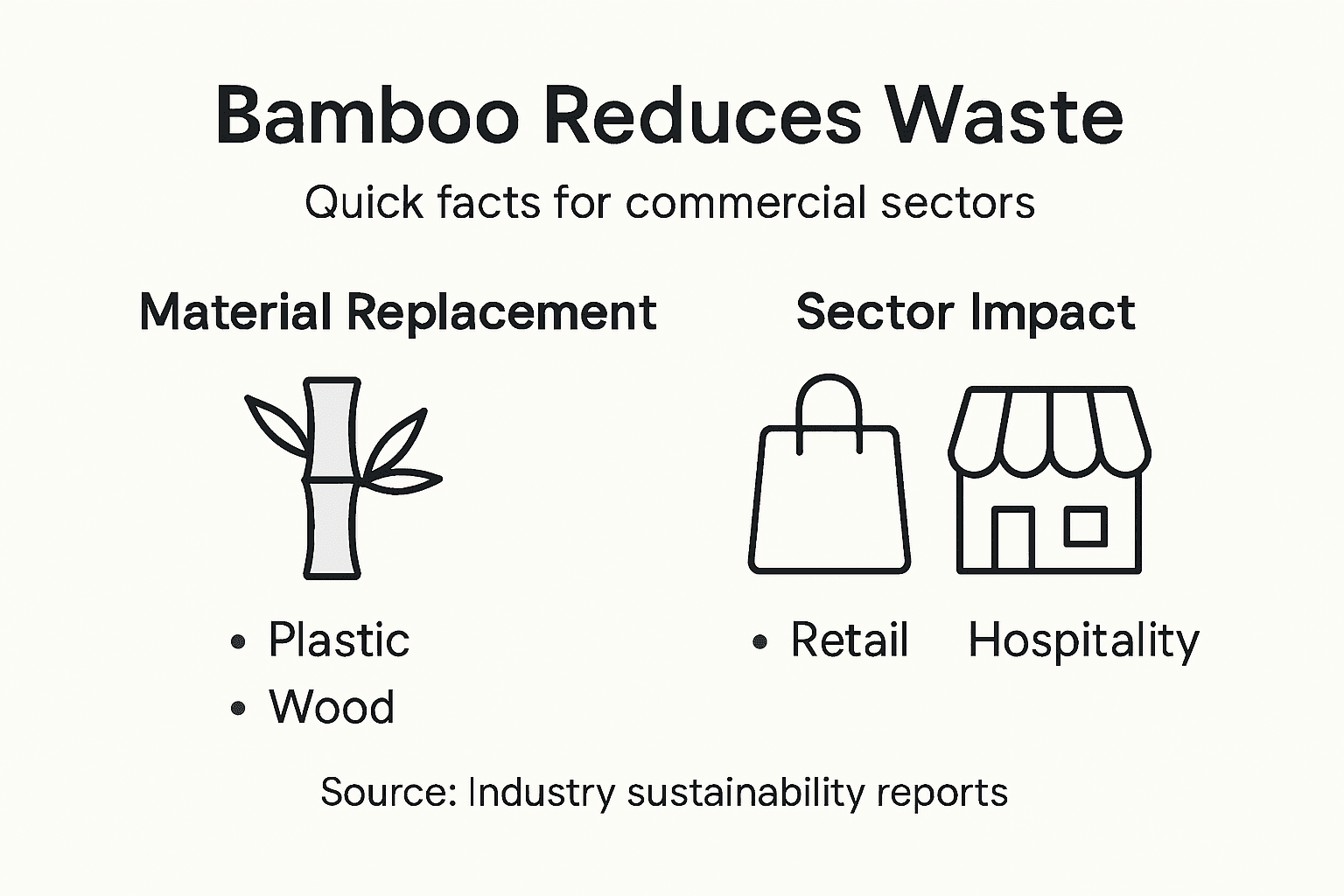
Pro Tip: Implement a phased transition strategy to gradually replace plastic-based products with bamboo alternatives, tracking waste reduction metrics to demonstrate environmental and economic benefits.
Businesses committed to sustainability are discovering remarkable environmental advantages through strategic bamboo implementation. Ecological performance extends far beyond traditional material alternatives, offering comprehensive benefits that transform operational sustainability approaches.
The key environmental and operational benefits of bamboo include:
Biomass energy technologies have been significantly advanced through innovative renewable fuel strategies, demonstrating bamboo’s potential to replace fossil fuel dependencies. Its ability to provide sustainable energy solutions while maintaining low carbon footprints represents a critical breakthrough in industrial sustainability.
Moreover, bamboo’s operational versatility allows businesses to simultaneously address environmental challenges and operational efficiency. By integrating bamboo-based solutions, companies can reduce their ecological footprint while maintaining high-performance standards across multiple commercial sectors.
Pro Tip: Conduct a comprehensive sustainability audit to identify specific areas where bamboo-based materials can replace traditional resources and optimize your organization’s environmental performance.
Businesses seeking sustainable alternatives are discovering remarkable material advantages in bamboo technologies. Material performance represents a critical evolution beyond conventional construction and manufacturing resources, offering unprecedented ecological and economic benefits.
Key comparative characteristics between bamboo and traditional materials include:
Here’s a comparison of bamboo versus traditional materials across key business dimensions:
| Dimension | Bamboo | Traditional Materials |
|---|---|---|
| Growth Cycle | 3-5 years | 20-70 years (wood), indefinite (steel) |
| End-of-Life | Biodegradable and compostable | Often landfilled or incinerated |
| Resource Efficiency | Low water and input needs | High energy and resource demands |
| Typical Applications | Packaging, textiles, construction | Plastics, concrete, synthetics |
Green manufacturing strategies have been significantly transformed through innovative sustainable material development, demonstrating bamboo’s potential to outperform traditional materials across multiple industrial applications. Its unique combination of ecological benefits and performance characteristics positions bamboo as a superior alternative in sustainable product design.
Unlike concrete, steel, or synthetic materials, bamboo offers a holistic solution that addresses environmental concerns while maintaining high-performance standards. Its versatility allows businesses to simultaneously reduce ecological footprints and achieve operational excellence across diverse commercial sectors.
Pro Tip: Conduct a comprehensive material assessment to identify specific applications where bamboo can replace traditional resources, focusing on performance metrics and sustainability potential.
Many businesses struggle with increasing commercial waste and the environmental impact of traditional materials. This article highlights bamboo’s exceptional ability to serve as a biodegradable, renewable alternative that supports circular economy principles and dramatically decreases plastic and landfill waste. If your goal is to integrate sustainable materials that combine durability with eco-conscious innovation, bamboo products are a proven solution that meets these key challenges.
Discover how Cozee Bay’s premium collection of Bamboo Paper Towel Dispensers offers both functional excellence and stylish design while helping you reduce your commercial waste footprint.

Start transforming your waste management strategy today with sustainable bamboo products carefully crafted for residential and commercial use. Explore our full range of eco-friendly options at Cozee Bay and take the first step toward a cleaner environment and smarter resource use. For easy integration and enhanced sustainability impact, browse our Bamboo Paper Towel Dispenser- A Sleek Look Home or Office page now and experience the benefits firsthand.
Bamboo offers exceptional environmental benefits, including high carbon sequestration rates, minimal land requirements for cultivation, and biodegradability. It enhances soil stability, promotes biodiversity, and requires less water than traditional materials.
Bamboo grows much faster than traditional wood—taking only 3-5 years to mature compared to 20-70 years for wood. It is biodegradable, whereas many plastics are not, and it uses fewer resources in production, leading to lower environmental impact.
Bamboo can effectively replace materials in many sectors, including construction (flooring, wall panels), textiles (uniforms, bedding), and disposable products (utensils, packaging), contributing to significant waste reduction.
Businesses can conduct a comprehensive audit of their current materials to identify opportunities for bamboo integration. Gradually replacing single-use plastics and other materials with bamboo alternatives will help track waste reduction metrics and demonstrate environmental benefits.
Comments will be approved before showing up.