Your Cart is Empty


For most people, a solid bamboo modular organizer gives the best mix of durability, eco-credentials, and flexible storage as your collection changes. If your counter is tight or your collection is large, a stackable solid-wood drawer unit or a rotating cabinet solves the space problem without sacrificing that same real-wood durability.
TL;DR:
- Bamboo organizers offer a practical balance of durability, fast renewability, and moisture resistance suitable for bathroom environments.
- Solid wood options like walnut and cherry are more durable than veneer but come with higher costs and possible repair limitations.
- Proper measurement, including space for daily use and obstacles, is essential to choose an organizer that fits and functions effectively.
- Regular maintenance with a food-safe oil every few months extends the lifespan of bamboo and hardwood organizers, especially in humid settings.
- Prioritizing solid construction and natural oil finishes is more important than extra compartments or decorative layers when selecting a long-lasting storage solution.
The right configuration depends less on how much makeup you own and more on how you actually get ready in the morning. Do you want everything visible and grabbable, or do you want a clean surface with your products tucked out of sight?
Here’s how the main formats stack up:
Open storage wins on speed. You see everything, so nothing gets lost behind a bottle of setting spray. Closed storage wins on cleanliness and looks calmer on a shared bathroom counter. Most people do best with a hybrid: an open top tray for daily essentials, with drawers below for backups and occasional-use products. Modular and stackable pieces make that hybrid easy to build gradually rather than committing to one fixed layout on day one.
The material decides how long your organizer survives daily contact with lotion, spilled powder, and bathroom humidity. Not every “wood” organizer is actually solid wood, and that distinction matters more than color or grain pattern.
Bamboo is a technical grass, not a hardwood, but it behaves like one once pressed and laminated. It grows back fast, resists moisture better than most softwoods, and takes an oil finish beautifully. Walnut brings a deep, dark grain and excellent durability, though it costs more per piece. Cherry darkens attractively with age and light exposure, giving an organizer that looks better after a year than it did new. Beech is a tighter-grained hardwood, often used in smaller handmade boxes where a fine, smooth surface matters for delicate compartments.
For finish, favor food-safe natural oils over sprayed lacquers, especially in a bathroom. Oil seals the wood’s pores against humidity without off-gassing anything near your skincare and makeup, while lacquer can crack or yellow under repeated moisture exposure. To spot a veneer imposter, check the edges and any drilled holes: a thin, uniform layer over a different-colored core is definitely not solid wood.
Pro Tip: Run a fingernail lightly across an inside corner before buying in person. Real wood grain continues consistently; veneer often shows a slightly different texture or color line where the laminate ends.
Measuring before you buy helps avoid a common return reason: an organizer that looks right online but doesn’t fit the counter, or worse, blocks a mirror or outlet.
Small apartment counters do best with a relatively narrow stackable unit. Shared bathrooms with more surface area can handle a wider modular layout with room to add drawers later.
A good wood organizer earns its price through material, construction, and honest specs. A bad one hides exactly those details.
Red flags include listings with no dimensions at all, stock photos that don’t match the described material, or any mention of peeling laminate in reviews. If budget is tight, prioritize solid wood over extra compartments. A smaller solid piece outlasts a large veneer one. If eco-impact matters most to you, bamboo generally beats slower-growing hardwoods on renewability without giving up strength.
Daily dusting with a soft, dry cloth handles most upkeep. Skip water and skip harsh cleaners entirely, since both strip the protective finish and let humidity into the grain underneath.
Ventilation does more work than people expect. A well-ventilated bathroom with an oil-finished piece will outlast a lacquered organizer sitting in a steamy, closed-off room, even if the lacquered piece looked shinier on day one.
Pro Tip: Keep a small bottle of food-safe mineral oil under your sink. A two-minute wipe-down every couple of months costs less than replacing a dried-out organizer in a year.
Styling comes down to restraint. A wood organizer already brings warmth and texture to a counter, so it doesn’t need much dressing up around it.
For a minimalist bathroom, stick to one wood tone and let a single open tray or modular block do the work, with nothing else on the counter but your daily essentials. For a modern space with cooler tones, a dark walnut or cherry piece with clean, boxy lines contrasts nicely against white or gray surfaces. For a warm, wood-forward interior, lean into it fully: pair a bamboo organizer with wooden hairbrushes, a wood soap dish, and matched drawer pulls so nothing feels mismatched.
A little visual restraint reads as far more intentional than a fully packed organizer ever will.
Cozee Bay builds its organizers around one material philosophy: bamboo does the job better than most alternatives, and it does it without the environmental cost of slower-growing hardwoods. Every piece gets a food-safe natural oil finish, chosen specifically because it holds up in humid bathroom conditions without introducing anything you wouldn’t want sitting inches from your skincare.
Bamboo regenerates in a fraction of the time hardwood trees need, yet it matches or exceeds many hardwoods on strength per pound. That combination is why we build around it rather than treat it as a budget substitute for “real” wood.
Bamboo organizers from Cozee Bay show up in homes and in commercial settings alike, from bathroom vanities to salon back bars, because the same qualities that make it durable at home make it durable under heavier daily use. Low maintenance matters just as much as good looks: a quick dusting and an occasional oil refresh keep a piece looking new for years, which is a lower time cost than most people expect from a wood product.
Bamboo behaves a little differently than traditional hardwood, and knowing that difference helps you keep a Cozee Bay piece looking sharp for years rather than months.
Bamboo’s tight, fibrous grain resists moisture better than most softwoods right out of the box, but it still benefits from the same oil-based care routine as walnut or cherry. Wipe it down with a dry or barely damp cloth, never a soaked one, and avoid letting standing water sit on any surface, especially around drawer seams where moisture can work its way into joints.
Reoil bamboo pieces every three to four months in a humid bathroom, or every six months in a drier space like a bedroom vanity. A thin coat of food-safe mineral oil, rubbed in with a soft cloth and left to absorb for a few minutes before wiping off the excess, keeps the surface sealed against splashes and everyday spills.
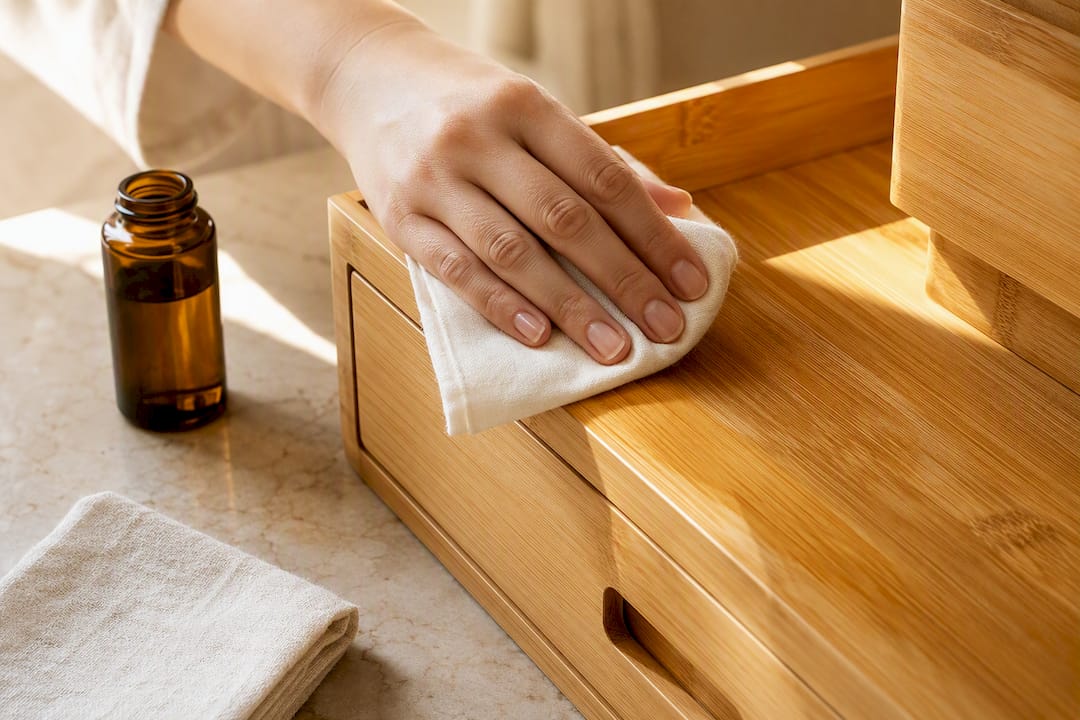
Avoid placing bamboo organizers directly in a shower splash zone or under a leaky pipe. Bamboo tolerates humidity well, but it isn’t waterproof, and prolonged direct contact will eventually dull the finish and swell the joints. For deeper maintenance steps, Cozee Bay’s guide to maintaining bamboo organizers walks through reoiling schedules and scratch repair in more detail.
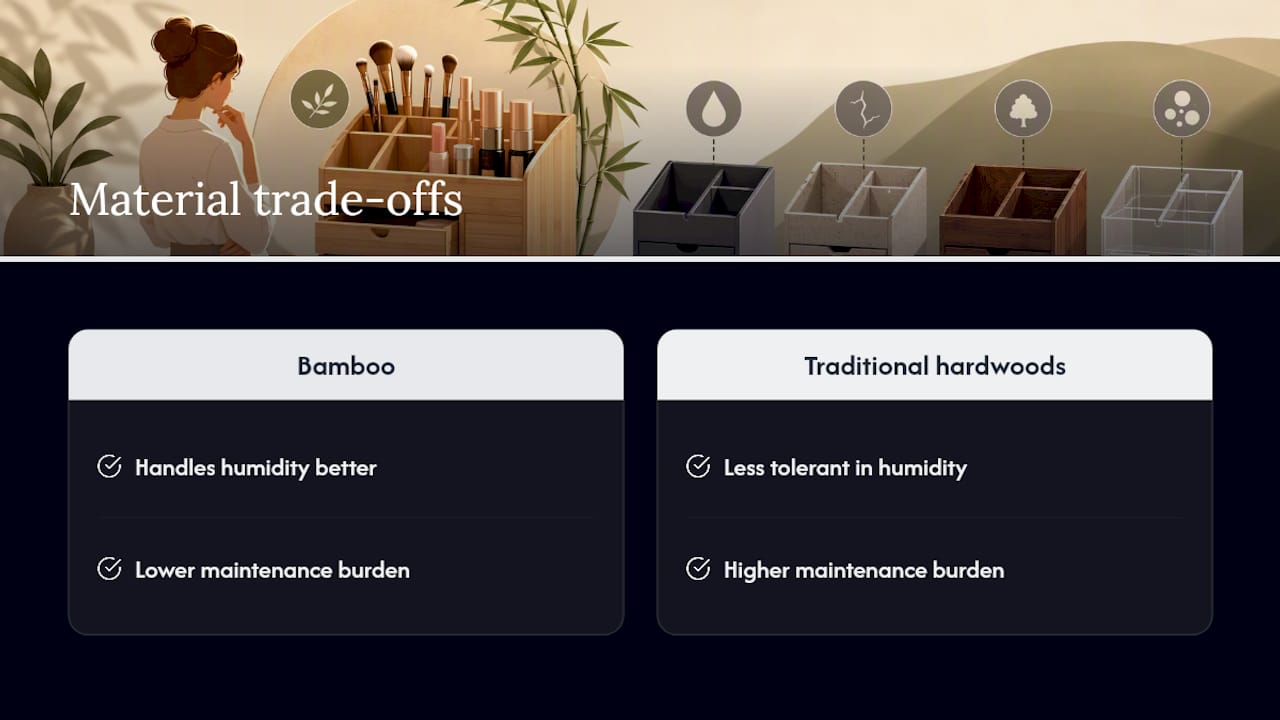
Most buying guides treat bamboo as the budget option, something you settle for when walnut or cherry costs too much. That framing gets it backward. Bamboo isn’t a compromise material, it’s the more practical choice for a bathroom environment specifically, because it handles humidity better than many traditional hardwoods while asking less of you in upkeep.
The bigger mistake shoppers make isn’t choosing the wrong wood, it’s buying for capacity instead of visibility. A giant organizer that holds your entire collection sounds appealing until you realize you use maybe fifteen products daily and the rest sits buried in a bottom drawer you never open. Design for what you reach for every morning first, then build outward with modular or stackable pieces as your collection actually grows.
If you take one thing from this guide, prioritize solid construction and a real oil finish over extra compartments. Everything else, the drawer count, the rotating base, the jewelry hooks, is a nice-to-have layered on top of that foundation.
— Cozee
Cozee Bay gives you the durability of solid wood construction without the higher price tag or slower renewal cycle of walnut or cherry, since bamboo delivers comparable strength while growing back far faster. That’s the practical tradeoff worth knowing before you commit to a pricier hardwood piece.

On the Cozee Bay landing page, you’ll find full product specs for each organizer, including exact dimensions, drawer depth, and the specific food-safe oil finish used on every piece. Reviews from other buyers cover real-world durability, and every purchase comes backed by a money-back guarantee, so you’re not gambling on a listing photo. Before you buy anything wood, check three things on any product page: the stated dimensions against your counter measurements, whether the finish is named specifically, and the shipping and returns terms in case a piece arrives and doesn’t fit your space the way you expected.
Ready to see the options in person? Visit Cozee Bay to browse current bamboo makeup organizers, or reach out about custom configurations if your vanity has an unusual footprint.
A few extra reads help round out your decision, especially if you’re still weighing style against sustainability or want a deeper maintenance routine before your organizer arrives.
Comments will be approved before showing up.