Your Cart is Empty


TL;DR:
- Removing unnecessary items and organizing remaining essentials keeps kitchen and bathroom surfaces clean and functional. Applying a rule that only items used three to four times weekly stay on counters helps prevent clutter buildup. Regular nightly resets and proper storage solutions maintain long-term surface tidiness.
Reducing clutter on countertops is the practice of removing unnecessary items and organizing what remains so your kitchen and bathroom surfaces stay clean, functional, and calm. A cluttered counter is less a storage problem and more a decision problem. Every item sitting on your counter got there because no one made a firm choice about where it actually belongs. The good news is that a few clear rules, a couple of smart habits, and the right organizers will have your surfaces looking tidy without you pulling your hair out every morning.
The fastest way to clear your counters is to apply one firm rule: if you do not use it at least 3–4 times per week, it does not earn countertop space. This is the core idea behind the “Countertop Curfew,” a method that treats your counter like prime real estate. Only the most-used items pay the rent.
Start by pulling everything off your counter and placing it on the kitchen table. A blank surface forces you to make real choices about what comes back. Most homeowners are surprised to find that only a handful of items actually qualify under the 3–4 times per week rule.
Here is what typically earns a permanent spot:
And here is what usually fails the test:
Pro Tip: Take a photo of your counter once it is fully cleared. That image becomes your reference point. Whenever clutter creeps back, one look at the photo reminds you exactly what “clean” looks like, and research confirms that photographic records reinforce long-term habits through visual anchoring.
Once you know what stays, the next challenge is giving everything a proper home. The tray method is one of the most effective storage solutions for countertops. Place a single decorative tray on your counter and allow only what fits inside it to live there. When the tray is full, nothing new gets added without something else being removed. This physical limit keeps the surface visually tight and organized by design.
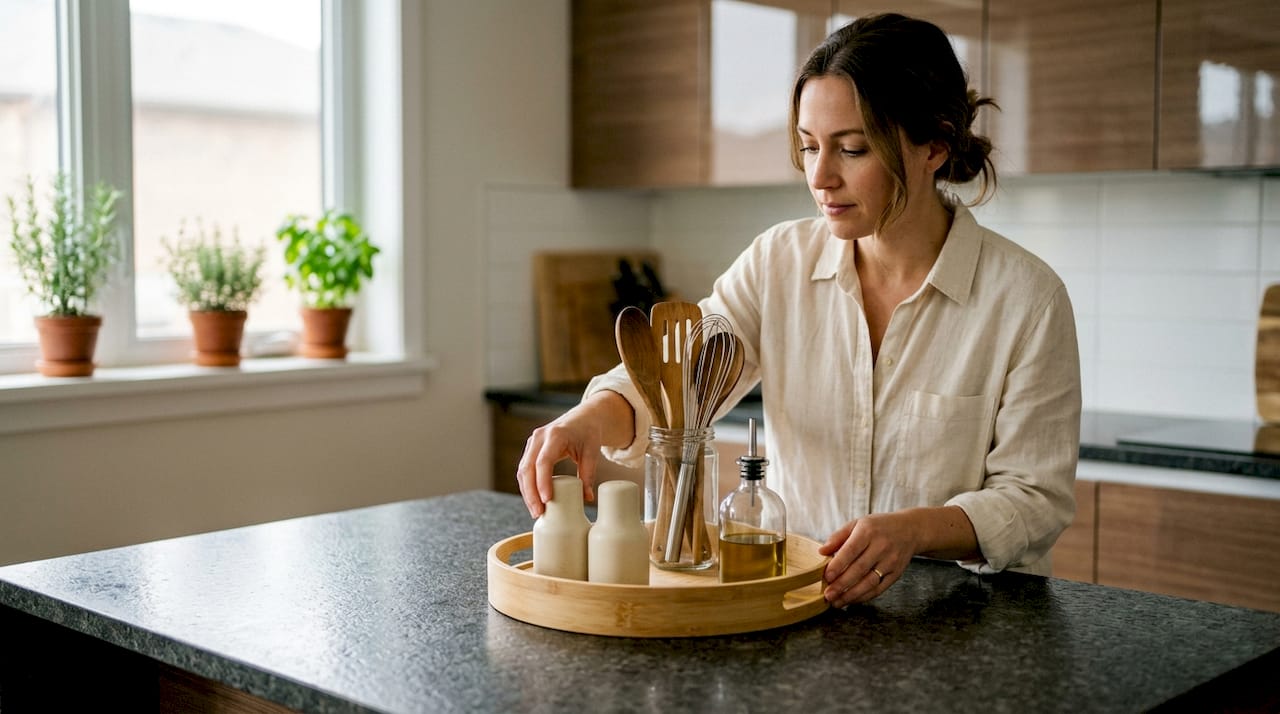
Cabinets and drawers are underused in most kitchens. Appliances you reach for a few times a week belong behind a cabinet door, not on display. If your kitchen has deep lower cabinets, a pull-out shelf makes retrieval easy without sacrificing convenience. An “appliance garage,” a cabinet section with a roll-up or hinged door at counter height, keeps small appliances accessible but out of sight.
Cord clutter is one of the most overlooked contributors to a messy counter. Visible cables from phone chargers, electric kettles, and small appliances make surfaces feel messier than they actually are. Simple cord clips or a cable management box tucks wires away in seconds.
Going vertical frees up flat space without sacrificing function. A wall-mounted magnetic knife strip replaces a bulky knife block and keeps blades accessible. Pegboards above the counter hold utensils, small baskets, and even spice jars. Tiered shelf risers inside cabinets double your storage capacity without requiring a renovation.
Here is a quick comparison of common storage approaches by use case:
| Storage method | Best for | Space impact |
|---|---|---|
| Decorative tray | Daily-use items grouped together | Low footprint, high visual order |
| Appliance garage | Small appliances used a few times weekly | Removes bulk from sight entirely |
| Wall-mounted strip | Knives, utensils, and tools | Frees significant counter real estate |
| Drawer organizers | Cords, small gadgets, and accessories | Moves clutter completely off the surface |
| Tiered cabinet risers | Pantry items, canned goods, spices | Maximizes hidden storage depth |
Pro Tip: For kitchen organization ideas that work in small spaces, look for products that serve double duty, like a bamboo wrap and foil dispenser that mounts inside a cabinet door and frees up an entire drawer.
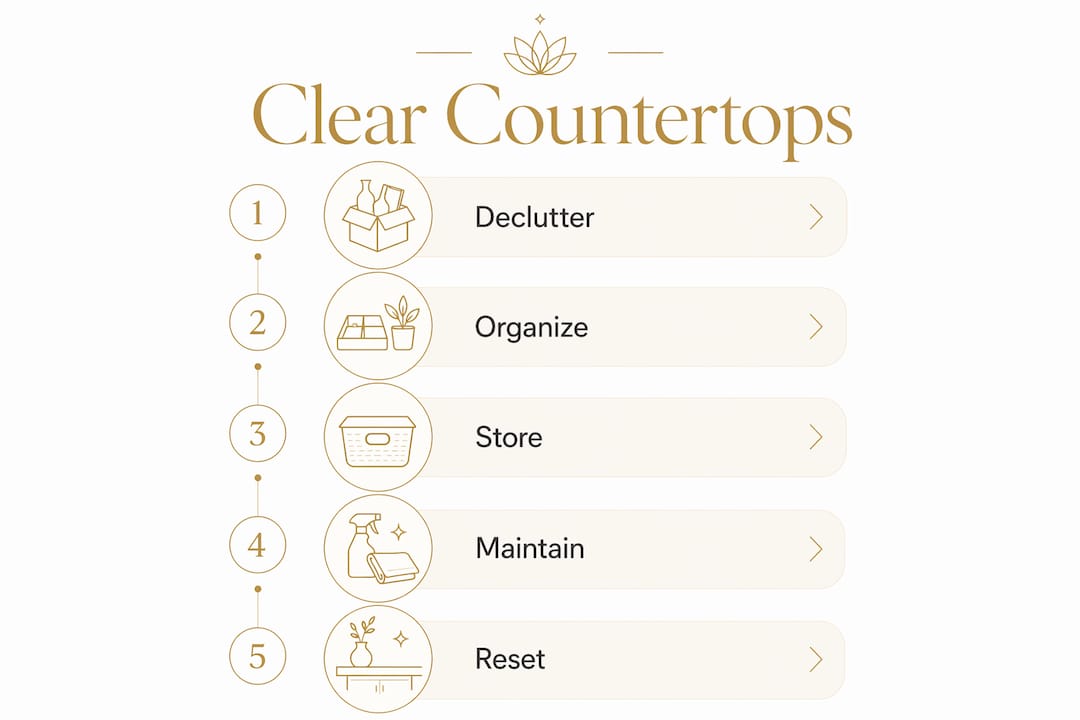
Clearing your counters once is satisfying. Keeping them clear requires a short daily routine. The most effective method is a 5–10 minute nightly counter reset. That small window of time prevents the slow creep of clutter that turns a tidy kitchen into a chaotic one within days.
Here is a simple nightly reset routine you can follow:
The nightly reset works because it prevents accumulation. A counter that gets a 5-minute reset every evening never reaches the point where it needs a full hour of decluttering on the weekend. Small consistent actions beat occasional big cleanups every time.
Mornings benefit from a quick scan too. Before you leave the kitchen after breakfast, put away the coffee supplies, wipe the counter, and confirm nothing stray landed there overnight. The whole process takes under two minutes once the habit is set.
Bathroom counters face a different kind of clutter than kitchens. The culprits are toiletries, personal care tools, and the random items that migrate in from other rooms. The same core principles apply: only daily-use items earn surface space, and everything else gets a drawer, bin, or cabinet.
Start with a small decorative tray on the bathroom counter. Keep only what you reach for every single day: hand soap, a face wash, and perhaps a moisturizer. Everything else, including serums used a few times a week, styling tools, and backup products, belongs in a drawer or under-sink organizer.
A few rules that make a real difference in bathrooms:
Pro Tip: Designate one small bin or basket under the sink as a “waiting zone” for products you are testing or using occasionally. This keeps them off the counter without making them hard to find. When the bin fills up, that is your signal to edit.
Bathroom counters also benefit from the same photographic anchor technique used in kitchens. Snap a photo of your cleared bathroom counter and keep it on your phone. When the surface starts to drift, the photo gives you a concrete target to return to.
Clearing countertops is a decision process, not a storage problem. The most effective approach combines a firm keep-or-remove rule, a physical boundary like a tray, and a brief nightly reset.
| Point | Details |
|---|---|
| Apply the 3–4 times per week rule | Only items used at least 3–4 times weekly earn permanent countertop space. |
| Use the tray method | A single decorative tray sets a physical limit for daily-use items on any surface. |
| Run a nightly counter reset | Five to ten minutes each evening prevents clutter from building into a bigger problem. |
| Move paper clutter immediately | Mail and paperwork multiply fast; relocate them to a dedicated landing zone daily. |
| Photograph your cleared counter | A photo of a clean surface acts as a visual anchor that reinforces long-term habits. |
I used to believe that a full counter meant a well-equipped kitchen. Spice rack front and center, knife block by the stove, a fruit bowl, the coffee maker, the toaster, and somehow a pile of mail that I kept meaning to deal with. It looked productive. It was actually exhausting.
The shift happened when I tried the Countertop Curfew for one week. I pulled everything off, applied the 3–4 times per week rule, and only put back what passed. The knife block did not make it. Neither did the spice rack, which I later learned was actually hurting my olive oil by keeping it next to the stove’s heat. The counter went from a cluttered staging area to a workspace.
What surprised me most was the mood shift. Removing visual clutter from a surface you see dozens of times a day genuinely reduces low-level anxiety. You stop mentally cataloging the mess every time you walk into the room. The kitchen feels larger. Cooking feels easier. That is not a small thing.
The photographic anchor trick is the one I recommend most. Take a photo of your cleared counter on day one. When life gets busy and things start piling up again, that photo is a two-second reminder of what you are working toward. It is far more motivating than any organizational system on its own. For anyone curious about organizing vintage accessories or curated displays on open shelves, the same principle applies: define the boundary first, then fill it intentionally.
— Cozee
Knowing what to remove is half the work. Having the right organizers makes the other half easy.

Cozee-bay’s range of eco-friendly bamboo organizers is designed specifically for the surfaces and drawers where clutter tends to collect. From bamboo drawer organizers that corral small gadgets and accessories to wrap and foil dispensers that move bulky items off the counter entirely, each product is built to give everything a proper home. Cozee-bay ships free within the contiguous U.S. and backs every purchase with a money-back guarantee. Browse the full collection at Cozee-bay.com and find the organizers that fit your kitchen or bathroom layout.
Pull everything off the counter at once and only return items you use at least 3–4 times per week. This single action forces the decisions that prevent clutter from coming back.
A 5–10 minute nightly reset is the most reliable method. Put away non-essentials, wipe the surface, and check for paper clutter before bed.
No. Oils and spices degrade faster when exposed to kitchen heat and light. Storing them in a pantry or cabinet preserves their quality and frees up significant counter space.
Chargers, mail, backup toiletries, and rarely used personal care products do not belong on a bathroom counter. Keep only daily-use items on the surface and store everything else in drawers or under-sink organizers.
Yes. A decorative tray creates a physical boundary that limits how many items can accumulate. When the tray is full, nothing new gets added without something being removed first.
Comments will be approved before showing up.