Your Cart is Empty


Over 90 percent of American designers are seeking eco-friendly materials that do not sacrifice style or strength. As sustainability reshapes the way people build and decorate, bamboo stands out for its rapid growth, sturdy nature, and natural elegance. Its widespread adoption signals a shift in modern interiors, offering solutions that fuse environmental responsibility with remarkable design flexibility. Discover why bamboo is redefining how Americans create living and working spaces that truly reflect conscious choices.
| Point | Details |
|---|---|
| Bamboo as a Design Material | Bamboo represents a sustainable and versatile option for modern interiors, redefining sophisticated spaces with its aesthetic innovation. |
| Sustainable Growth Characteristics | Bamboo matures rapidly and harvests sustainably, making it an eco-friendly choice that supports environmental responsibility. |
| Comparative Advantages | Bamboo outperforms traditional materials like wood and steel in strength, durability, and carbon sequestration, promoting sustainable design practices. |
| Diverse Applications | Bamboo’s adaptability allows for a wide range of products, including furniture, textiles, and construction materials that align with various design styles. |
Bamboo represents more than just a plant in contemporary interior design. It symbolizes a sophisticated intersection of sustainability, aesthetic innovation, and functional versatility. Nicholas A. Stile Jr.'s architectural research challenges traditional perceptions by highlighting bamboo’s transformative potential in creating meaningful, resilient interior environments.
Modern designers view bamboo as a dynamic material that transcends traditional decorative boundaries. Its unique properties enable architects and interior specialists to reimagine spatial configurations, offering lightweight, strong, and naturally elegant solutions. Unlike conventional materials, bamboo brings an organic warmth that simultaneously communicates environmental consciousness and design sophistication. The material’s inherent flexibility allows for creative applications ranging from structural elements to intricate decorative accents.
The versatility of bamboo extends beyond aesthetic appeal. Its sustainable characteristics make it an ideal choice for environmentally aware consumers and design professionals. Bamboo grows rapidly, requires minimal cultivation resources, and can be harvested without destroying the root system, making it a regenerative material. Interior spaces featuring bamboo elements communicate a commitment to ecological responsibility while maintaining a sleek, contemporary visual language. Whether used in flooring, wall treatments, furniture, or decorative accessories, bamboo represents a holistic approach to design that harmonizes human living spaces with natural ecosystem principles.
Bamboo’s remarkable versatility has transformed it from a traditional material to a cutting-edge design solution across multiple industries. Comprehensive product research reveals bamboo’s expansive range of applications, spanning construction, furniture design, and innovative industrial uses. From residential interiors to commercial spaces, bamboo products offer an eco-friendly alternative that combines aesthetic appeal with exceptional functional performance.
In construction and interior design, bamboo demonstrates extraordinary adaptability. Engineered bamboo technologies have revolutionized traditional material usage, creating advanced products like bamboo scrimber and laminated panels that serve as robust alternatives to conventional wood. These innovative materials are increasingly utilized in flooring, wall panels, roofing, and structural elements, providing designers with lightweight, strong, and sustainable options that maintain exceptional visual and structural integrity.
The product spectrum of bamboo extends far beyond structural applications. Contemporary designers and manufacturers have developed an impressive array of bamboo products, including:
These diverse applications underscore bamboo’s transformative potential in modern design, offering eco-conscious consumers and professionals a material that seamlessly blends environmental responsibility with aesthetic sophistication.
Bamboo represents a revolutionary sustainable solution that transforms environmental responsibility into practical design innovation for both residential and commercial spaces. Research on interior design architecture demonstrates bamboo’s extraordinary potential to replace traditional materials like wood and steel, offering substantial ecological advantages that extend far beyond aesthetic appeal.

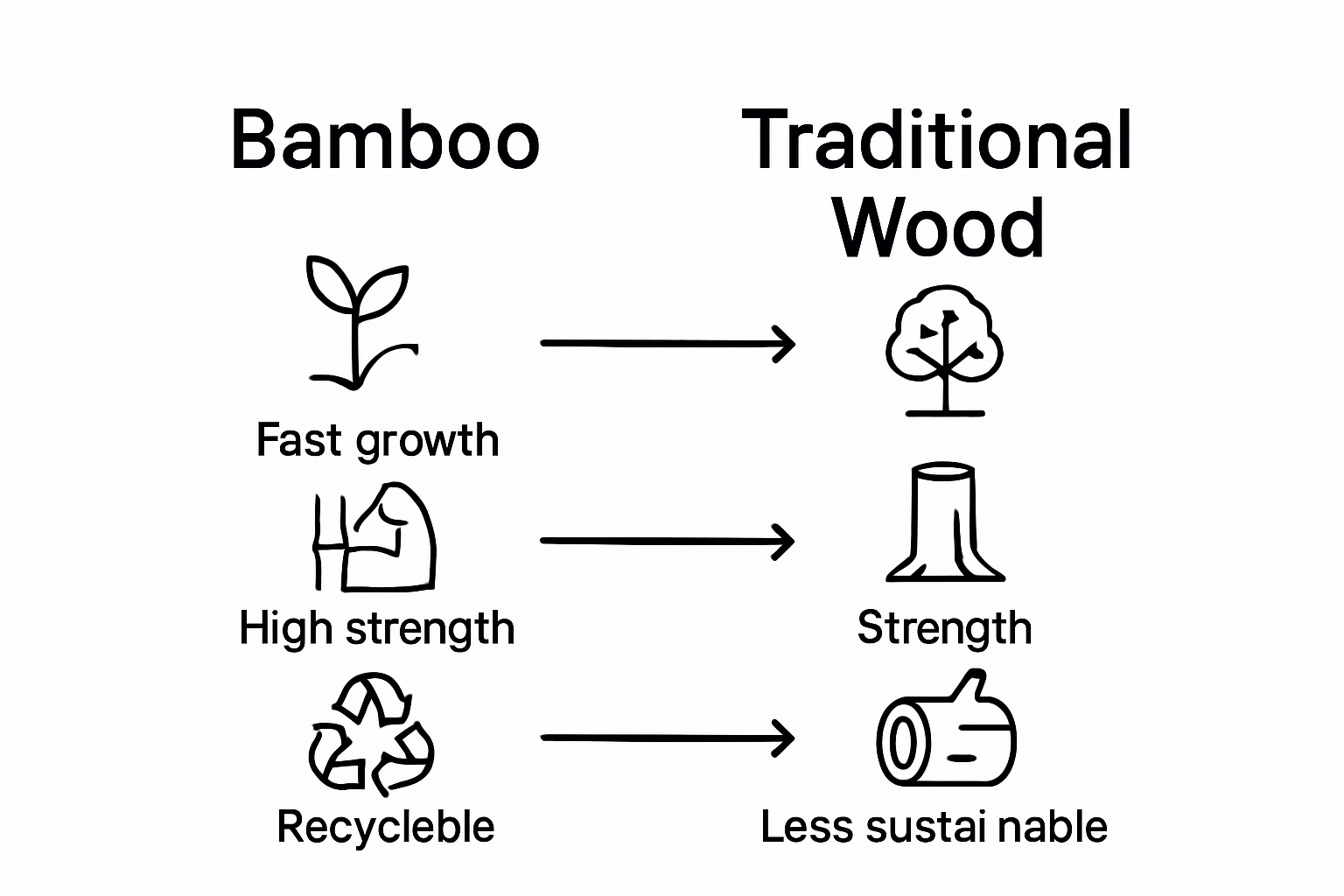
The sustainability of bamboo stems from its remarkable growth characteristics and minimal environmental impact. Unlike slow-growing timber, bamboo can mature in just 3-5 years, making it an incredibly renewable resource. Its rapid regeneration means that harvesting does not destroy the root system, allowing continuous production without deforestation. Businesses and homeowners choosing bamboo products directly contribute to carbon sequestration, reduced environmental degradation, and conservation of natural forest ecosystems.
Beyond environmental benefits, bamboo provides exceptional functional advantages. Traditional woven bamboo techniques showcase its natural ability to create lightweight, breathable structures that enhance living environments. Bamboo products offer unique properties that traditional materials cannot match:
By integrating bamboo into homes and businesses, individuals and organizations can make meaningful sustainability choices that do not compromise on performance, style, or functionality.
Bamboo transcends traditional design boundaries, offering designers a versatile material that seamlessly integrates with multiple aesthetic approaches. Comprehensive research on modern interior design reveals bamboo’s unique ability to introduce natural aesthetics while promoting a green, environmentally conscious design philosophy that resonates across contemporary design styles.
From minimalist to bohemian, rustic to industrial, bamboo demonstrates remarkable adaptability in interior design. Its natural texture, warm tones, and organic visual language enable designers to create spaces that feel simultaneously sophisticated and grounded. Asian interior design approaches have long recognized bamboo’s potential to create culturally resonant spaces that reflect ecological consciousness and design innovation.
The design styles most dramatically enhanced by bamboo materials include:
By incorporating bamboo, designers can transform spaces, creating environments that are not just visually compelling but also deeply connected to principles of sustainability and natural harmony.
Bamboo emerges as a superior alternative to traditional materials, challenging long-established construction and design norms. Engineered bamboo technologies have revolutionized material performance, creating products that significantly outperform conventional wood in hardness, shape retention, and temperature resistance, particularly in challenging environmental conditions.
Unlike traditional timber, bamboo offers a remarkable combination of strength, sustainability, and versatility. Architectural research exploring material substitution demonstrates bamboo’s potential to replace wood and steel, providing substantial environmental benefits while maintaining structural integrity. The comparison between bamboo and traditional materials reveals several critical advantages:
By choosing bamboo, designers and builders can create spaces that are not just aesthetically pleasing, but also fundamentally more sustainable and technologically advanced than traditional material alternatives.
The article highlights the powerful role bamboo plays in modern interior design by solving the challenge of combining eco-friendly materials with stylish, durable products. If you are looking to embrace sustainability without compromising on elegance or functionality, bamboo offers a unique blend of natural warmth and long-lasting performance. Its appeal lies in being lightweight yet strong and delivering a renewable resource that enhances any home or commercial space. Whether you want to improve environmental responsibility or create visually compelling interiors, bamboo meets these goals with remarkable versatility and appeal.
Discover how Cozee Bay’s handcrafted collection can help you achieve these aims effortlessly. Featuring products like the Bamboo Paper Towel Dispenser - A Sleek Look Home or Office, our curated selection transforms everyday essentials into eco-conscious statements. Our bamboo dispensers have proven popular in settings from restaurants to schools, combining functional innovation with sustainable craftsmanship. Start your journey to a greener, more elegant space today by exploring Cozee Bay.
Upgrade your environment with bamboo products that deliver style, sustainability, and durability all in one. Browse our range now and take advantage of free shipping within the contiguous U.S along with our money-back guarantee. Your eco-friendly interior transformation begins here at Cozee Bay.
Bamboo is a rapidly renewable resource that grows in just 3-5 years, making it a sustainable alternative to traditional hardwoods. Its harvesting method does not destroy the root system, allowing for continuous growth and minimal environmental impact. Additionally, bamboo absorbs more carbon dioxide compared to equivalent timber stands, contributing positively to carbon sequestration.
Bamboo offers several advantages, including a faster growth rate, a higher strength-to-weight ratio, and remarkable durability. It is resistant to moisture, insects, and structural degradation. Bamboo serves as a robust substitute for wood and steel, providing substantial ecological benefits while maintaining excellent structural integrity.
Bamboo’s natural texture and warm tones make it a versatile material suitable for various design styles. It enhances minimalist, Scandinavian, bohemian, industrial, and Zen-inspired spaces, promoting an aesthetic that is both sophisticated and eco-conscious.
Bamboo can be used in numerous applications, including flooring, furniture, wall treatments, and decorative accessories. Its versatility spans residential interiors to commercial spaces, offering eco-friendly alternatives that combine aesthetic appeal with functional performance.
Comments will be approved before showing up.